How to Finish a Custom Art Piece (or any art for that matter)

Last week I posted about a custom art portrait I have been working on for my neighbor. It is a group portrait and has it ever been challenging! It is like painting three separate paintings rather than just one painting. What I didn’t share in last week’s post was how difficult it has been to finish this project, which I feel has been dragging. Although the project started out to be deceptively simple, with the colors and the drawing coming together in a few days, once I got to the smaller version of the painting, the trouble began.

I discovered that working small on a 5 x 7 canvas was extremely challenging. I am used to working on medium sized canvases of about a 9 x 12 size and using large brushes, either a one inch flat or a 2 inch bright. For this project, I have had to use tiny brushes and it has made it take all the longer to complete. Also, working in acrylic rather than oil has been really difficult because the paint keeps drying faster than I would like and I have to keep squeezing out more of it and spritzing it with water or adding slow dry medium to the paint.  When the paint dries too fast, I get really hard edges which aren’t good. I’m worried that this project might fall into the realm of being overworked if I am not careful, but I want both the client and myself to be happy. So far, neither of us are. I’ve set a deadline for myself and I hope that works! Yesterday I painted out the middle person’s face in frustration because the proportions were off and the paint values seemed to have been too dark. So I am starting from scratch with the middle figure’s face. I re-measured the head and drew a new oval and repainted the whole in flesh tone.

In an effort to finish this painting by the deadline, I have been scheduling in time to work on it every week, and have been taking pictures of it after each painting session to make sure that it is really progressing and not just getting overworked.  When will I know if the painting is really completed? I looked up an article on ThoughtCo. to try and get some more perspective on this subject. According to the author, Marion Boddy-Evans, the answer to when a painting is done is as individual as each artist who completes the work, based on their individual skills, and their vision for the work. Source: Boddy-Evans, M. (2017). How Long Should it Take to Finish a Painting?ThoughtCo. https://www.thoughtco.com/duration-to-finish-a-painting-2578835. For me, it will be a difficult tightrope between not finishing it and over working it. Diane Custom Art Tanya face painted out

Custom Art Portrait, in Progress

This week I have been working on a custom art portrait for my neighbor. These photos represent stages 1 and 2 of the custom art process. The first stage is stage 1, the three value pencil sketch, and stage 2, the color sketch. The first stage helps to define the lights and darks of the piece and the composition. And the second stage is a chance to explore different color schemes for the final portrait. If you are interested in ordering a custom portrait of your family member, celebrity or pet, email me at

jsjschmidt2@gmail.com or visit my Etsy site: http://www.etsy.com/shop/ArtofSchmidt to learn more about the process.

Art of Schmidt Blog Post: Dealing with Rejection as an Artist


Rejection is something most artists deal with, especially when attempting to take their artwork to the next level of professionalism, i.e. entering juried art shows. It happens to all of us, and especially to artists who are brave enough to put their artwork out there into the world of juried shows. Often times it comes in the form letter, which is worded something like this: “Dear Artist, Thank you for participating in our show”, etc, etc. Bottom line, for whatever the reason, your artwork wasn’t selected. Maybe it didn’t fit the theme or style of the gallery you submitted it to, maybe it was just one person who didn’t like it, or maybe (gasp), it might be a sign that you need to up your game art wise. Whatever the cause, not knowing why your artwork wasn’t accepted into a juried show can cause a lot of insecurity, even making some artists want to give up making art or submitting it for further review.

I have certainly had my share of rejection, be it from art show jurors and I have even had some cutting critiques from people who have critiqued my art. Sometimes it makes me feel like giving up, and I need to take a break to re-group and think about why my work wasn’t accepted. On the other hand, at times these setbacks have led to further growth. For example, after one harsh critique from a well-known artist and teacher, I rebounded by asking myself if there was any truth in what the person said, and if so, how I could improve my artwork. Ultimately, I started trying to paint in a more colorful and impressionistic way, and I took a drawing class which helped me to improve my drawing skills. But it took several days and some encouraging words from an old friend and trusted art teacher to “shake the dust off”, so to speak.  I’m still working on not taking it too personally when I get a rejection letter for an art show because unless I talk to the actual juror, I can’t know why my work was rejected. And trying to figure that question out on my own, can lead to filling in the blanks with negative thoughts such as, “Maybe I don’t have any talent,” or something along those lines. This line of thinking is rarely helpful or productive for me.

I recently faced a rejection email from an art gallery where I had submitted what I thought was one of my finest portraits ever. I had gotten a lot of positive feedback about it on Instagram and put in many hours of work. I had carefully selected the theme, trying to make sure it would “fit” with the call for art motif of Inspiration. My expectations were high. Unfortunately, the jurors didn’t agree with me.  It’s been a few months since then and I just submitted another piece of artwork to a different gallery for review. A few years ago, that rejection would have taken me out of the game for several months, maybe even years. But now, I am trying to step back from the experience, process the emotion and see what can be learned from it.

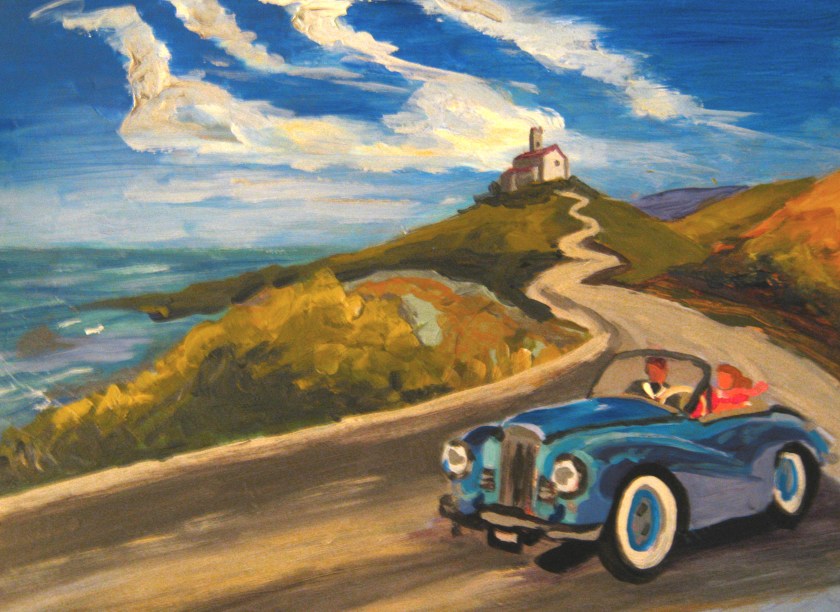
So my next step is to try and submit my artwork for review and not the rejection keep me from moving forward and making more art. Below I attached the latest artwork I submitted,  for review, To Catch a Thief at The Artist Angle Gallery in Frederick, MD. The entry deadline for this latest show is June 10, 2017, so I should know whether the painting, To Catch a Thief, Reimagined was accepted. This newest painting is inspired by classic cars and the theme of driving. In addition, I used the movie, To Catch a Thief, as a springboard to get the composition and setting for this painting. I combined multiple photos from the movie, based in the French Riviera and stitched them together in Adobe Photoshop as a reference for this painting. This work was painted with acrylic on Ampersand board.


To Catch a Thief, Re-Imagined , Art Show Entry

Hello friends,

I am working on a new painting, To Catch a Thief, Re-imagined. This piece is acrylic on Ampersand board and is based on the Alfred Hitchcock movie, To Catch a Thief. I wanted to capture the feeling of movement and speed, so I blurred the paint strokes in the front to make the car seem like it is in motion. And I wanted to capture that vintage, the 1950s vibe, so I went wild with a bright color scheme of blue, blue-green, red, pink, and blue-violet.  Stay tuned and I will let you know what happens with my entry. If accepted into the art show at the Artists’ Angle Gallery in Frederick, MD, I will be sure to post the details about the time/place that the show takes place. To Catch a Thief, re-imagined

Master Copy Tutorial: Girl with a Pearl Earring

Last week I talked about the importance of copying the work of the old masters and this week I am going to give you a step by step tutorial about how to get started. I have several master copies in the works, but I am choosing to focus on Vermeer’s well-known work, Girl with a Pearl Earring, circa 1656, according to Maritshuis, 2014. If you wish to read more about this painting, you may visit the following link: Details: Johannes Vermeer, Girl with a Pearl Earring, c. 1665, Mauritshuis. Retrieved on 9 December 2014. This citation is from an article about Vermeer’s painting, Girl with a Pearl Earring, which I found on Wikipedia. The original painting was painted in oils on canvas, but to save drying time, I used acrylic paints.

Step One: Make a Grid from a Photocopy of a Master Copy

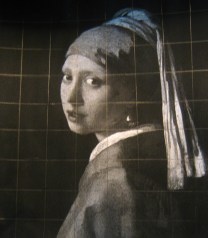
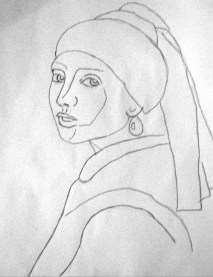
My first step in creating a master copy of Vermeer’s, Girl with a Pearl Earring, was to locate a good print copy which I could use to create a grid for the initial sketch. Creating a grid helped me to make sure the proportions of the head were proportionate to the copied image. I photocopied an image of Vermeer’s painting, Girl with a Pearl Earring, from the book, Vermeer, by Arthur K. Wheelock, Jr. After I made the copy, I created a grid, measuring one inch from the horizontal and vertical edges of the printed copy with a ruler. After I measured out the markers for the grid, I drew vertical lines to create the vertical axis. Then I drew horizontal lines for the horizontal axis.  Each box on the horizontal lines of the grid should be numbered starting with 1, and the vertical boxes should be labeled A, B, C, etc. After that, I created an exact duplicate of this grid on a clean sheet of sketch paper. Note: it is very important to ensure that you have the exact amount of boxes on both the vertical and horizontal axes on your grid copy as the one from the original, or the proportions may be incorrect. Also, be sure that when you draw vertical and parallel lines that your ruler is perpendicular to the picture plane and doesn’t shift, or it make affect the measurements of the one-inch boxes.

Step Two: Create a Duplicate Grid and Transfer it to Canvas with Carbon Paper

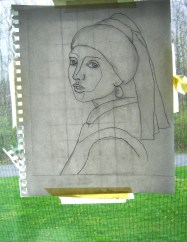
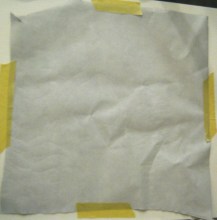
Next, I located my first set of coordinates on the vertical and horizontal axes, on my grid copy to start drawing in the edge shape of the portrait, i.e. A1. The artist, Thaneeya McArdle, gives an excellent description of this process with detailed visuals of the grid method at https://www.art-is-fun.com/grid-method/?rq=draw%20a%20grid. To complete the portrait, I moved on the next grid coordinate, and so on. My next step was to trace the completed grid sketch onto a clean sheet of sketch paper, using my window as a light box. I taped the original sketch to the window with masking tape, then taped a clean sheet of paper on top of the original. Then I traced the image to the cover sheet. The traced image was then transferred with a pen to canvas paper, using carbon paper, with the dark side taped face down.

Step Three: Paint a three value underpainting in Acrylics

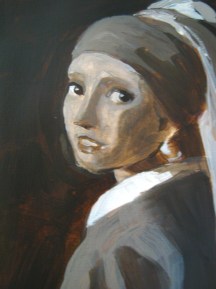
Are you still with me? I know it sounds like a lot of steps…Don’t worry I am including some photos of this process to help jog your memory. So now we move on to the fun part, the painting itself. To break down the light and dark values, I consulted a well-used book from my art library, The Complete Oil Painter, by Brian Gorst, which gives a detailed demonstration about how to paint a monotone underpainting. I mixed up three values from darkest to lightest with Liquitex Acrylic paints and a palette knife using Burnt Umber, Titanium White, and Ivory Black. The darkest value was applied to the background, while the middle and lighter values were painted on the figure. Intermittently I sprayed the palette and the canvas with water from a spray bottle to keep the paints wet so they wouldn’t dry up, especially while I was mixing them. I also stepped back every so often to view the painting from a distance and be sure that the drawing in my painting was accurate, and made corrections as needed. These values will give me a roadmap of where to put light and dark values when I get into the color portion of the painting. They help to simplify the lights and darks without the difficulty of color matching. Next week, I will paint a “limited color lay in” with the local color

Meisje_met_de_parel
Photo copy, Girl with a Pearl Earring by Vermeer ca. 1656
Vermeer copy with grid
Photo copy, Girl with a Pearl Earring by Vermeer ca. 1656, with grid 
Vermeer paper copy with grid
Copy of Grid with pencil on sketch paper 


Vermeer Copy Light Box
Traced image of grid using window as light box


carbon paper trace 1
Carbon Paper used to trace image to canvas


Carbon Paper tracing, complete
Carbon paper tracing completed


Jodie Schmidt after Vermeer three value
Three Value Underpainting in Acrylic