Here are some of my new acrylic paintings featuring my Autumn series which I plan to exhibit at the Frederick Coffee Company in Frederick, MD as Artist of the Month in October of 2017. I will be selling these miniature canvases for $35 each, and I will also have some larger paintings for sale. Pictured are some completed canvases and some three value sketches and color sketches to plan the other paintings which are
These are two completed acrylic paintings on miniature canvases.
Two three value sketches for works in progress.
Two color sketches to use as guides for the final acrylic paintings.
in progress. Here is a link to the Frederick Coffee Company website if you would like to find out more about the venue. The coffee house has a variety of coffees, teas, sandwiches, and salads and features live music on selected days of the week. http://fredcoffeeco.com/. If you would like to join my Mail Chimp email list to learn more about this event and more art shows like it, please email me at jsjschmidt2@gmail.com and I will gladly add your email address to my Mail Chimp account. Thanks for looking!
Hello, Friends, last week I posed the question, “Can artists make money from their artwork”? It’s a question I’m sure other artists have asked themselves in the past and certainly one that I have been asking myself lately, and more specifically, “What can I do to make that money”? In last week’s post, I discussed two specific traditional methods, listed on the Art Bistro.com article, How do Artists Make Money? by Valerie Atkisson. Some of the methods listed in this article are: 1.) exhibiting artwork at art galleries and museums, and 2.) Exhibiting artwork at not for profit art galleries. Both methods have pluses and minuses. With the former, the artist may have to submit their work to juried shows, where the competition can be tough, and the entry fees can add up, the more shows that artists apply to. Also, many for-profit galleries take a commission for artworks that are sold, which can be up to 60%, so artists need to price their work accordingly so that they can be sure to make a profit. Source:How do Artists Make Money? by Valerie Akisson, http://artbistro.monster.com/careers/articles/5848-how-do-artists-make-money?page=2.
In a Business of Art Class, I took this January with teacher and Photographer, Rebecca La Chance, at The Artist Angle Gallery, in Frederick, MD; I learned that there are some ways of coping with the competition for art show entries. For example, a guest artist, Bill Watson, taught a class on Artist Branding. One of his points was that before you choose an art gallery to submit artwork too, be sure that your artwork is a good fit for the style of artwork that is exhibited there. For instance, you can visit the art gallery website to review the types of artists and artwork that has already been exhibited, and you can take the time to visit the gallery and get to know the staff there before you decide if you would like to work with them. I think this strategy can help artists to find their target audience of people who are likely to like their artwork and sell it, rather than simply submitting art portfolios to every art gallery in the area without a specific goal. That would be kind of like throwing darts at a dartboard with your eyes closed, not a very effective strategy. It’s kind of like when you are job hunting and you tailor your resume to fit the job description advertisement of jobs you wish to apply for. This can save you a lot of time and headaches to have a targeted plan, and hopefully this method gives you time to create a fantastic portfolio, which I am learning is the foundation I need to build onto first, before getting caught up in the newest craze of how I should be marketing my artwork, etc. Moreover, your chances of success in this venture should surely increase if you are giving galleries the type of work they already love.
But to return to the topic of,” How do Artists Make Money?” I will reference a few more methods that the Art Bistro.com article mentioned. Another method that artists can utilize to sell their work is to host an open studio event where they can sell their artwork from their studio and invite friends, family, collectors, etc. (Akisson).Using these method artists can retain 100% of the sales, provided they don’t have a contract with an art gallery limiting how they sell their artwork. (Akisson). However, artists also need to be 100% responsible for marketing their open studio and collecting RSVP, getting refreshments, as well as setting up the show, collecting cash, updating their inventory, deciding on what payment methods to use, such as cash, check, or credit card payments using Square or a commerce site, such as Etsy or Shopify, and posting online marketing to advertise their show using Mail Chimp, Facebook, Instagram, or other social media channels to let people, specifically collectors know about an artist’s art show.
I have tried this method of hosting an Open Studio with mixed results. The first show I hosted, I had a great turn out and a lot of art sales from friends and family who attended. I used Facebook’s event page tool and I printed fliers I had made in Photoshop to advertise the art sale which was last July. However, the second Open Studio sale I hosted this past February was very disappointing. Many people did not respond to my invitations even though I made a Facebook page and texted their cell phones, or people said they were coming and didn’t, etc. Only a few people came to the art show and I felt like it was a wasted day with very few sales for so much effort, setting up the art show, making labels for art, marketing the artwork for sale, creating an inventory list, etc. It was a frustrating experience and I don’t think I will be trying this method again, but maybe I will try some other new things instead.
And finally, here is the last method I will discuss today from the Art Bistro article, and that is, selling artwork online. Source: (Akisson, 2014). This particular method seems to get a lot of positive press, especially on websites that talk about how great it is to sell your artwork online, how easy, etc. To use this method, artists can create online commerce sites with their artwork on websites such as Etsy.com, Art Fire.com, Fine Art America.com, Red Bubble.com, Shopify.com, etc. I am sure there are many more sites, but these are the first examples that come to mind. One thing I learned a few years into setting up my own Etsy site is that I need to take into account the commission taken by Etsy and price my artwork accordingly, so I make a profit from it. However, an advantage of building my own commerce site and selling my artwork directly to others is that there are no gatekeepers who can reject my artwork, although there is usually a subscription fee or other fees associated with membership on the website. Another thing is that it is not enough for artists to build the Etsy shop and just wait for customers to buy their artwork. In fact, many of the people who buy my artwork are friends and family who have seen my artwork on Facebook or have commissioned artwork from me, not strangers who have visited my website or Etsy store.
Because there are many, many artist commerce shops out there, artists need to advertise their artwork on Facebook, Instagram etc. and make sure that collectors and friends know about their shop so there will be a greater share of online sales. Furthermore, artist commerce sites need to be updated frequently with a variety of artwork, but not so much that buyers don’t recognize your personal art style.
One more thing, I highly recommend is that artists host art shows in person as much as they can, and not just relying on their art website or commerce store to sell their work. It seems to me, base don my own experiences that people want to meet the artist in person and sell the physical artwork before they will buy it. It is also a chance for the artist to build a personal connection with collectors and to find out why they like the artist’s artwork. Sometimes even the best photography will not show details such as texture, etc. of specific mediums like an oil painting or acrylic. However, it is important to take the best possible photos of your artwork that you can before posting these on your commerce site or artist website. If you aren’t good with photography, take a photography class, or hire a professional photographer so you can present your artwork
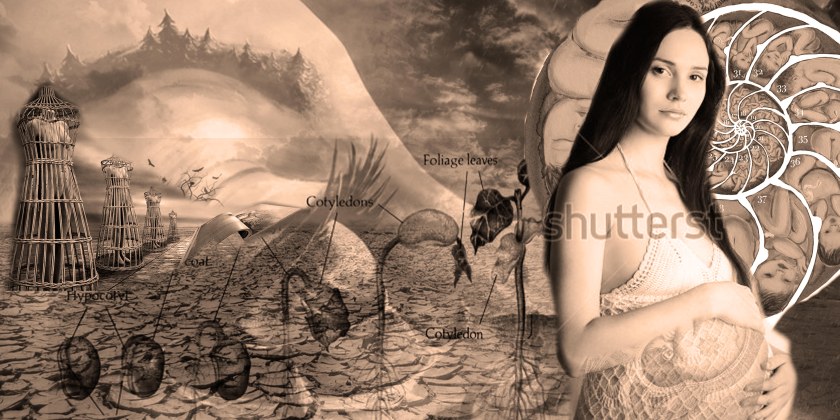
Here is a photo collage I made in Adobe Photoshop which I made by combining various photographs in the Photoshop program. I wanted to illustrate the feeling of artists’ block, which can feel like a time of dormancy. I plan to translate this collage into a watercolor painting soon.
in the best possible light. It is your visual resume and your most effective selling tool to show the world who you are as an artist. Best of luck!
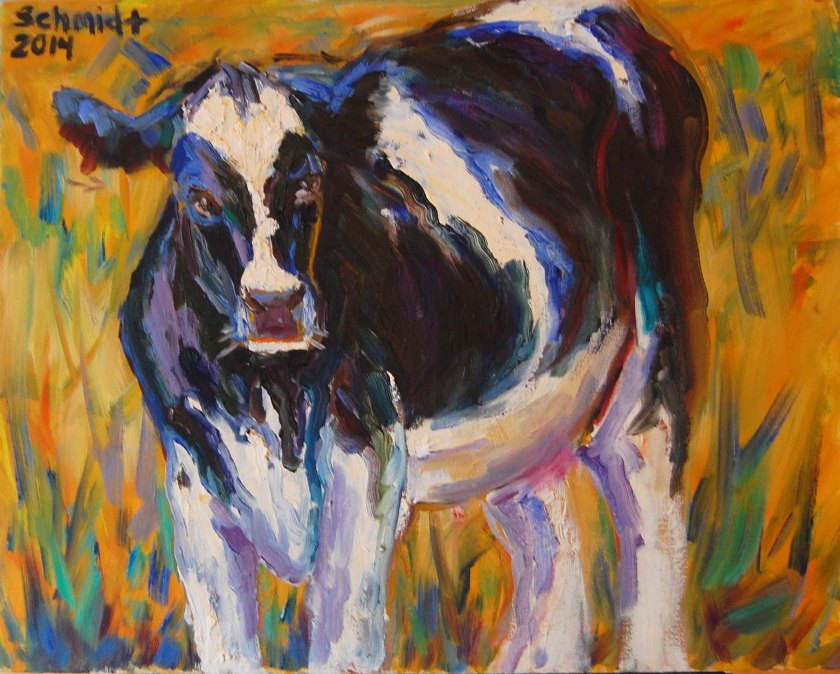
I am pleased to share that my oil painting, Cow in the Meadow, sold to a client this May. If you wanted to purchase the painting but didn’t get a chance, I have reproductions of this painting for sale on my Redbubble store at https://www.redbubble.com/people/jsjschmidt2017/works/26919397-cow-in-the-meadow. There are canvas prints, iPhone cases and more with this painting on it! Iphone cases are selling for $25 each.
Last week I talked about some common stereotypes about artists, such as all artists wear berets, starve and live in attics, etc. And another misnomer about art, according to the McDonald’s advertisement I had mentioned, is that art is all about play, and is just for kids. And yet another stereotype describes two extremes of the artist type as the brilliant artist failure or the artist celebrity, according to the author, Emily Browne, of the article, Ten Things About Being an Artist that Teachers Won’t Tell You, (2013).
The celebrity artist type makes it big with a gallery opening and becomes rich and famous, or perhaps just famous. The brilliant failure is unable to break into the art world despite their talent and only gains recognition for their artwork after they are dead… A well-known artist, Van Goh, is a good case in point of this type. He struggled to find an audience who liked his work and only sold two paintings during his lifetime. Now his work is famous and very well known.Source:https://www.theguardian.com/education/mortarboard/2013/feb/21/10-things-art-teachers-wont-teach-you.
The former stereotype of the famous artist, was featured in the BBC television documentary series, What do Artists Do All Day? (2014).This show featured artists who are well known in the United Kingdom such as, Jack Vettriano, whose celebrated painting, The Singing Butler, sold for something like 750 pounds sterling at Sotheby’s Gallery in 2004. Source:https://www.jackvettriano.com/biography/. But what about the artists who haven’t made it big but aren’t necessarily starving either, or flakey or mentally ill or driven by emotions? How do these artists make money from their art? I know I have wondered about this question myself regarding other artists. Lately, I have wondered what types of avenues I might pursue to make money from my artwork and have begun researching what people have to say about making money from artwork by reading articles online about this subject.
One article entitled, How Do Artists Make Money? , written by Valerie Atkisson in 2008 on the website, ArtBistro.com, listed a few traditional methods to the path of earning money from your art. These methods include: 1.) Showing your art at Commercial Art Galleries, 2.) Displaying your artwork at a nonprofit Galleries, 3.) Hosting an art show at your studio, 4.) Selling Your Artwork online, 5.) Creating custom art for clients, 6.) Obtaining a public art commission, 7.) Applying for an art grant, 8.) Securing an Art Residency, 9.) Teaching art at a secondary school, college, or as a guest artist. Source:http://artbistro.monster.com/careers/articles/5848-how-do-artists-make-money?page=4
For the sake of space, I will only be discussing the first two methods of making money from your art, but I will follow up with the other methods listed in my future blog posts. The trouble with the first two methods is that no sales are guaranteed and artists might end up just taking home the work that they exhibited. Not to mention that the competition for art shows is fierce, and rejection is a common theme among artists, which can be demoralizing for sensitive egos. It can also be expensive to pay for art submission fees if an artist is applying for juried shows which require application fees. In addition, according to Atkisson, (2008), most commercial galleries take a 40%-50% commission to sell artists works, which the artist and gallery owner decide with a contract. So, with that in mind, artists need to take that factor into consideration so they can price their work accordingly and actually make a profit if the work sells.
In addition, regarding the next method of making income, which involves using not for profit galleries, many of these galleries “do not represent artists or enter into relationships with them.” Source:http://artbistro.monster.com/careers/articles/5848-how-do-artists-make-money?page=4. It is also important to note that although some commercial galleries do offer to advertise for art shows, the art world has changed, and the way artists make sales has also changed, particularly with the advent of the Internet and Social Media sites like Facebook, Instagram,
Here is a drawing from my 100 faces in 100 days challenge. Pictured are the famous 1980s rock band, The Police. I used a photo by photographer, Terri O’Neill, (1982) as reference for the drawing.
and Twitter. It is no longer enough to follow the traditional method of letting galleries do all of an artist’s marketing or to find an influential patron of the arts to fund artists as was the case in the patronage system in European countries or museums and galleries today. Source: http://unconventionalguides.com/art.htm.
In the current art world, artists need to do a lot of self-promotion for their work to gain followers and collectors through social media sites such as Instagram, Twitter, and Facebook. Also, because of the stiff competition for gallery shows, the artist must also look for non-traditional venues to showcase their work, whether it be online selling, hosting open studio venues, or showing their artwork at non-traditional art venues, such as coffee shops. This can be especially useful for emerging artists, who may not have a gallery that represents their work yet. However, all of these methods of making money from art are a gamble, especially the art show venues. Furthermore, to make them effective, the artist must develop marketing, technological, and business skills to keep up to date with current trends in the art world. I myself did not learn any of these skills until I graduated from McDaniel College in 2005 with a degree in Art. To keep pace with the emerging technology I have taken classes in Photoshop, In Design and Illustrator, which have taught me how to edit my photos professionally and how to make marketing materials such as flyers to advertise my custom art pet portraits. I also try to keep up with the art world trends by reading articles and blogs about artists and business skills. The art business coach, Allyson Stanfield is an excellent resource for artists who want to learn more art marketing skills. For more tips on how to market you as an artist, go to the following link: https://artbizcoach.com/wp-content/downloads/50-things-better.pdf. Good luck!
I am pleased to announce that my artwork is available for sale as mugs, t-shirts, i-phone cases and more on the website http://www.redbubble.com. Here is a link for my online shop: https://www.redbubble.com/people/jsjschmidt2017. A few samples of my work that will be featured on this site are Owl at Midnight, Ghost House and Self-Portrait. iPhone cases are available for sale at $25 each. I made this online store in an effort to make my artwork more affordable for those who admire my artwork but might not be able to afford prices for my originals. Each piece is based on my original work and is copywritten art of Schmidt 2017. If you are interested in purchasing my original artwork please go to my Etsy website at http://www.etsy.com/shop/ArtofSchmidt. Thank you for stopping by!
A few weeks ago, I was visiting McDonald’s and I noticed an advertisement about artists where the tag line was, “Play like an Artist.” The advertisement featured a picture of a young child with art supplies in its mouth and surrounded by various artwork pieces, wearing, of course, the inevitable beret hat that defines a stereotypical vision of an artist. This advertisement highlights the prevailing beliefs in American culture that one, art is for kids and two that artists just play all day…
And what are some other common artist stereotypes? I did some research online to find out. On one blog called Endpaper,The Paperblanks Blog, the author listed a variety of so-called traits that all artists share in common. For example, all artists are out of touch with reality, perfectionist, a Casanova, moody or flakey. Source: http://blog.paperblanks.com/2016/04/the-top-20-artist-stereotypes-you-cant-avoid/. Where did these stereotypes come from? My guess is that many of the celebrated artists that we have heard of from books or movies fit this stereotype, like Van Goh, who was mentally ill, or Picasso who was a lady’s man, or Monet who lived an impoverished lifestyle, (before he was discovered by American art collectors). And these stereotypes are continually reinforced by popular culture such as the well-known TV sitcom, Friends. For example, in one episode of Friends, the character, Ross, talks to his girlfriend Rachel about baby names and she suggests the name, Rain. Ross responds with the following comment: “Hi my name is Rain. I have my own kiln and my dress is made of wheat!” Source: https://www.theodysseyonline.com/who-art-thou. So if you are an artist, then you must be eccentric seems to be the message.
While there is some truth that art is an important part of child development and education and that there is some element of play in the life of an artist, it is not all fun. For instance, according to, author, Grace Hwang Lynch, the art classes teaches children a variety of skills such as “fine motor skills, language development, decision making and visual learning.” Source:http://www.pbs.org/parents/education/music-arts/the-importance-of-art-in-child-development/. Also, regarding the element of play in art, there are times when art can be considered fun, like that light bulb moment when I get an inspiration for a new art series and feel excited about getting in the studio and making my vision come to life with paper and pencil or oil paint and canvas. However, it is not called art work for nothing. For example, in the case of a hobbyist artist who is trying to imitate a certain style of painting or get into an art show, or a professional artist who is trying to make a living out of their art, or someone who straddles both worlds as a semi-professional artist, who still works a day job to support them, there are many tasks involved in getting your art work ready to be viewed by the outside world in art shows, art festivals, etc. For example, in addition to juggling everyday demands, the artist must contend with a variety of other things such as: bad days in the studio when the artwork is not going well, difficult art clients, rejections for art shows or grants, working the day job, marketing yourself, perfecting your craft, etc., etc. And if you want to become a professional artist, there are many, many hats to wear.
According to Art Business Coach, Alyson Stanfield, who is the author of, I’d rather be in the Studio! (2008), if you are trying to sell your artwork “You are no longer only an artist. You’re a businessperson as well.” For example, in my experience as a semi professional artist, I have found that there are many other administrative tasks that do not come under the category of “fun”, like accounting, marketing on social media, setting up online commerce sites such as Etsy or Shopify, writing custom art contracts, keeping time sheets, etc. And with so many demands on my time, making time to actually do the art can be a real challenge. I personally have struggled to make time to make art every day, and am currently participating in a 100 faces in 100 days challenge, where I am drawing one celebrity portrait a day, for 15 minutes a day and then posting the results on Instagram. I’m hoping this practice will enable me to be a better portrait artist and that it will help me to build the skills of discipline and time management.
By the way, the BBC has created a documentary tv series entitled, What Do Artists Do All Day?, which features several well known artists , such as Norman Ackroyd, and Michael Craig-Martin, which went live in 2014. Source: http://www.bbc.co.uk/programmes/articles/49j3ZhwyXyPq703lDJzrNfc/what-do-artists-do-all-day. I haven’t seen this series yet, but I am wondering if the series will simply reinforce commonly held stereotypes of artists or hopefully, offer some more balanced insight into all the work that goes into making art.
Last week I posted about a custom art portrait I have been working on for my neighbor. It is a group portrait and has it ever been challenging! It is like painting three separate paintings rather than just one painting. What I didn’t share in last week’s post was how difficult it has been to finish this project, which I feel has been dragging. Although the project started out to be deceptively simple, with the colors and the drawing coming together in a few days, once I got to the smaller version of the painting, the trouble began.
I discovered that working small on a 5 x 7 canvas was extremely challenging. I am used to working on medium sized canvases of about a 9 x 12 size and using large brushes, either a one inch flat or a 2 inch bright. For this project, I have had to use tiny brushes and it has made it take all the longer to complete. Also, working in acrylic rather than oil has been really difficult because the paint keeps drying faster than I would like and I have to keep squeezing out more of it and spritzing it with water or adding slow dry medium to the paint. When the paint dries too fast, I get really hard edges which aren’t good. I’m worried that this project might fall into the realm of being overworked if I am not careful, but I want both the client and myself to be happy. So far, neither of us are. I’ve set a deadline for myself and I hope that works! Yesterday I painted out the middle person’s face in frustration because the proportions were off and the paint values seemed to have been too dark. So I am starting from scratch with the middle figure’s face. I re-measured the head and drew a new oval and repainted the whole in flesh tone.
In an effort to finish this painting by the deadline, I have been scheduling in time to work on it every week, and have been taking pictures of it after each painting session to make sure that it is really progressing and not just getting overworked. When will I know if the painting is really completed? I looked up an article on ThoughtCo. to try and get some more perspective on this subject. According to the author, Marion Boddy-Evans, the answer to when a painting is done is as individual as each artist who completes the work, based on their individual skills, and their vision for the work. Source: Boddy-Evans, M. (2017). How Long Should it Take to Finish a Painting?ThoughtCo. https://www.thoughtco.com/duration-to-finish-a-painting-2578835. For me, it will be a difficult tightrope between not finishing it and over working it.
This week I have been working on a custom art portrait for my neighbor. These photos represent stages 1 and 2 of the custom art process. The first stage is stage 1, the three value pencil sketch, and stage 2, the color sketch. The first stage helps to define the lights and darks of the piece and the composition. And the second stage is a chance to explore different color schemes for the final portrait. If you are interested in ordering a custom portrait of your family member, celebrity or pet, email me at
Rejection is something most artists deal with, especially when attempting to take their artwork to the next level of professionalism, i.e. entering juried art shows. It happens to all of us, and especially to artists who are brave enough to put their artwork out there into the world of juried shows. Often times it comes in the form letter, which is worded something like this: “Dear Artist, Thank you for participating in our show”, etc, etc. Bottom line, for whatever the reason, your artwork wasn’t selected. Maybe it didn’t fit the theme or style of the gallery you submitted it to, maybe it was just one person who didn’t like it, or maybe (gasp), it might be a sign that you need to up your game art wise. Whatever the cause, not knowing why your artwork wasn’t accepted into a juried show can cause a lot of insecurity, even making some artists want to give up making art or submitting it for further review.
I have certainly had my share of rejection, be it from art show jurors and I have even had some cutting critiques from people who have critiqued my art. Sometimes it makes me feel like giving up, and I need to take a break to re-group and think about why my work wasn’t accepted. On the other hand, at times these setbacks have led to further growth. For example, after one harsh critique from a well-known artist and teacher, I rebounded by asking myself if there was any truth in what the person said, and if so, how I could improve my artwork. Ultimately, I started trying to paint in a more colorful and impressionistic way, and I took a drawing class which helped me to improve my drawing skills. But it took several days and some encouraging words from an old friend and trusted art teacher to “shake the dust off”, so to speak. I’m still working on not taking it too personally when I get a rejection letter for an art show because unless I talk to the actual juror, I can’t know why my work was rejected. And trying to figure that question out on my own, can lead to filling in the blanks with negative thoughts such as, “Maybe I don’t have any talent,” or something along those lines. This line of thinking is rarely helpful or productive for me.
I recently faced a rejection email from an art gallery where I had submitted what I thought was one of my finest portraits ever. I had gotten a lot of positive feedback about it on Instagram and put in many hours of work. I had carefully selected the theme, trying to make sure it would “fit” with the call for art motif of Inspiration. My expectations were high. Unfortunately, the jurors didn’t agree with me. It’s been a few months since then and I just submitted another piece of artwork to a different gallery for review. A few years ago, that rejection would have taken me out of the game for several months, maybe even years. But now, I am trying to step back from the experience, process the emotion and see what can be learned from it.
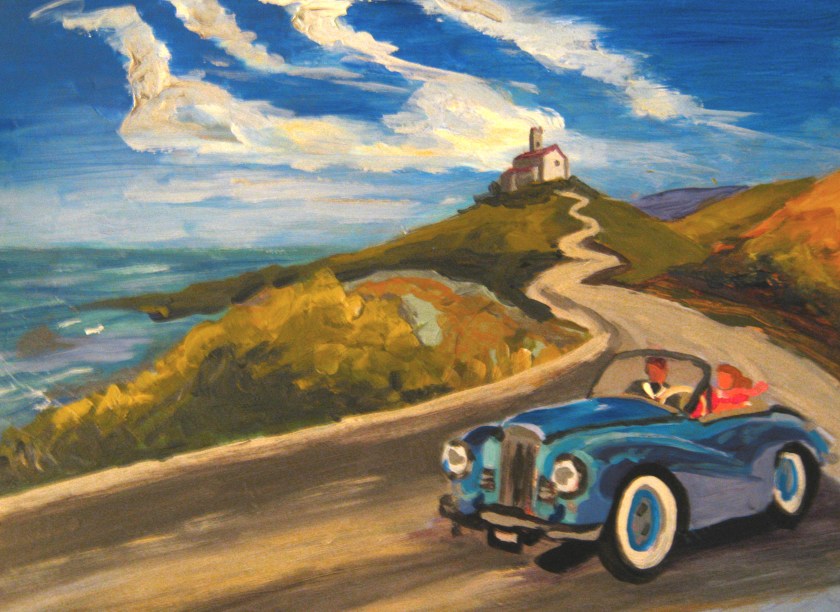
So my next step is to try and submit my artwork for review and not the rejection keep me from moving forward and making more art. Below I attached the latest artwork I submitted, for review, To Catch a Thief at The Artist Angle Gallery in Frederick, MD. The entry deadline for this latest show is June 10, 2017, so I should know whether the painting, To Catch a Thief, Reimagined was accepted. This newest painting is inspired by classic cars and the theme of driving. In addition, I used the movie, To Catch a Thief, as a springboard to get the composition and setting for this painting. I combined multiple photos from the movie, based in the French Riviera and stitched them together in Adobe Photoshop as a reference for this painting. This work was painted with acrylic on Ampersand board.
I am working on a new painting, To Catch a Thief, Re-imagined. This piece is acrylic on Ampersand board and is based on the Alfred Hitchcock movie, To Catch a Thief. I wanted to capture the feeling of movement and speed, so I blurred the paint strokes in the front to make the car seem like it is in motion. And I wanted to capture that vintage, the 1950s vibe, so I went wild with a bright color scheme of blue, blue-green, red, pink, and blue-violet. Stay tuned and I will let you know what happens with my entry. If accepted into the art show at the Artists’ Angle Gallery in Frederick, MD, I will be sure to post the details about the time/place that the show takes place.




 Art of Schmidt