Hello Friends, family, and fans, At long last, I am posting some progress photos of my series, Constructed realities. They are still mostly in the phase 2 stage of color sketches, but they are coming along. So many things seem to get in the way of making time for art, I have got to start making this more of a priority. I often wonder how other creative types, such as Jane Austen, made time to write so prodigiously despite overwhelming household chores that were required during the 19th century in a family without servants or modern conveniences. Even when she was dying she managed to crank out a new book, Sanitation, which was left unfinished because of her death.
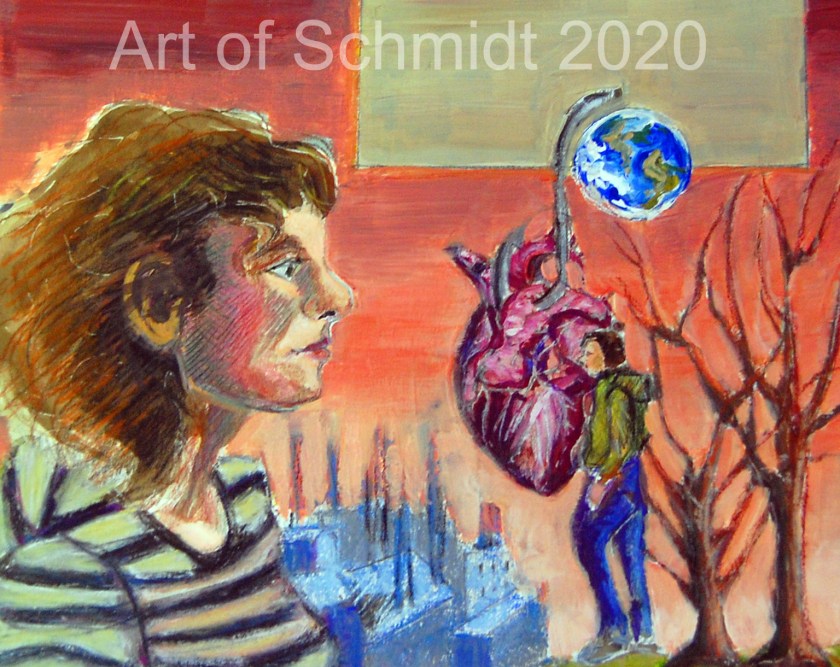
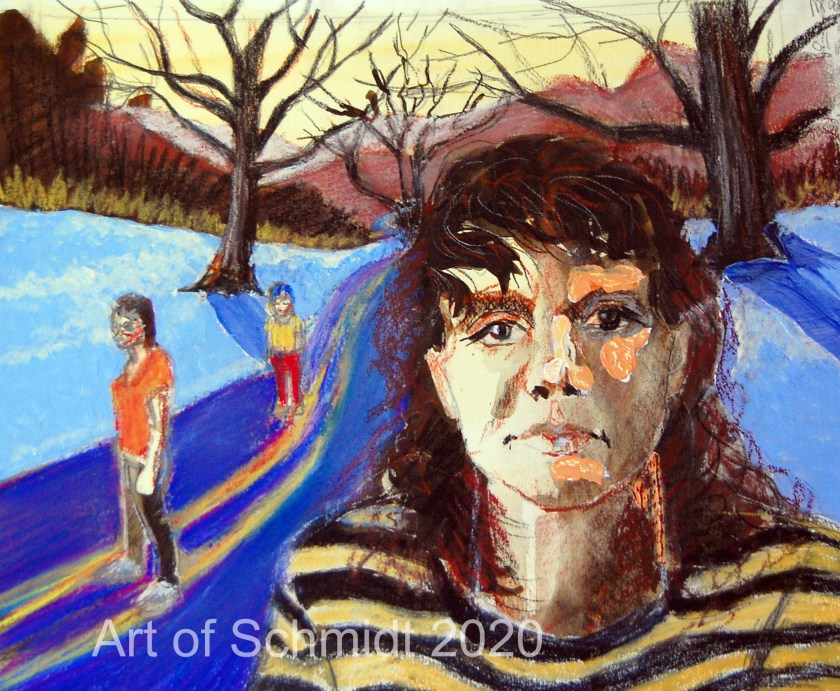
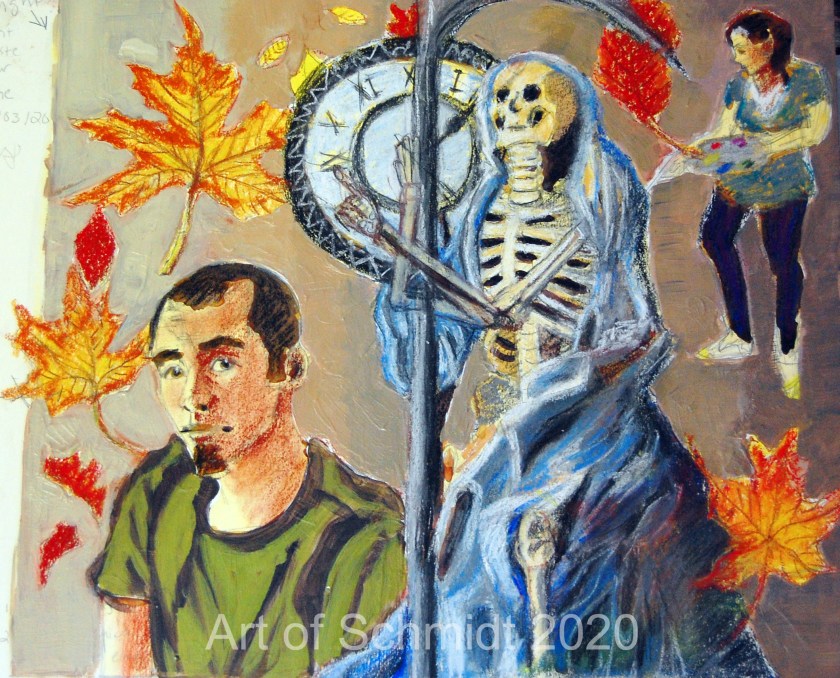
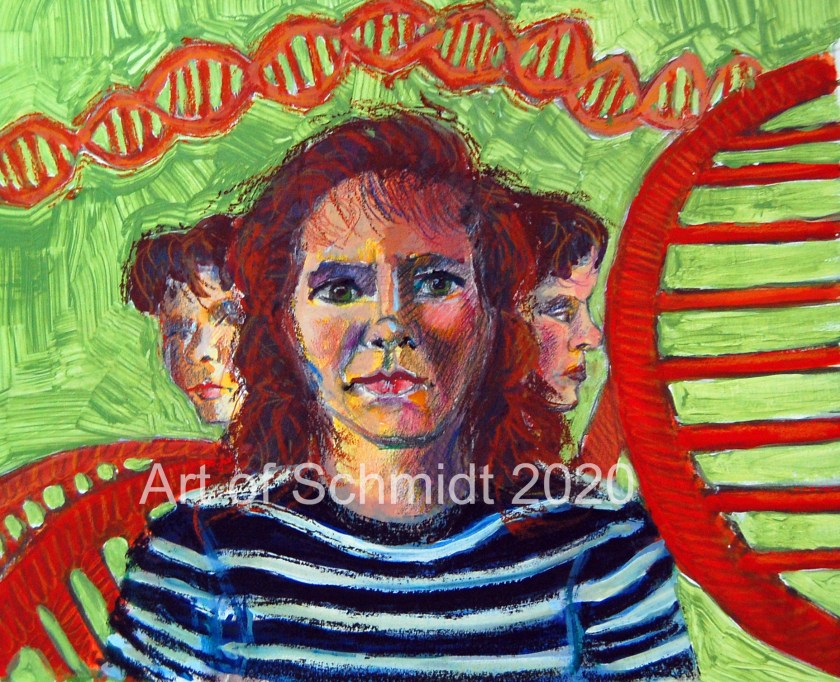
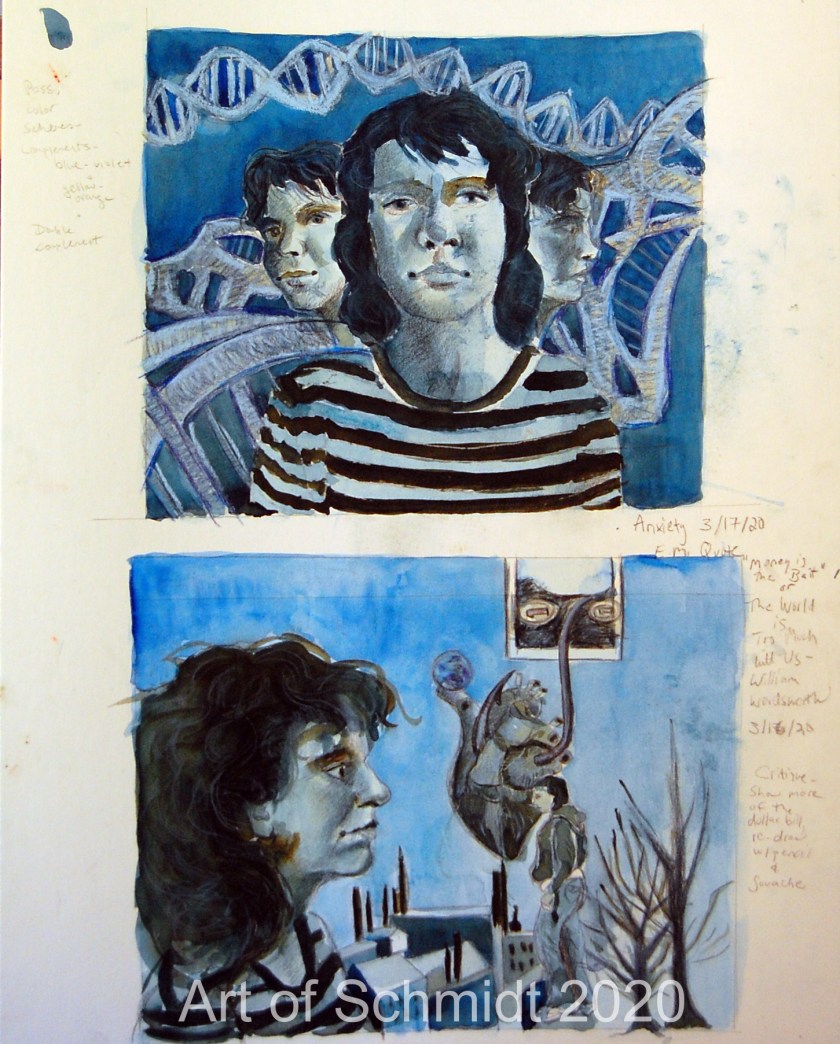
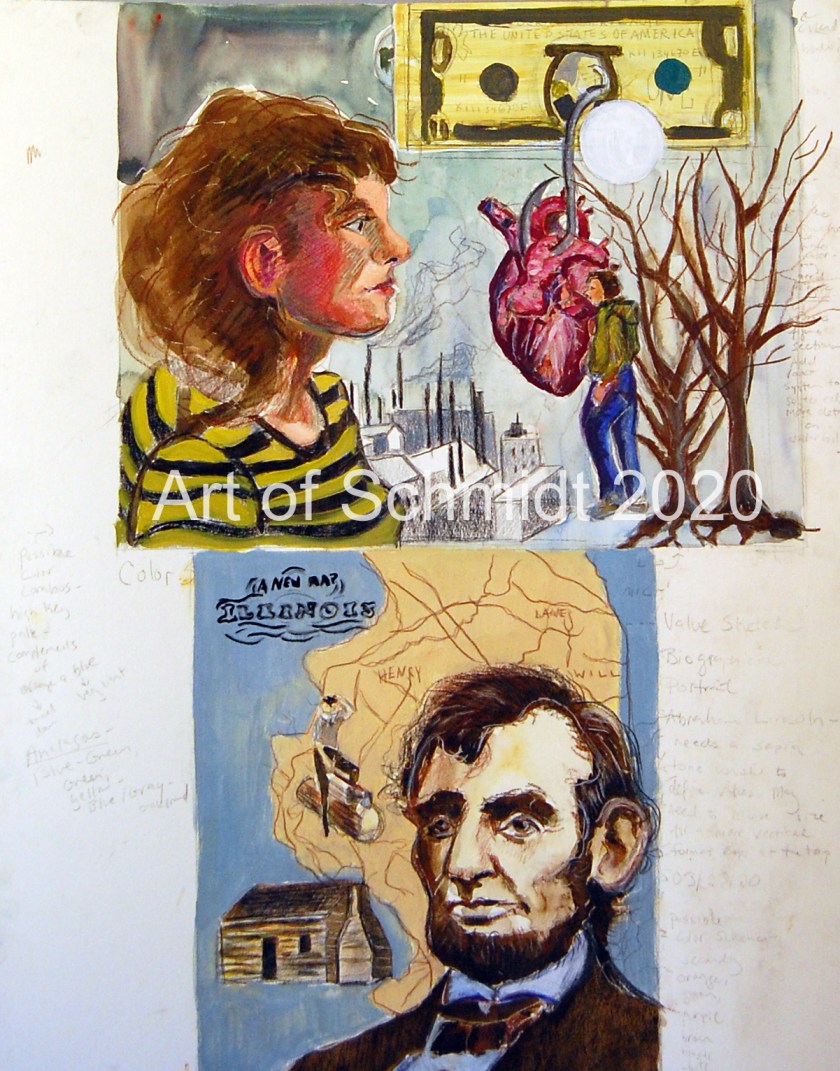
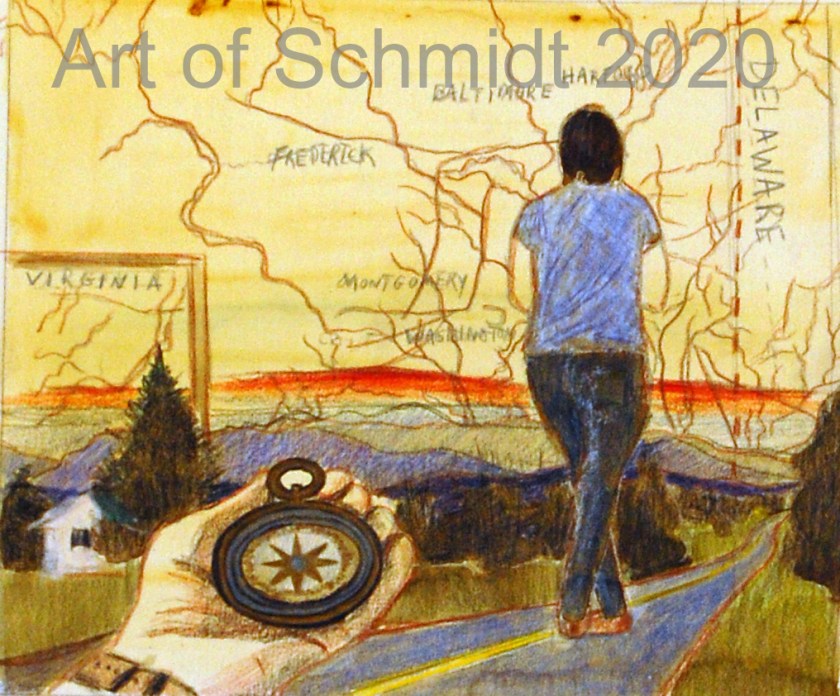
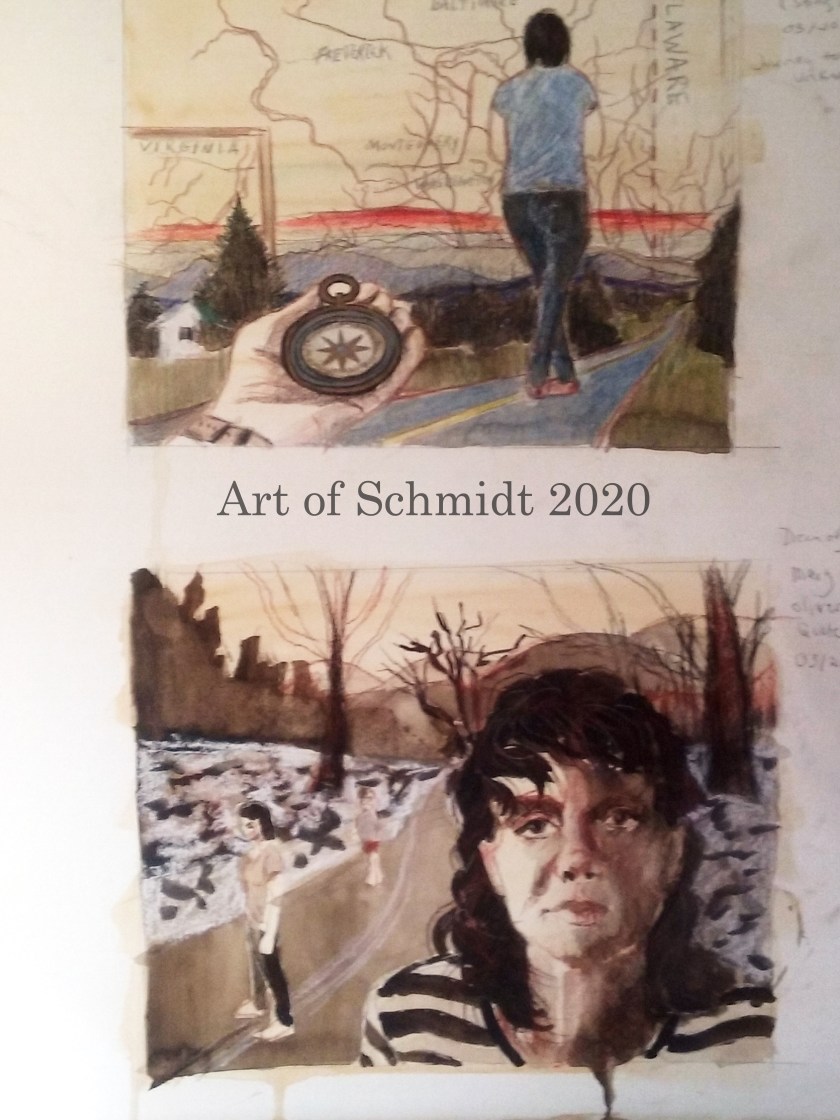
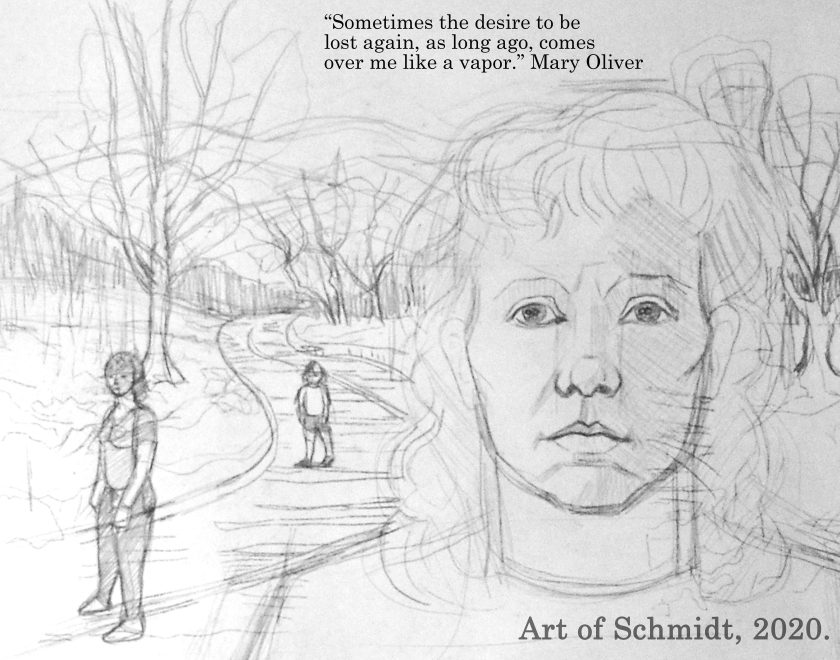
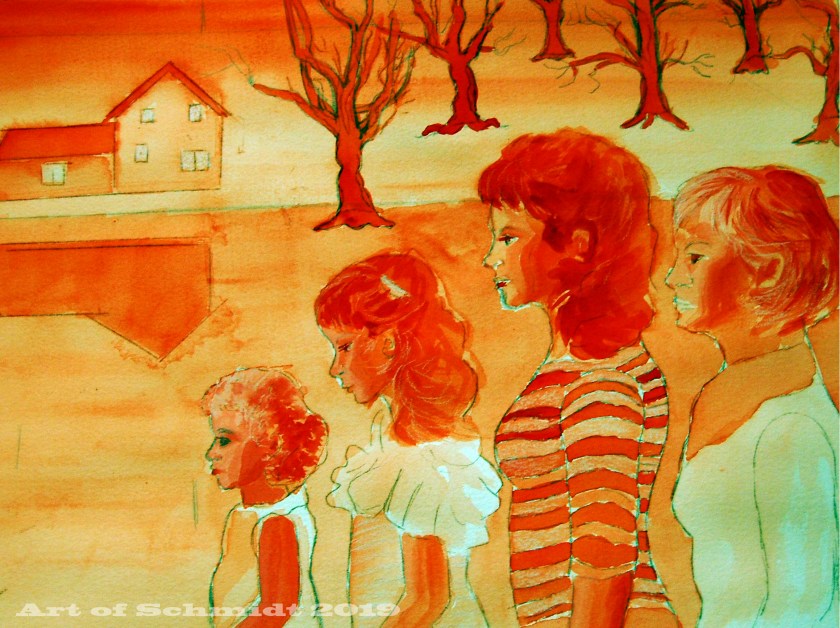
This poem is inspired by a poem by William Wordsworth, entitled The World is too Much with us, about the dangers of industrialization and how we may lose our connection with nature, and eventually with ourselves, due to greed. “The world is too much with us; late and soon, Getting and spending, we lay waste our powers,;-Little we see in nature that is ours; We have given our souls away, a sordid boon! WordsworthHere is another mixed media piece in progress. It’s based on a fantasy I have about going back to being a child, as represented by the multiple figures that get smaller as you follow the path. Sometimes adulting is just too hard, and I long for carefree days full of energy, health, and creativity. Here is a quote from a writer Mary Oliver which nicely sums up this idea: “Sometimes the desire to be lost again, as long ago, comes over me like a vapor.” Mary OliverThis is an unfinished piece about the fleeting nature of time and youth. I have used several symbols to illustrate this, such as the clock and the grim reaper. The other supporting characters are myself and my husband, back when we were about 12 years younger. It’s about not letting too much time pass before you make important decisions. For us it was about getting married. The poem which inspired this piece states: “Gather ye rosebuds while ye may, Old time is still a-flying, And this same flower that smiles today Tomorrow will be dying.” Robert Herrick, To the Virgins, Make Much of Time.This piece is about emotionality, and especially about anxiety. I used bright contrasting colors here to try and emphasize the jarring and explosive nature of anxiety and symptoms associated with it, which can easily turn your world upside down, difficulty breathing, making decisions, sleeping, avoidance behaviors, etc. Its a subject close to my heart, because I suffer from generalized anxiety disorder and have had to work very hard to not let it take over my life. Several of my family members have it too, hence the DNA strands. Here is a quote from Emily Dickinson that inspired it: “In this short Life that only lasts an hour How much- how- little is within our power.
Despite the obstacles of daily life, she made time to write. I hope I can follow her example and bring my passion, time, and energy into making art, no matter what obstacles I face. I am taking stock of my progress so far to try and gain some more objectivity about the work still to be done, and to see the progress in hopes that it will motivate me to make more art! As mentioned in earlier blog posts this series is based on quotes from poetry, and a small portion of the quote will be added to the artwork so you can get the gist of what feelings and moods I hoped to convey in these pieces.
Art of Blog Schmidt: How to Build Artistic Muscles
Hello Readers. This is an older blog post, but I felt that it has some points which still resonate with me, such as the importance of making time to practice my craft as an artist, making daily and weekly time to work on my paintings and drawings. This new series, Constructed Realities has been challenging in many ways, with challenges in coming up with new ideas, overcoming weaknesses as an artist, and sometimes just getting started. I feel afraid to make a mistake sometimes, and just have to choose to jump into the deep water and see what happens. Below is a recycled blog post, How to Build Artistic Muscles. But the artwork I am posting here is new. This artwork is based on song lyrics and poems, and is all about the figure, using mixed media materials for drawings and paintings.
Anxiety, Mixed Media on Crescent Illustration Board, Jodie Schmidt 2020. Top: Anxiety, (Value Sketch) Mixed Media on Crescent Board, Jodie Schmidt 2020.
Bottom: Money is the Bait, (Value Sketch) Mixed Media on Crescent Board, Jodie Schmidt 2020.
Top: Money is the Bait, (color sketch), Mixed media on Crescent illustration board, Jodie Schmidt, 2020.
Bottom: Abraham Lincoln Biographical Portrait (value sketch), Mixed Media on Crescent Illustration Board, 2020.
Let Your Soul Be Your Pilot, (color sketch) Mixed Media on Crescent illustration board, Jodie Schmidt, 2020.
A few weeks ago, one of my art fans complimented me on a painting which she had viewed on my Art of Schmidt website, entitled, Phyllis and Dad. She said that she liked the colors, that she admired my talent, and wanted to know the story behind the painting. I told her that the painting was based on a collection of family photos that I had collected and that I always remembered my father as being older than other kid’s fathers. I also shared that this was the first photo I had ever seen of my father taken when he was young. Although I do not know his exact age, as the picture is not dated, I would estimate that he was in his early twenties when this photo was taken of him and his first wife, Phyllis.
I was of course, grateful to hear the compliments about my artwork, but at the same time, I wanted to share that the artwork I post on my website does not come about by magic. It takes a lot of effort. Furthermore, sometimes more than one version of a painting or drawing is created to lead to the finished product that people see on my website, commerce site, and social media feeds on Facebook and Instagram. In fact, I have to practice on a weekly basis to keep my drawing and painting skills from getting rusty. During this conversation, I shared all of these insights with her and I hastened to add that if I relied solely on my artistic “talent” then it wouldn’t get me very far. Instead, I have found that practicing art is much like practicing a sport or playing an instrument. I believe that in order to get good at any of these disciplines, one needs to practice, a lot, and on a regular basis to maintain a certain level of skill. And sometimes it may require me to make a drawing or painting over and over again until I get it “just right.” In the words of songwriter, Sting: “I will reapply the needle of the record player again and again to the bars of music that seem beyond my analysis, like a safecracker picking a lock, until the prize is mine.” (Sting, Broken Music, dust jacket cover, 2003).
I was thinking about this conversation this week when I was trying to decide what to blog about. While I was pondering this, I wondered how to make this knowledge which I have gained about the need for artists to practice their art, into an applicable blog post that anyone can learn from. According to the author, and textile artist, Bren Boardman, one specific way for artists to stay “in practice” with their craft is to keep a sketchbook. The sketchbook serves as a repository to record their ideas and inspirations, such as “color swatches, quotes, magazine clippings, newspaper cuttings, or reference photos” for artwork in progress. (Boardman, Bren. “Sketchbooks and Mind Mapping for Artists”, https: www.textileartist.org).
Bren Boardman, textile artist, and author of the article, “Sketchbooks and Mind Mapping for Artists”, states that sketchbooks can help artists to develop their ideas for artwork and that using a mind map in their sketchbooks is an effective strategy for fleshing out ideas for new artwork. In her article, she provides some useful tips on how to start a mind map diagram, sort of like the “web” I remember from grade school in which my teachers used to help my fellow students brainstorm new ideas. In Boardman’s mind maps, she starts with a word or phrase that encapsulates her concept for a new artwork and draws connecting branches, which describe her ideas in more detail, sometimes using imagery. To start a mind map, she recommends that you write a word or phrase, with which you can associate, the main idea. (Boardman, Bren. 2013)
In addition, Boardman states that it is helpful to consider what type of sketchbook you would like to create such as a reference sketchbook, where you might “collect color mixing tests, color swatches or samples, or an idea generation sketchbook”; such as creating a mind map which describes the process and ends with the final result. On the other hand, perhaps you might make a sketchbook that would describe a trip or journey. Furthermore, if you still feel overwhelmed about the process of starting a sketchbook, I’m including a list of suggestions that Boardman offers in her article to get you started with the process. For example, you might include: “photos, magazines or prints, magazine or newspaper cuttings, drawings, sketches and doodles, text, poetry, stories, thoughts, thoughts, letters, extracts, statements, words, fabric, threads, wools, beads, buckles, papers of all kinds.” (Boardman, Bren. “Sketchbooks and Mind Mapping for Artists”)
In this blog post, I include my process for adapting Boardman’s mind map idea and translating it into a project I wanted to create a genealogical portrait of recording artist, Sting. My inspiration for this project was based on an overworked watercolor painting I made last summer, a portrait by Durer of a man standing in front of a landscape, and a TV miniseries, entitled, Finding YourRoots, with Henry Louis Gates, J., on PBS. The segment I took inspiration from was called, “Sting, Sally Field, and Deepak Chopra,” and was filmed in 2014. Gates spoke with each individual in turn and he shared what he had learned about their ancestry through genealogical research. In particular, Gates shared that Sting’s third-great grandparents were lacemakers who started a family in Nottingham, England in the 1820s. However, due to the Industrial Revolution, which led to mass production of products and consumer goods, they were forced to seek work elsewhere in Calais, France, and Australia.
I took inspiration from this TV series, a failed watercolor portrait of Sting, and from a sketch by Duerer which featured a portrait of a man and a landscape in the background. To record my thoughts, I took notes as I watched the TV segment and I re-draw these thoughts in a mind map. I knew I wanted to make a portrait that was different from the typical face front painting or sketch of a person with a wall as background, and that I wanted to let the artwork tell a story about the person. I wanted to use symbols to tell the person’s story so that it would lead the viewer to contemplate the scene and ask questions about what the symbols might mean. After I completed the notes, I set to work looking for images on the internet of Sting, his home town of Wallsend, England, and some symbols to describe his ancestor’s migration to France and their profession as lacemakers. Then I put all the photos together in Adobe Photoshop to create a collage as reference for the resulting sketch and three value watercolor painting. I plan to continue this project as a larger acrylic painting in a 12 x 24-inch size. Stay tuned for more updates on my painting process of this portrait! Thanks for stopping by!
I am including my revised artist statement for this series, which I have called Voices and Visions, but I am now calling Constructed Realities. I am finally getting into he value sketches and drawings, and its starting to slowly come together. But I still have a long way to go toward the final product. I’m not sure if they will be traditional oil paintings or mixed media pieces. Right now, I am looking for readers to let me know how my artist statement sounds, and if the artwork I am posting here, “matches” with it. If you could, post a comment on my website, http://www.artofschmidt.com or Art of Schmidt Facebook page and let me know how this statement and artwork make you feel. I want to be sure that I am not too esoteric, and that everyone who reads it can understand what I hope to express in my art. Thanks!
Artist Statement for Constructed Realities
How does an idea for a painting get born? For me, it’s sometimes a memory being replayed, hearing a song lyric that resonates with me, reading a poem that lends itself to telling a story or visiting an inspiring art exhibit. This series of paintings focuses on the connection between the human condition and stories described in the written word, through poetry and song lyrics. The works may describe a feeling, such as a search for love, broken relationships, and homes, uncertainty, nostalgia about one’s childhood, wishes and desires, journeys, the modern world and industrialization, overcoming adversity, artist’s block, etc. These themes are described using metaphors and symbols, such as maps, industrialization, etc. In addition, limited. The color palette in oil paint, to keep the focus on the content of the artwork and not the color.
Two things have sparked this re-current theme about visual storytelling, and they are: 1.) An art class that I took at Frederick Community College, and 2.) Learning about art journals and mixed media artwork. In January of 2015, I took a drawing course at Frederick Community College in Frederick, MD. One of the final assignments I tackled was to illustrate a poem of my choice using pastels. A major challenge in this assignment was to find a poem that had some concrete images to illustrate. I chose Robert Frost’s poem, Ghost House, which has an abundance of concrete imagery. The first lines, “I dwell in a lonely house I know, that vanished nearly a summer ago, and left no trace but the cellar walls …”
(Frost) griped me with a strong visual picture. I immediately thought of a derelict house and I tried to create a narrative about this haunted house. Slowly, different images popped into my head, a derelict house, a ghost bride, a tree, a path, and some crows. To facilitate this process, I collected artwork that inspired me on Google image searches and checked out art technique books on vampires and fantasy creatures from the public library. To create this current body of work, I collected a notebook of images that inspired me, from Google searches or Pinterest, and stitching them together in PhotoShop to create unique compositions. Next, I read books on poetry or did Google searches to look for poems that lent themselves to visual depiction. Brief lines from the poems or songs which inspired these works are embedded within the works so that the viewer can make the connection between the imagery and words which inspired each work.
I then collaged various photos of the house, ghost bride, path, crows, landscape, etc. in Adobe Photoshop and printed out the collage on copier paper in the size in which I intended to create the artwork. The final step was to trace the image with carbon paper and Pen and to begin filling in the pastel paper with tones and shades of blue and purple pastels. Some of the poetry that has inspired this new series, entitled, Voices and Visions, are verses written by Emily Dickinson, William Wordsworth, Robert Frost, and T.S. Elliot, among others.
And my second inspirational spark to create this series is the art journaling movement. A new trend in popular culture is the concept of the art journal, in which the artist writes and illustrates specific things, feelings, seasons, etc., often in mixed media materials. According to mixed media artist, Dina Wakely, art journaling is a way to express your emotions through imagery and text, and no specific rules need to apply to this process. She also shares that the idea of art journaling is not a new one, and well-known artists, such as Leonardo Da Vinci, kept a series of notebooks. Like Dina, I find that creating narrative art can be a meaningful process, either to express difficult emotions such as sharing universal truths with others in
Much the same way as song lyrics do. In a similar fashion to the poets, Dickinson and Frost, songwriters such as The Cranberries, Sting, Shawn Colvin, U2, Roseanne Cash, Johnny Cash, and Coldplay, and many others have masterfully shared universal truths about love, loss, uncertainty, identity, depression, and loneliness. A good case in point is Sting’s song, Let Your Soul Be Your Pilot, an ode about uncertainty and the process of finding answers in the midst of it.
Hello Friends, I am recycling an old blog post here, because it seems so relevant to the struggle I have had in getting this new series, Voices, and Visions off the ground. It has taken me several months to get traction, but I finally have some sketches to share! At last! The series is about the human condition, and is inspired by poems, by writers such as Williams Wordsworth, who wrote the poem, “The World is too much with us.” Though it was written several hundred years ago, in 1807, about the conflicts between our connection to nature, and the pull of materialism driven by the industrial revolution in England during the 19th century, it still seems so relevant today. Anyways, on to the blog post, which is about the Artist’s Block.
What is Artist’s Block?
Art of Schmidt Blog Post
This year has been a difficult one with lots of transitions and changes. One of these big changes was my decision to drop out of the Human Services Associate’s degree program at Frederick Community College, after 18 months of double-mindedness between feeling like I had to finish it because I didn’t have any other solid plans for my career, and I had already put in countless hours writing papers, studying and completely fieldwork. I had felt burnt out and unmotivated to finish the program, and I also felt split in half between my desire to be a professional artist and the need to carve out a definite career plan for myself. It was a difficult decision but I finally decided to drop out after some soul searching and talking with my academic advisor for a variety of reasons. In addition, the workload that this academic program demanded left very little time for creating art. And if I am 100 percent honest with myself, I have always wanted to take my art to the next level beyond just a hobby, but felt unsure of how to pursue this goal after I graduated from McDaniel College with a degree in Art in 2005, and it didn’t seem “practical” to pursue art as anything more than a hobby. I always felt somewhat unsure if Social Work was really the right path for me in contrast.
Lately, I have been learning that creative time is important to me and my well being. Creating artwork has been an outlet for me at various times in my life during stressful moments and personal struggles, especially during my father’s long illness and eventual death in 2011 from heart disease. Making paintings and drawings in oil, watercolor, pastel, and pencil has provided me with a safe way to process difficult feelings and emotions. However, lately, making art has been very challenging and more like a test of endurance and skill than the oasis or refuge it used to be. In spite of the difficulties, I have been pressing on with sketches and paintings to prepare for my October art show at the Frederick Coffee Company as Artist of the month. However, the joy I once felt in making art seems to have deserted me. I am making very slow progress with starting only 1-2 paintings a week, after looking at some reference photos I took of Catoctin State Park, here in Thurmont, MD. What is going on here? How can I go from feeling like creating artwork is my lifeline, to it has become my enemy and tormentor and relentless critic? After reading an article, entitled, “7 Types of Creative Block(And what to do About Them)”, by Mark McGuiness, I think I am beginning to understand that this lack of forwarding motion is the dreaded Artist’s Block that seems to afflict creative types from a variety of field from musicians, writers, and artists.
Voices and Visions: Work in Progress: Extreme Makeover
Make Time for Art
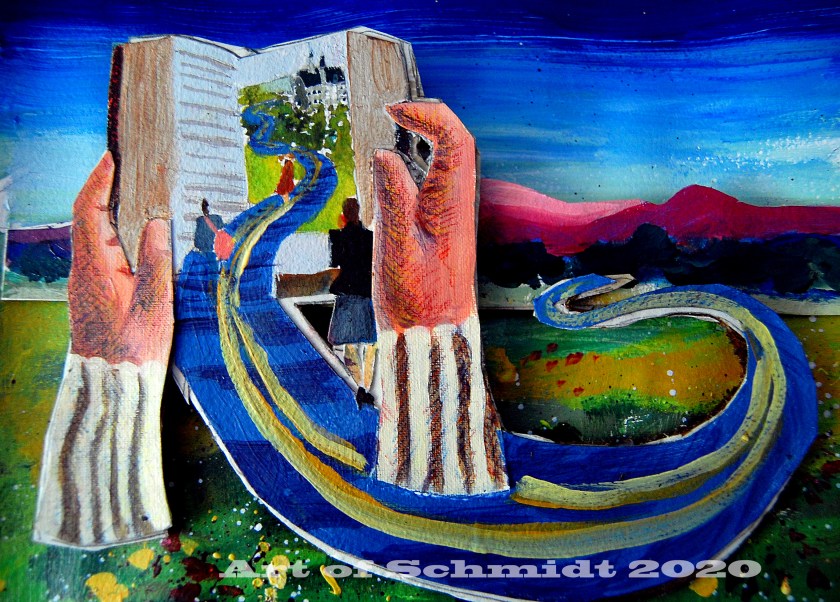
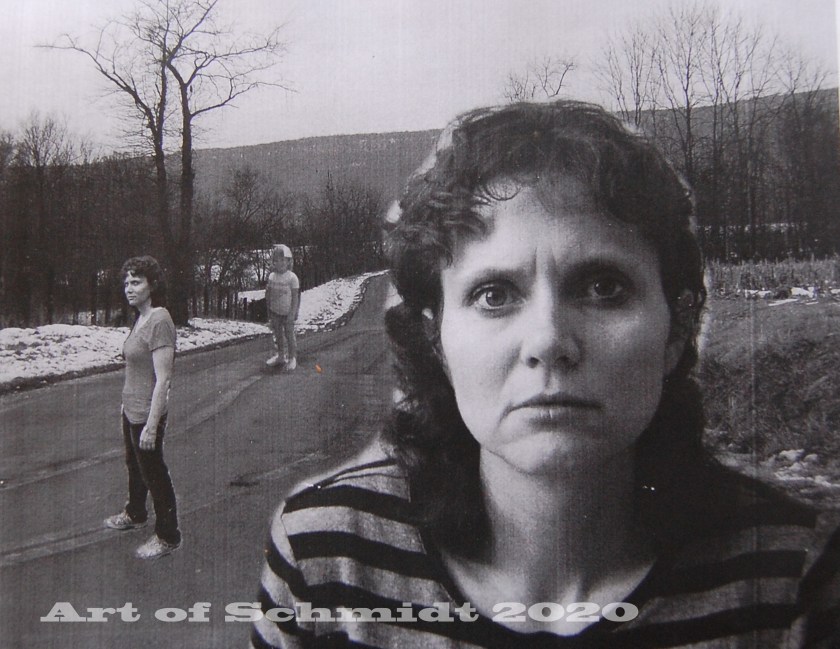
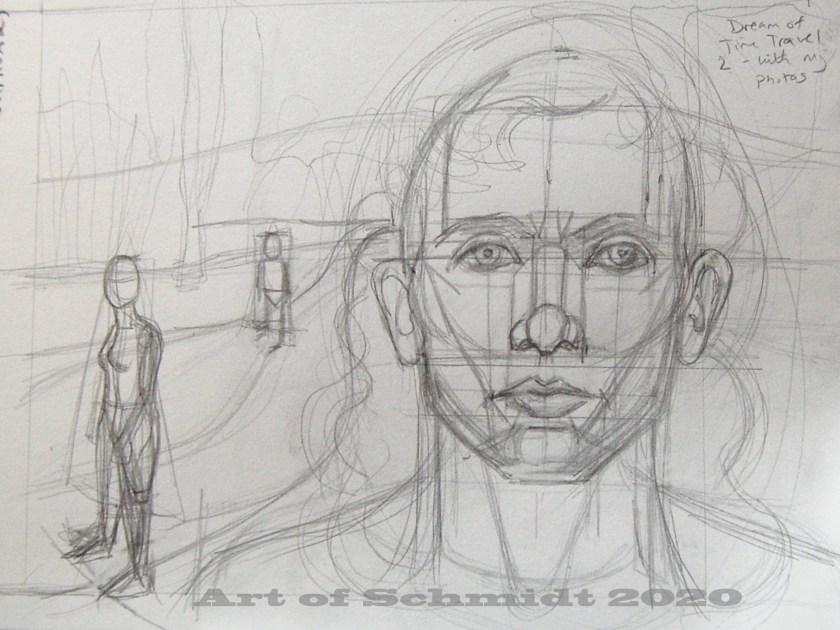
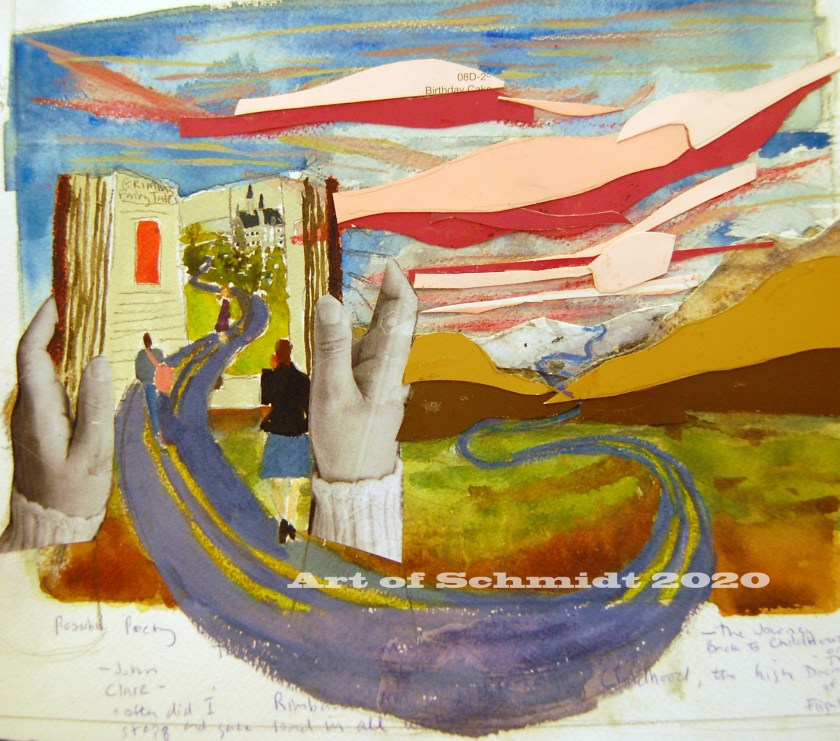
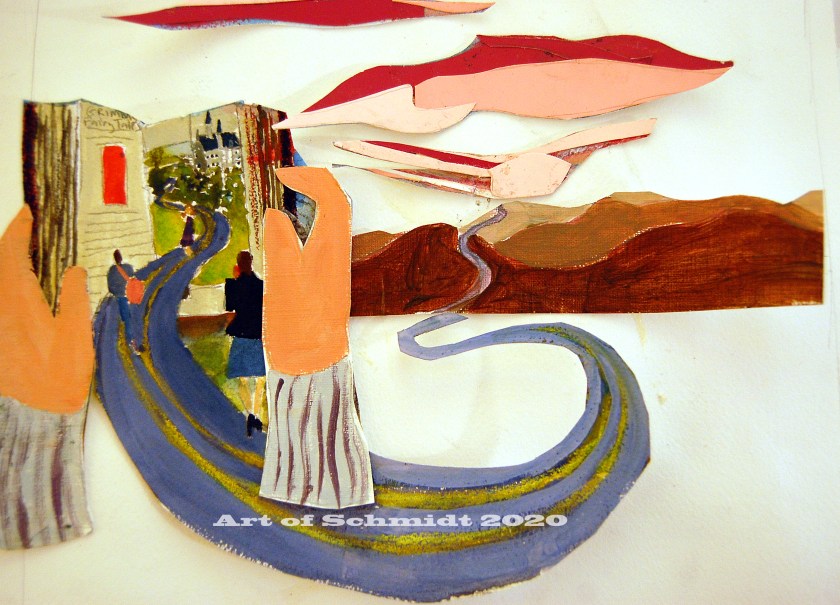
For the past two weeks, I have really been making an effort to make time to get into my art studio and work on my Voices and Visions series, every Thursday from 10 am-12 pm. It’s been challenging. I am focusing on finishing one piece of artwork that I started a few weeks ago, called, The Dream of Time Travel. This mixed media piece has gone through many changes and edits. I’ve subtracted some elements and added others trying to find the right composition and color scheme to express the emotions I want viewers to feel when looking at this artwork.
The Creative Process: Dream of Time Travel
And yet, I am still trying to figure out just what that feeling might be that I want the viewer to take away from my painting. Is it sadness, longing, discontent, or some other emotion? I feel that finding the answer to this question will be the key to solving the difficulties I have had with completing this piece in terms of composition, color choices and subject matter.
Extreme Makeover
I began making my edits on this piece by cutting up my color sketches in watercolor and adding other elements such as paint chips for the clouds. After that, I took more drastic measures, cutting out anything from the painting that did not add to the composition, seeking simplicity. Even after hours of work, I could see that I needed to start the whole project over from scratch, because some elements of the piece just didn’t work, especially the imaginary ones, like the road leading to the fairy tale book. I realized that trying to do a surrealist style in this work, and it just wasn’t working.
Back to the Drawing Board
After I realized that the piece was not working, I decided to start over from scratch and gather my own photo references of self-portraits and a landscape to combine them into a Photoshop collage. Then, after I had placed all of my photos into the collage, I began drawing the composition free hand, trying to make it the same scale as the photo reference. While I was working on this piece, I realized I need to draw more often, and that I had become too reliant on tracing photos for my art, rather than drawing from life or photo references. So, my new piece is a sketch that I still need to finish, but one that I think will be easier to complete as a painting.
The Takeaways from the Creative Process
Other takeaways from this project are: 1.) Sometimes you just need to get started on art to make progress, even if you’re out of practice, 2.) Failed art pieces can be the springboard for new art, 3.) Simple compositions work best for me, 4.) I need to draw more often, 5.) Drawing from one’s imagination is really difficult, and perhaps I need to stick to a more realistic style, and 6.) I need to think about what emotion I want my viewers to feel from my artwork, which will influence my color and compositional choices. Through it all, I am learning that everything on my journey of creativity is useful to me and that good art can’t be rushed, not for me anyway.
Back in September of last year, I posted about getting started with a new body of artwork, Voices, and Visions, based on the human condition. However, I am sorry to say that the work on it has not been going well. Not at all smoothly in fact. For a while, work on it has ceased as other priorities took center stage. But the biggest obstacle to getting any headway on this project has been that I have been afflicted with an artist’s block and a lack of studio schedule structure. While I did finally get to the oil painting version of my painting, Maslow’s Hierarchy, I hesitate to even post a picture of it, it was so disappointing. Although I usually love to work in oils, things in this portrait just did not gel, and the piece ended up being stale and overworked. Another challenge about this piece was that it came almost completely from my imagination and I had very few reference photos to guide me.
The Analysis: I am Afraid
Only recently have I taken the time to ponder why things with this painting did not work out…Kind of like the analysis one goes through after a failed relationship. If I had only done this or that, or not done that, etc. Perhaps part of the problem is that I have been wanting to work with different materials, using mixed media, rather than oil paints and working in a more expressive art journaling style. From time to time, I have experimented with mixed media, but never really made a study of what mediums work well together, etc. Most of my mixed media pieces have been made for the Box Show at the Artists’ Gallery in Frederick, MD. Quite simply, I have lacked the courage to put pencil to paper, or brush to canvas and try something new. Just gessoing a new canvas brought on waves of anxiety that were difficult to banish yesterday. But I persevered anyway because I do not want to let fear win.
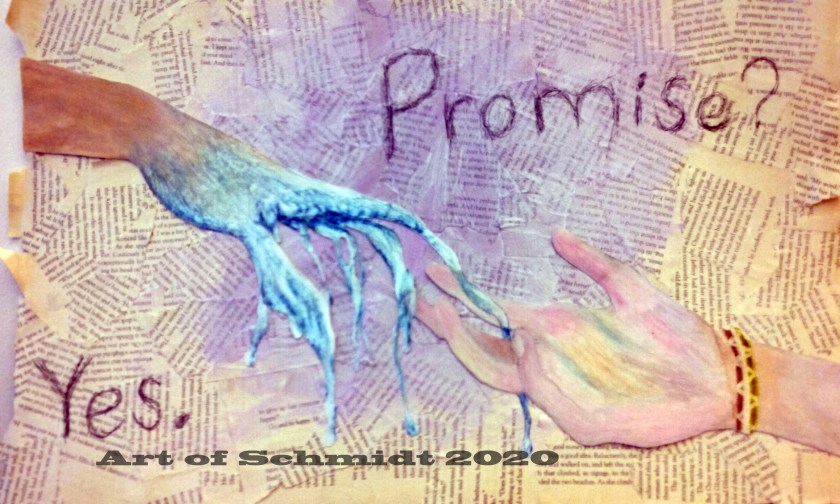
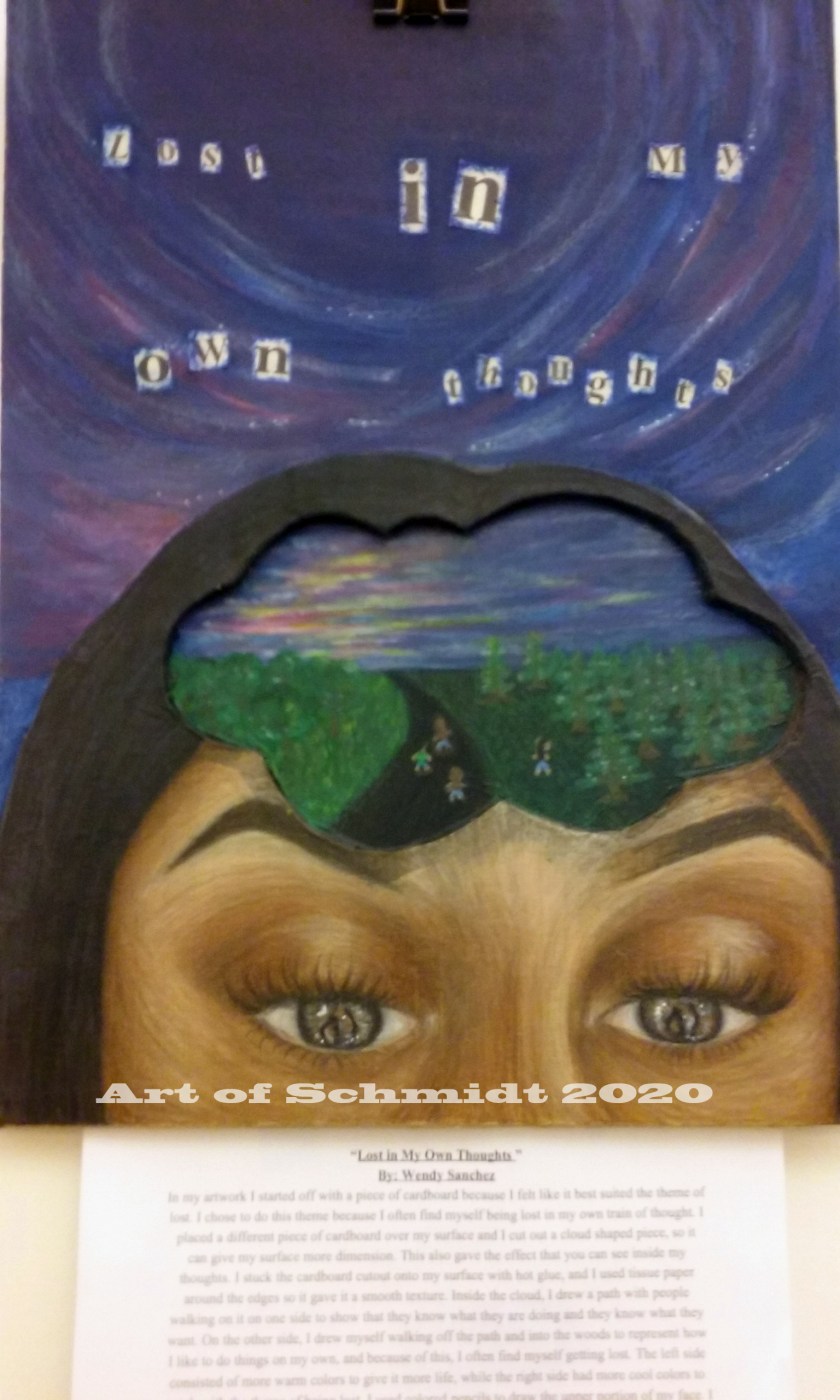
The Inspiration: Bermudian High School Art Show, Adams County, PA
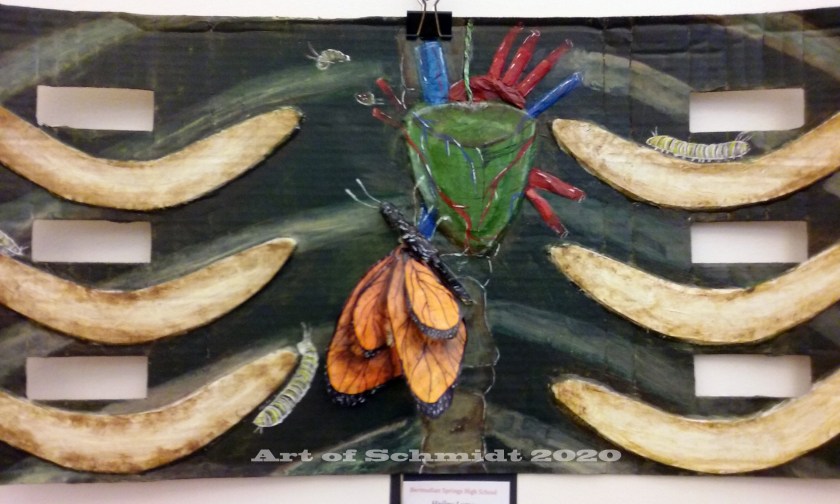
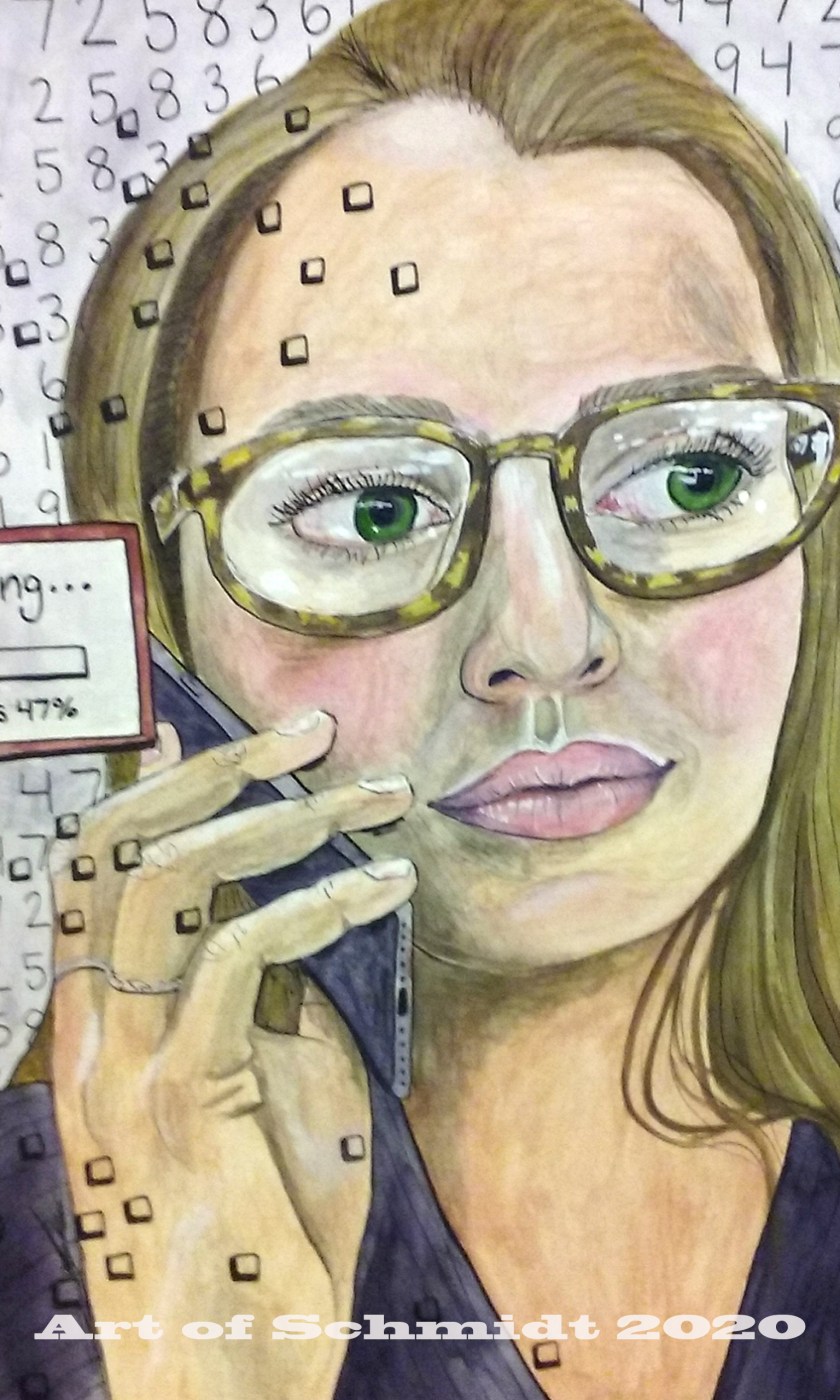
This past weekend I visited a new art show which opened my eyes to the possibilities of artistic representation, and I finally felt inspired to go back to the drawing board and make some art. The art show in question was an exhibit of mixed media artworks by 45 high school students from the Adams County, PA area and was housed at the Adams County Arts Council. Students focused their works on the theme of human emotion and experimented with a variety of media, such as cardboard, newspaper, colored pencil, magazine clippings, watercolor, etc.
The Breakthrough: Back to the Drawing Board
When I got home, I literally began cutting up color sketches of unfinished color sketches and began re-drawing and re-composing the artwork, The Dream of Time Travel. I have yet to tackle the Maslow’s Hierarchy painting, but maybe this new project will give me some ideas about how to re-think the artwork, such as what media I could use instead of oil painting, as well as what style I want to work in. I have limited myself to working in oils lately, and it’s been stifling. I’ve also been struggling to find my unique style of painting, which represents my love of expressive color and emotional content.
This is particularly apropos for this series, and it seems to be one of the main failings of the Maslow’s Hierarchy painting, it feels devoid of any emotion. One final thought for today, as the writer Stephen King said, “If you don’t have time to read, you don’t have the time (or the tools) to write. Simple as that.” Because I am not a writer, but an artist, I am going to modify that statement for myself and say that if I don’t make time to look at the artwork of others, I am not equipped with the ingredients to make good art. So I am going to make it an intentional habit to get out there, visit art galleries, read art books, go on Pinterest, etc., and fill up that creative tank.
I have been taking a break from blogging after teaching two classes back to back in Classic Drawing and in Pastel at Frederick Community College. An unexpected side effect of teaching others art has been learning that I have room to improve my own art-making skills. Lately, I have been dissatisfied with my artwork, especially a poetry illustration series that I can’t seem to finish. I think my drawing and my painting skills need more refinement.
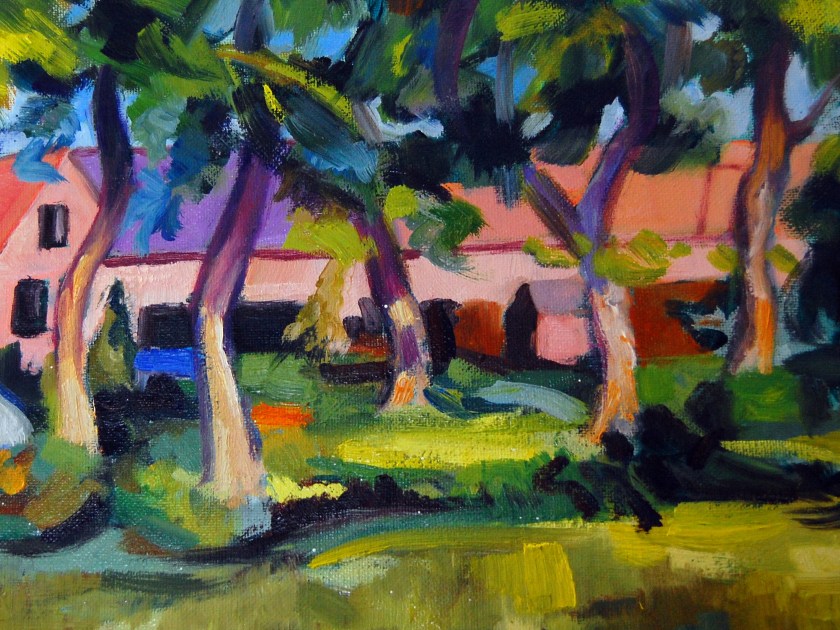
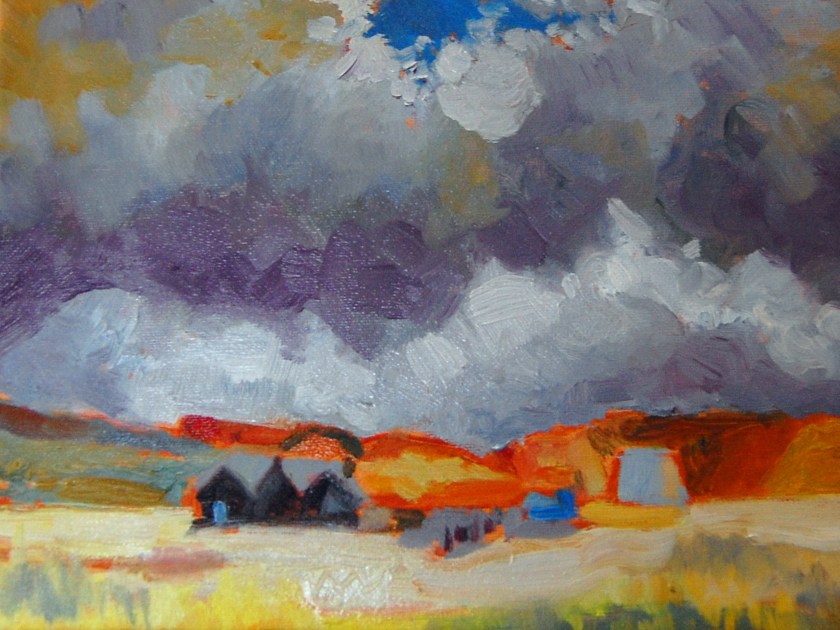
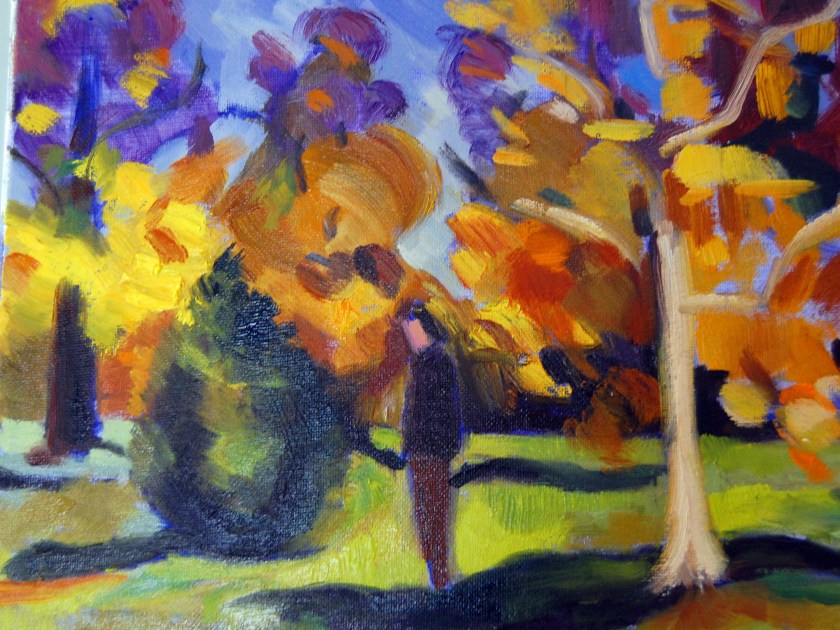
To that end, I have been scheduling in-studio days, in which I work on drawing from sketchbook prompts and also from oil painting tutorial books. The one I have been working with most recently is a text by Angela Gair, entitled, A Step-by-step Course in Oil Painting. I have learned a lot about color mixing, drawing with my brush and working in the landscape. I have a bad habit of being mean with the paint and I want to start adding more texture, which I am glad to see appearing in these new paintings. My drawing sessions are showing me that I need to slow and really observe my subject. I want to be the best teacher I can and so I think I need to start nurturing the artist in me so I will have more to give others and remember what inspired me to teach art in the first place.
This year I have taught five drawing and pastel classes at Frederick Community College! Its a dream come true, after many years of wanting to teach art, but not being able to find a job in this field. And it’s been a giant learning curve going from being a perpetual college student to an adjunct art instructor. My hat is off to teachers, you work so hard and your work makes such a difference in the lives of your students! I’m thankful for my many teachers who inspired my love of learning, especially at McDaniel College, and for my best teacher, my father, who introduced me to the world of reading and literature!
But, maybe being a perpetual student can help me be a better teacher because I am always seeking out new knowledge or trying new approaches to teaching art from including art history examples to applying art concepts in small activities such as value scales and color wheels… Every class I learn something new about myself and the areas I need to improve, or I learn something new about art that I can apply to my own work. My students keep me engaged by their passion to learn and their curiosity in learning about art. One of my growing edges has been trying to be brief in my lectures and to only give out small snippets of information so that my students can absorb and apply the concepts I am teaching and not feel overwhelmed. This month, I have been teaching a pastel class that focuses on color theory, and my most favorite thing about art is color, so I love this new teaching series! We’ve been working on concepts such as value, the color wheel, color theory, and how to draw from photos and real-life objects, using gesture and contour drawing techniques.
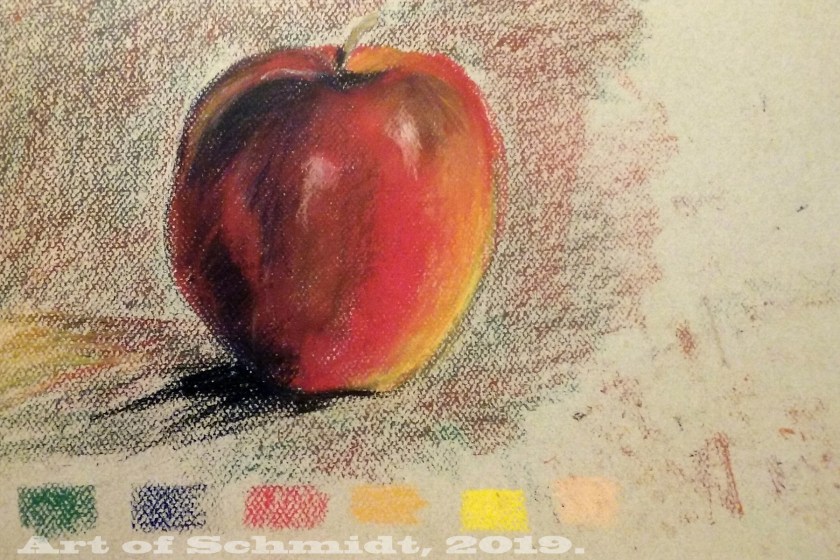
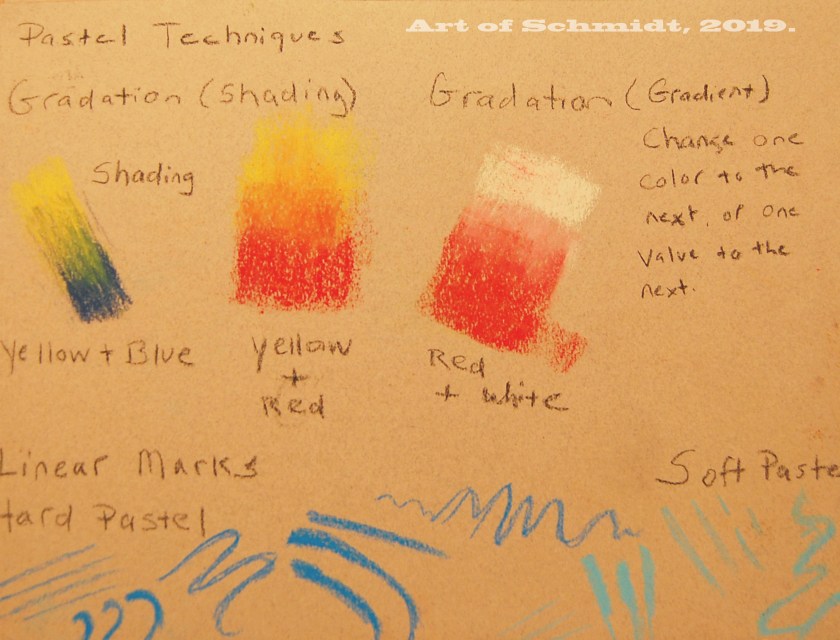
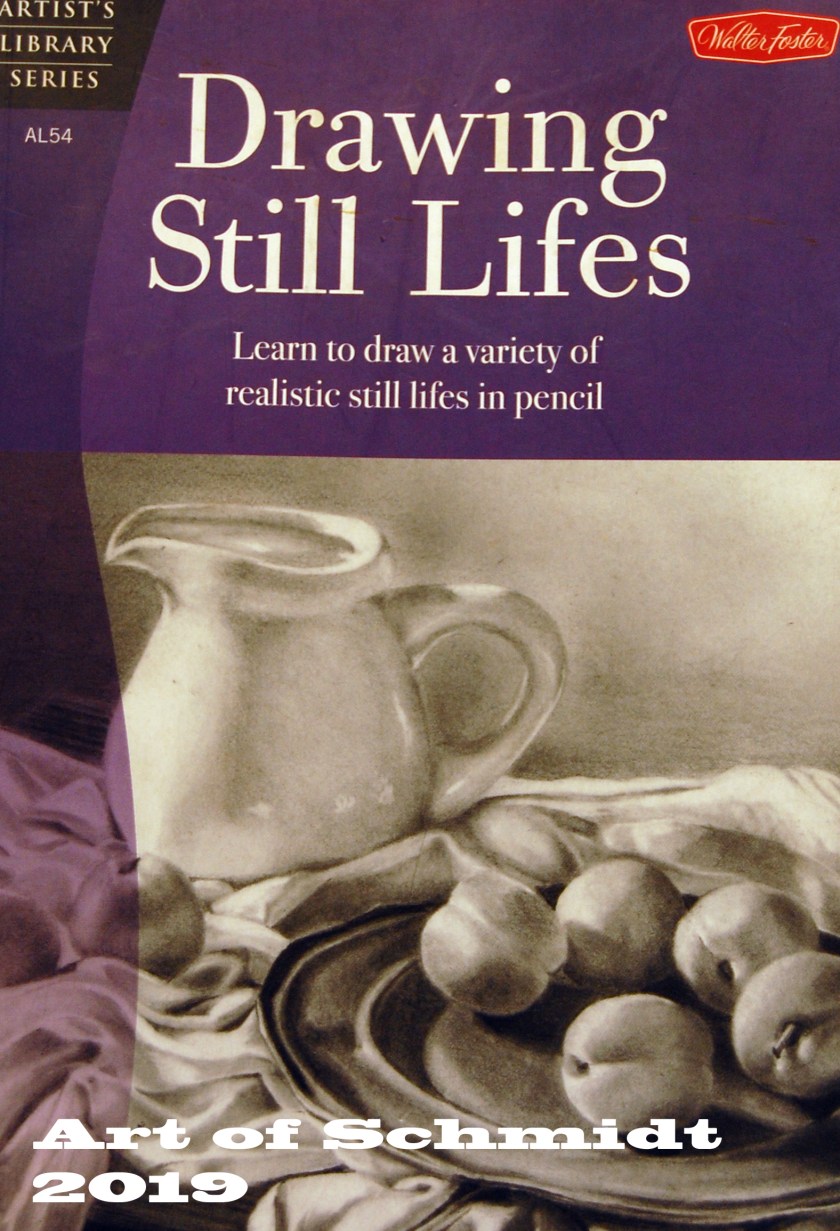
I have also learned once again how important it is to have a solid foundation in drawing from observation and have been adjusting my teaching lectures to include small nuggets about this important concept. If you want to make realistic art it is most important to work from photos, or from life, setting up objects for still life, hiring a model or painting on location for Plein art painting, (that’s French for painting outdoors, a concept that Impressionist painters made popular in the 19th century). My drawing professor from McDaniel really was right, I should be drawing every day! Here are some of the projects and exercises I have been teaching at Frederick Community College for my pastel art class. Note: Many of these projects are not my original art, and have been copied from art textbooks such as Pastels Made Easy, by Anne Heywood. These projects are for instructional purposes only, and not intended for sale or copyright violation. Thanks for reading!
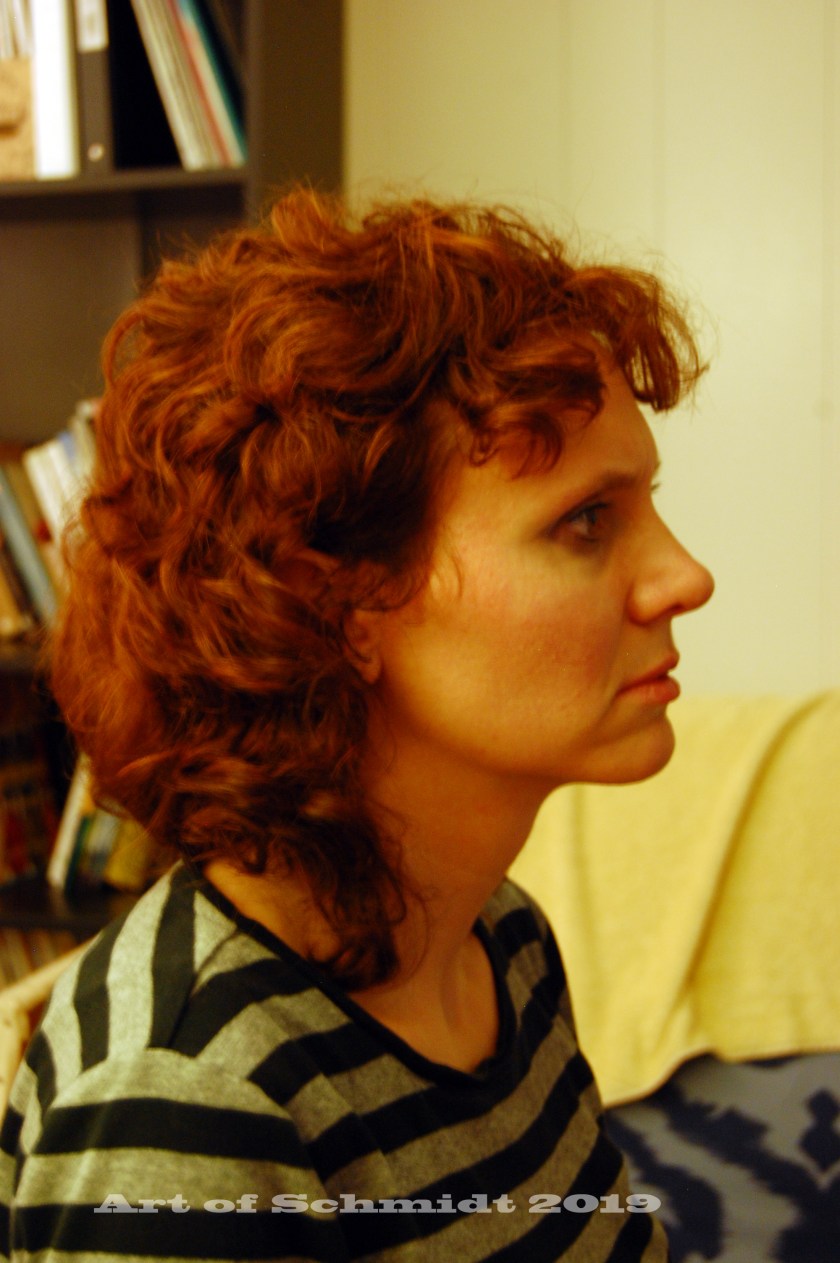
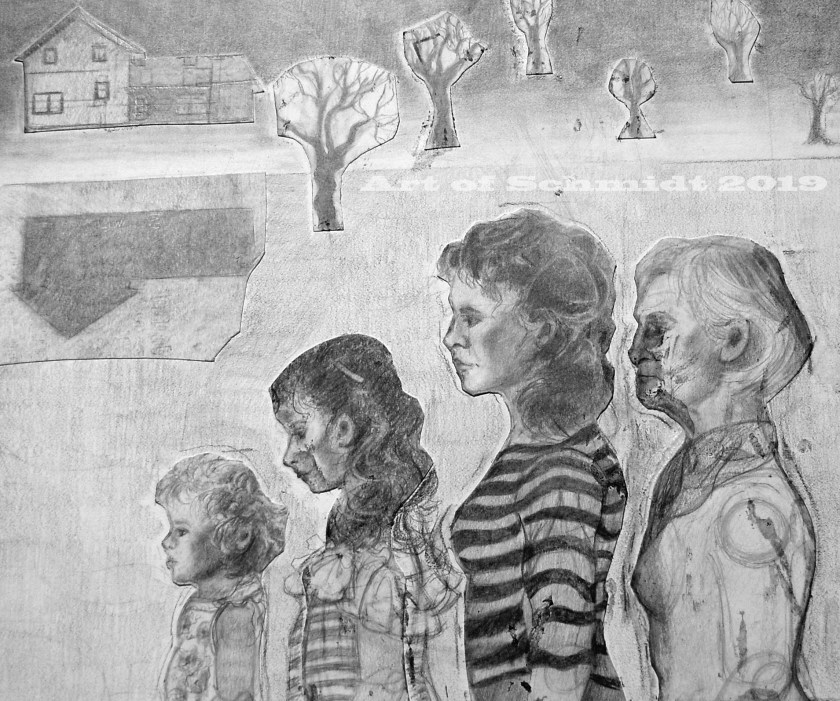
I have been taking a break from blogging since I started teaching art classes and my posts have been somewhat irregular. It’s partly a result of not having much spare time to write, and also because I haven’t made much new work lately. But now I have something new to share! I have finally begun working on a new series of portraits based on the human condition, which I have been working on and off for quite some while. This new piece focuses on psychological needs for belonging, shelter, etc., which are expounded upon by Maslow in his Hierarchy of Needs, and features self-portraits of me at different life stages, based on family photos. The oldest figure was one that I had to imagine though since I have not gotten to the senior citizen stage yet. These sketches are preparation for an oil painting I hope to get started on soon! Below is the artist statement which explains the inspiration behind this work. Thanks for reading!
Artist Statement: Constructed Realities
How does an idea for a painting get born? For me, it derives from a memory, hearing a song lyric that resonates with me, reading a poem that lends itself to narrative or visiting an inspiring art exhibit. This series of paintings focuses on the connection between the human condition and stories described in the written word, through poetry and song lyrics, and other sources such as psychological theories. For example, these works may describe a feeling, a memory, a season, or the human condition, such as a search for love, broken relationships, and homes, uncertainty, belonging, stages of life, nostalgia about one’s childhood, etc. Using symbols such as rainbows, pregnancy, desert landscapes, storms, and ravens, and houses, I tell visual tales in oil and pastel paintings. In addition, I use muted color schemes to keep the focus on the content of the artwork and not the color. The subjects of this series are my favorite subjects to draw, including the human figure, portraits, animals, and landscapes, which I have previously explored in other paintings.
Two things have sparked this visual storytelling theme. The first was an art class that I took at Frederick Community College several years ago. In January of 2015, I took a drawing course at Frederick Community College in Frederick, MD. One of the final assignments I tackled was to illustrate a poem of my choice using pastels. A major challenge in this assignment was to find a poem that had some concrete images to illustrate. I chose Robert Frost’s poem, Ghost House, which has an abundance of concrete imagery. The first lines of Frost’s poem, Ghost House, griped me with an intense visual impression: “I dwell in a lonely house I know, that vanished nearly a summer ago, and left no trace but the cellar walls…”
The second inspirational spark was learning about art journals and mixed media artwork. A new trend in popular culture is the concept of the art journal, in which the artist writes and illustrates specific things, feelings, seasons, etc., often in mixed media materials. According to mixed media artist, Dina Wakely, art journaling is a way to express your emotions through imagery and text, and no specific rules need to apply to this process. Like Dina, I find that creating narrative art can be a meaningful process, either to express difficult emotions or memories. This new series is entitled Voices and Visions. It was inspired by poetry that includes verses written by Emily Dickinson, Maya Angelou, Robert Frost, and T.S. Elliot, among others. Memories, feelings, and desires have also inspired this series.
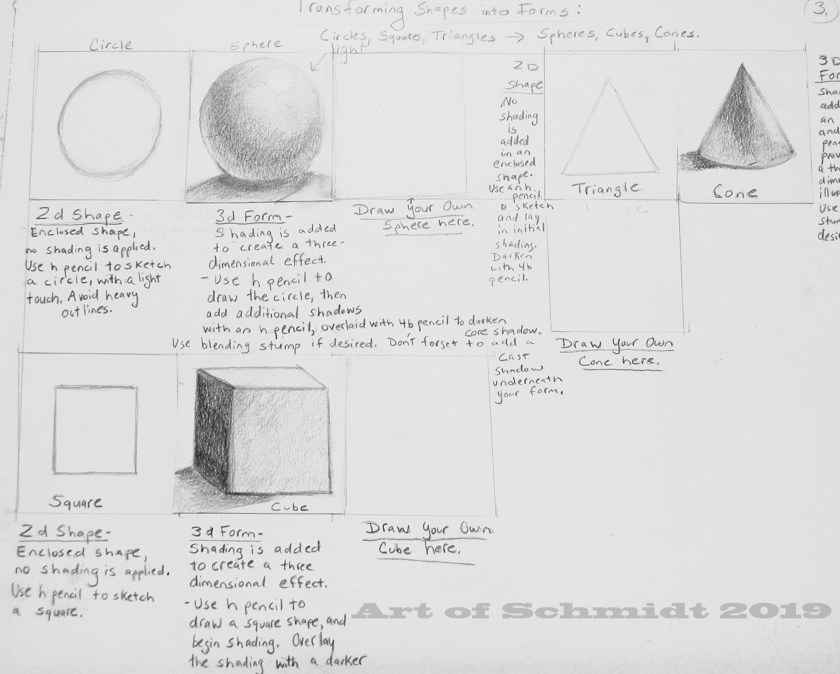
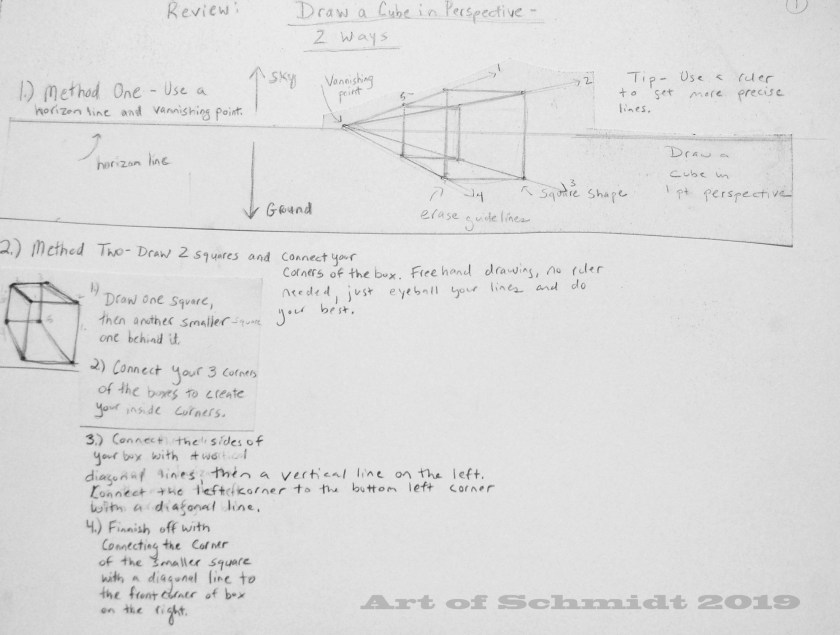
Maybe you’ve been wondering where I disappeared to, or not. I haven’t written any new blog posts in months since I started teaching as an adjunct art instructor at Frederick Community College. Its been a really busy season. I’m no longer trying to sell my art, (although the occasional sale would be welcome nonetheless) and my focus has now been on teaching art classes and juggling my other part-time job. My lastest adventure in teaching has been in instructing a drawing class at Frederick Community Colege, where I have been teaching senior citizens the basic skills of drawing, such as how to draw simple shapes, create the form by shading and how to draw from observation. Here are a few photos of my teaching demonstrations. Enjoy! And thanks for stopping by.



 Thanks!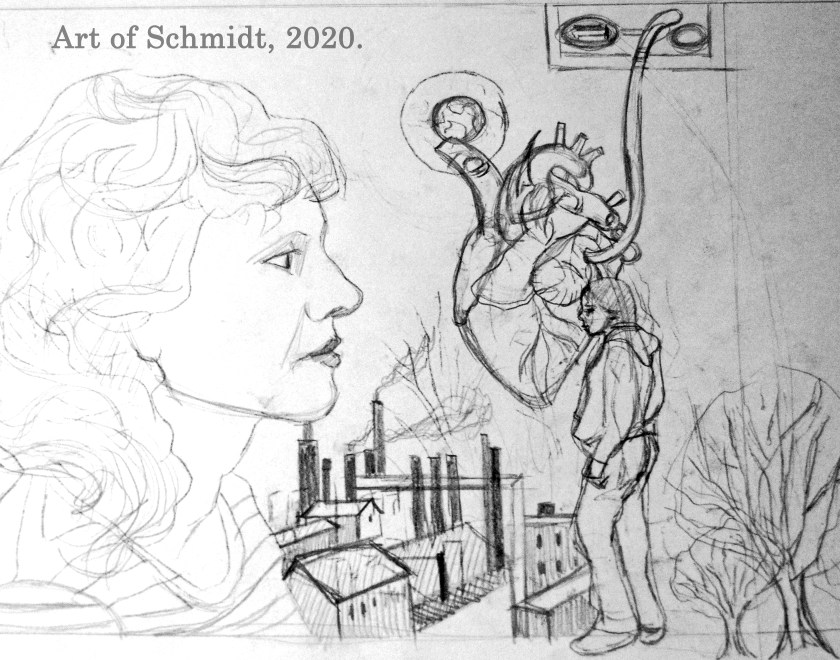
 and is inspired by poems, by writers such as Williams Wordsworth, who wrote the poem, “The World is too much with us.” Though it was written several hundred years ago, in 1807, about the conflicts between our connection to nature, and the pull of materialism driven by the industrial revolution in England during the 19th century, it still seems so relevant today. Anyways, on to the blog post, which is about the Artist’s Block.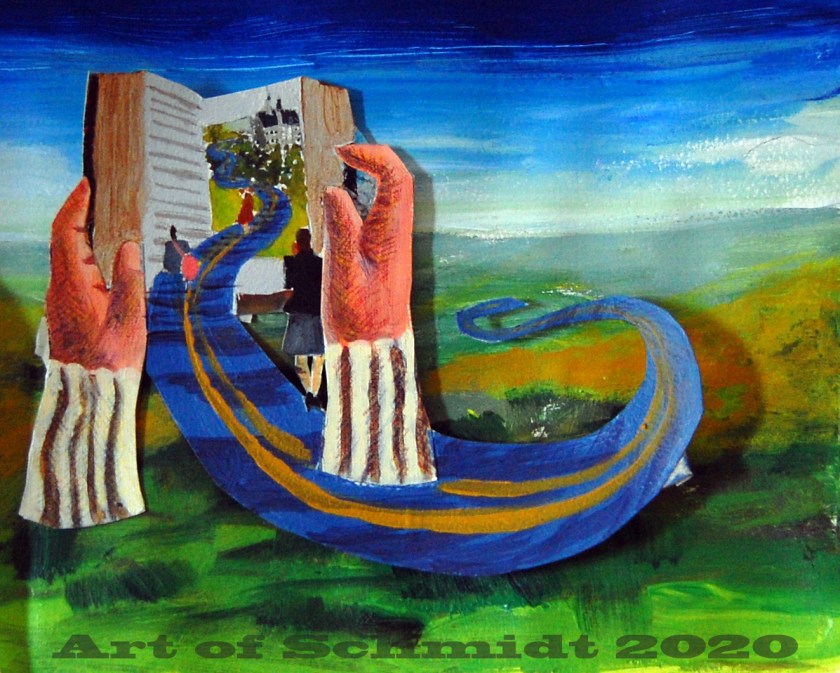

 takeaways from this project are: 1.) Sometimes you just need to get started on art to make progress, even if you’re out of practice, 2.) Failed art pieces can be the springboard for new art, 3.) Simple compositions work best for me, 4.) I need to draw more often, 5.) Drawing from one’s imagination is really difficult, and perhaps I need to stick to a more realistic style, and 6.) I need to think about what emotion I want my viewers to feel from my artwork, which will influence my color and compositional choices. Through it all, I am learning that everything on my journey of creativity is useful to me and that good art can’t be rushed, not for me anyway.

 etc., and fill up that creative tank.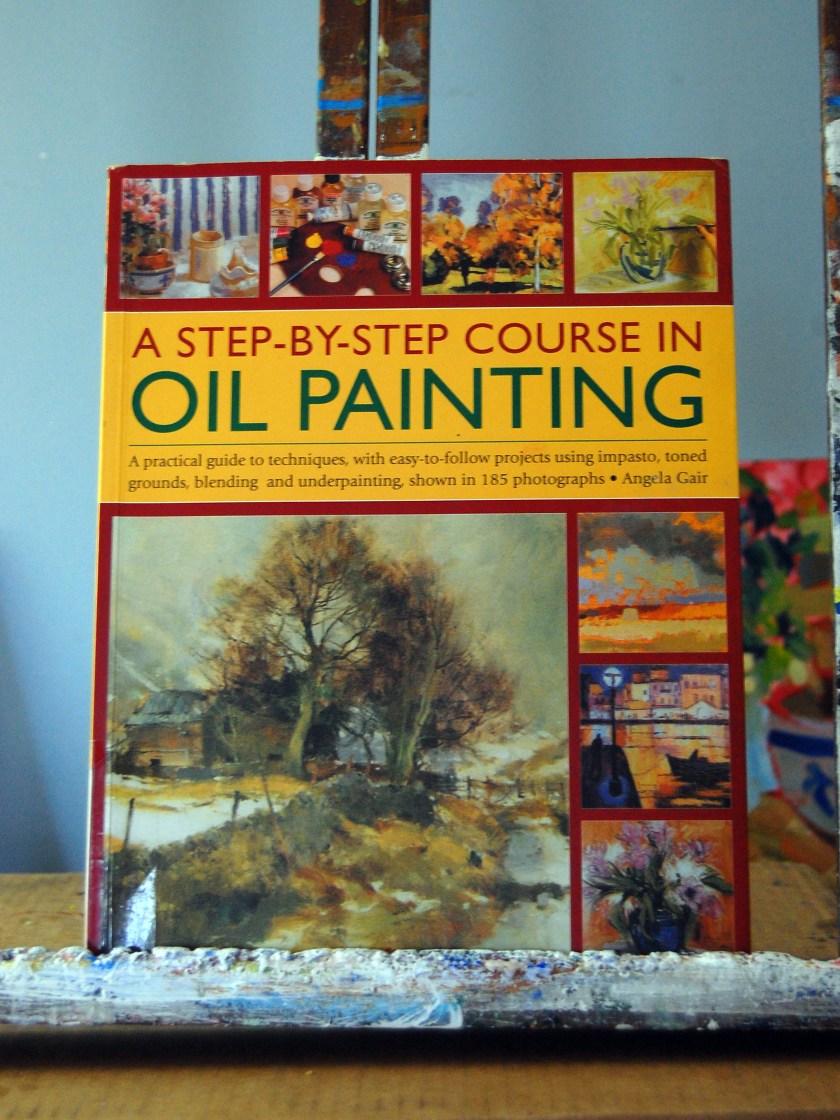

 and fans,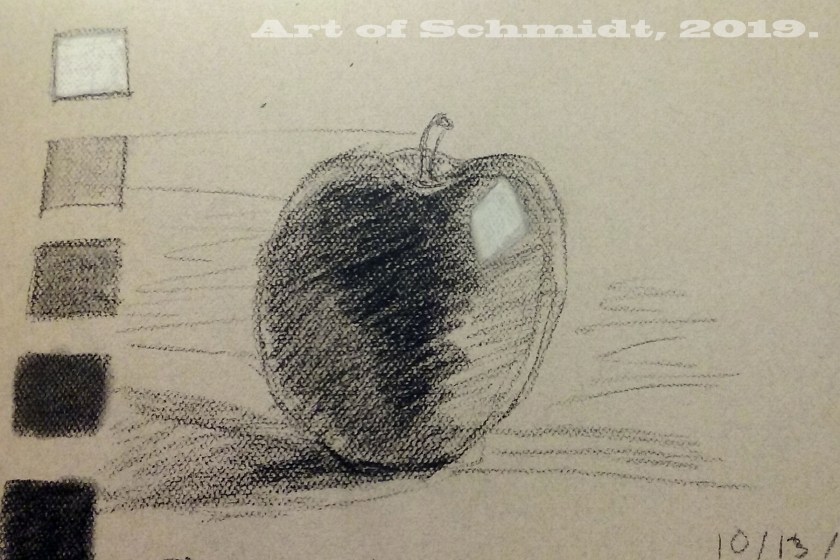





 Art of Schmidt