What is the Creative Process?

I am writing about the creative process this week in an attempt to provide a behind the scenes view of what it takes for me to bring an idea to a realized concept and finally a completed painting or drawing.  My inspiration for this blog post comes from an article by Amanda Truscott, entitled, This is What Creative Inspiration Really Looks Like, on www.skinnyartist.com.  I believe inspiration, or what the Greeks termed, “the Muse” is something which must be sought after in order to be found. Although it may seem to be a sudden insight, in my experience, it is not an isolated light bulb moment. Sometimes, indeed often, bringing my artistic visions to life it is the result of a hard-won battle of trying out different ideas in sketches, paintings, etc., to test out a compositional idea or a color scheme. Sometimes these ideas work, and sometimes they don’t and I need to make more revisions to the color schemes, composition, etc., to make it a successful artwork. Other times, I have to start over the painting from scratch.

For example, in my ongoing poetry illustration series, Voices and Visions, it has been a combination of hunting for inspiring poems to illustrate; these poems need to have some visual imagery and themes that lend themselves to storytelling, in order for me to consider them as potential candidates. So far, I have found a few poems written by Emily Dickinson, Robert Frost, and T.S. Eliot, whose works have several identifiable themes such as hope, time, and the artificiality of modern life. After reading the poems, I researched literary criticisms to identify possible themes that seem to suggest a story or feeling which I  translated visually through specific symbols or color schemes. I followed up these steps by looking for artwork by artists whose artwork has a narrative theme, such as Jacob Lawrence, Faith Ringgold, and Andrew Wyeth. When I found artwork that inspires, I pasted it into a sketchbook for future reference. Finally, after these steps have been completed, I created a photo collage in Adobe Photoshop of found images that I locate online and modify in Photoshop by creating several layers and layer masks. When I was pleased with the composition in my Photoshop files, I printed them out to scale, and then traced them onto my substrate of choice using carbon paper and pen, usually to cotton duck canvas or cold press watercolor paper. The painting is then completed in watercolor paints or acrylic or mixed media. Finally, I worked on the painting for 1-2 weeks, making revisions as I painted.

In addition, the backbone of the creative process for me is always the deliberate practice of the fundamentals of art, such as drawing or painting, so that when I finally find that intersection between deliberate practice and purposeful searching for inspiration, everything clicks. Although this process may seem instantaneous to others who were not there to watch the process, or read my blog posts, it is a painstaking process. It is not simply talent which I was born with that brings my visions and goals to life, it is a decision followed by a series of actions. It takes willpower and self-discipline to practice drawing and painting every week, and to continually seek out artistic inspiration through Pinterest searches, reading art books, watching documentaries about artists on youtube, reading poetry books, literary criticism, creating inspiration sketchbooks, etc. Moreover, it takes grit and determination to stick with a painting even when it goes wrong, and to figure out what went wrong so that I can critique the artwork

and decide what strategy to pursue to make the artwork sing.

Painting of the Week: Rooster, Hen, and Chick

Hello friends, family, and visitors,

I am posting a recently completed, acrylic painting, Rooster, Hen, and Chick. In a manner similar to my commissioned work, I started with a three step process. First, I decided on the composition and reduced the color photo referenced to three values in black, gray and white. After that, I began painting in the local colors, or the colors that I actually saw in the photo. Lastly, I did some problem solving with the composition by changing the arrangement of the chickens and by adding a baby chick to balance out the composition and fill in the empty space. The painting is available for sale on my Etsy site: https://www.etsy.com/shop/ArtofSchmidt?ref=seller-platform-mcnav. I will also be adding this painting to my Red Bubble site tonight so that it will be available in a variety of formats such as coffee mugs and fine art prints! Thanks for looking!Rooster, Hen, Chick

What to Do When Your Painting Goes Terribly Wrong

If you are a creative type or if you like to make things, you have probably encountered the moment when the finished product you imagined, does not live up to your expectations. As an artist, I have experienced this frustration more times than I can count. Some paintings and drawings are simply learning projects and are difficult to salvage, while others can be fixed. I know it’s been said that you learn more from your mistakes than your successes, but when I get to a point in a painting or drawing and I realize that the painting or drawing doesn’t look right, it can be really frustrating. I start doubting myself; feel like giving up, or doing something that I am not good at, like cooking or cleaning.  Since I know I am not a good cook, if it doesn’t turn out so well, it’s a waste of ingredients but I don’t feel as emotionally attached to the outcome as I would to a painting or drawing.

I recently read a forum question on the website, www.

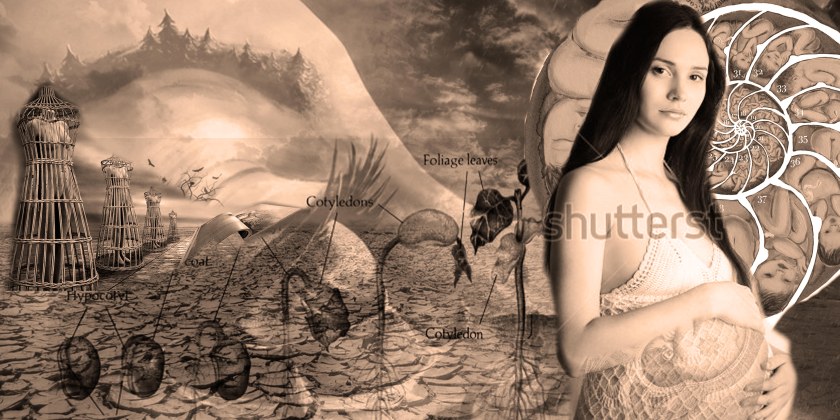
photo collage, pregnancy, desert, eye, dress forms, seeds, woman, process, artist's block.
Here is a photo collage I made in Adobe Photoshop which I made by combining various photographs in the Photoshop program. I wanted to illustrate the feeling of artists’ block, which can feel like a time of dormancy. I plan to translate this collage into a watercolor painting soon.
Waiting small
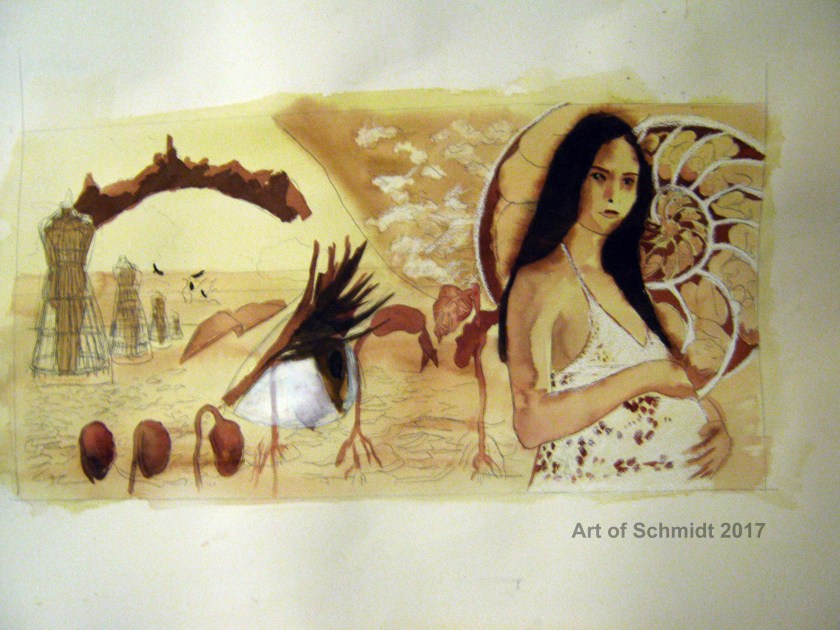
My first version of this painting was made with sepia brown watercolor paints. I’m not sure I like this color and the composition feels too busy.
Portrait Collage
Creative Block: Waiting ( with Gesso added). The composition was getting too cluttered so I decided to cover up the distracting elements with acrylic gesso.
Creative block, with color
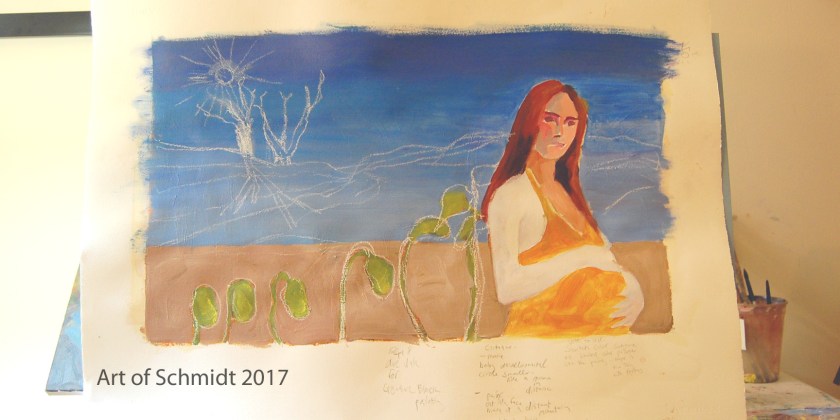
I painted out the brown watercolor paint to try and make the image more interesting with a limited color palette of yellow orange, red orange, blue, green, peach and blue violet. Still a little too busy with the composition.
Portrait collage
Here is the revision I made after painting out the busier composition with acrylic gesso. I also decided to limit the color palette to turquoise, red-orange, yellow-orange, blue- violet and muted green, with some additions of brown, black and white. I used a soft pastel to draw in the composition after the acrylic paint had dried.
Portrait collage
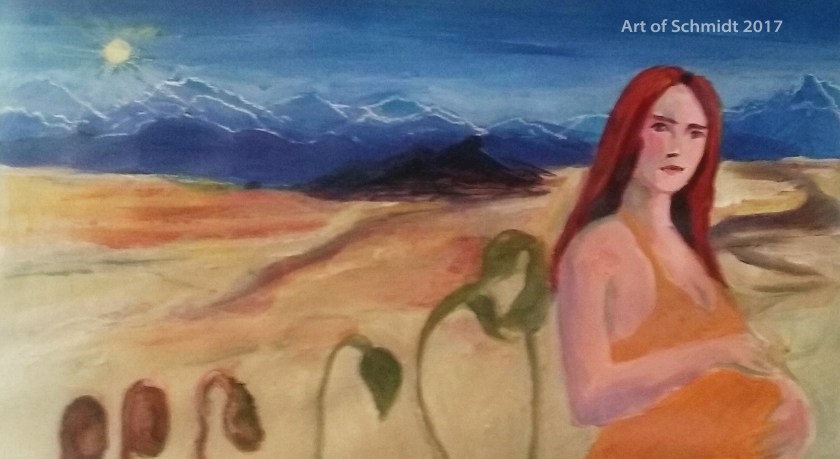
This is my most up to date version of the acrylic painting, Waiting: Creative Block. Here I have begun painting in the new compositional elements to add depth to the desert landscape, including sand dunes and distant mountains. I also painted in the flesh tones and shadow colors on the figure. A few more details and I hope to be finished with the painting soon!

Wet Canvas.com and the question of the day was,” When should I stop working on a painting?” I was intrigued by the question and wondered how other artists dealt with paintings that don’t go according to plan. I read about a variety of solutions suggested by artists who had hit the wall creatively. Some remedies were familiar to me, like my tendency to put the painting away and stop looking at it for a few days, weeks, months, or even longer. On the other hand, some solutions were not as familiar, such as displaying the painting on an easel in a living room and then taking time to look at it from time to time to diagnose the problem. A favorite technique of mine is to write a list of things I want to change in the painting, be it the drawing, colors, value, edges, etc.  In my case, some of the art work I have abandoned was started about two years ago, and I am just now starting to look at the sketches and Photoshop files.

This week I took some time to work some more on my acrylic painting, Waiting: Creative Block. I realized that there were several things bothering me about it. The composition was one of the biggest glaring errors I noted in this painting. First, I started with revising the composition in Photoshop, taking out some photos while adding others, to try and simplify the painting.  After that, I wrote a written critique and consulted a landscape painting art book, entitled, Paint Landscapes in Acrylic, by Lee Hammond, to search for tutorials on painting skies. Next, I watched a You Tube art tutorial, titled, How to Paint a Desert Tree, Acrylic Painting Lesson, by Schaeffer Art.  My next step was to begin painting out the busier parts of the composition with gesso. After the first two layers of gesso had dried, I started drawing the new composition in with a white Rembrandt soft pastel, using the photo references I had collected to draw in the distant mountains, sand dunes, and sun. My final step was to look in my portrait painting book by Chris Saper, Classic Portrait Painting in Oils, from which I took inspiration for the figure in my painting. I have included the various stages of this painting from the start to my latest revisions on it this week. Thanks for stopping by!

How to Stop Procrastinating and Get Things Done

This week’s topic focuses on a behavior that many can probably relate to, and I include myself in that number. The behavior of which I speak is procrastination. I confess that I seem to have only two settings with regard to task completion, and they are hyper speed and snail speed. At times I am hyper focused and hyper busy on whatever the project at hand may be, such as completing an art project, or writing an artist’s statement, etc.. However, at other times, I start and stop and ultimately avoid the task, if it seems too difficult or unpleasant. At present, I am battling with the dreaded enemy of time, procrastination. I procrastinate on the mundane, such as de-cluttering my studio and organizing hard copy art business files and paper work, to the more critical, like updating my web site, and balancing my checkbook, or finishing a complete body of work that features some sketches and Photoshop collages that illustrate favorite poetry quotes.  As to that later, I have started and stopped the drawings and paintings and Photoshop collages for the poetry illustration project numerous times since I came up with the idea in the summer of 2015.

Lately, I have been trying to finish one work from this series in particular, and it is an acrylic painting, entitled, Waiting: Creative Block. It has been a very challenging art piece to work on in terms of choosing the right composition and color scheme. I am being really stretched beyond my comfort zone with this series, as I have never attempted to illustrate something as ambitious as abstract thoughts and feelings such as creative block, creativity, childhood wonder, overcoming life obstacles, etc.! And though I know the stretching is good for my artistic muscles and that I will be happy with myself for completing the work, I tend to avoid the hard part. And the moment comes when you decide whether to press on despite the difficulty and finish the “run” or you give up.

Other things that I have procrastinated about completing are cataloging and watermarking my art work, getting art work framed and matted for an upcoming art show, writing this blog post, printing out my bookkeeping files for this year’s profit and loss sheet, (what fun!), to name a few. I need to find a balance between procrastination and workaholic tendencies when I don’t take time to rest and regroup. When I am unbalanced, I have very little physical energy or creative energy to finish the art work I start and all the other administrative tasks that I need to do to help support my business and market my art work.  I need to create margin in my schedule so that I can get these things done and set some deadlines for each task so that I am motivated to complete these projects!

One more thing I also need to do now is to not schedule any further art shows, and just take some time to regroup so that there will be time to get these things done, such as finishing the poetry series and updating my web site. To date, I have scheduled 9 art shows this year, and one possible art fair is currently in the works. This leaves me with little time to get these other tasks done, since I often have to get my art ready for distribution by pricing it, framing it, and marketing it on social media, such as Facebook and Instagram, in addition to making print postcards in Photoshop to give out to potential clients, fans, family, and friends. On the other hand, I have gotten to make more sales, more exposure for my art, and have met more people, which is always a good thing!

I wondered what others had to say about procrastination and how to stop doing it, so I listened to a podcast by author and art biz coach, Alyson Stanfield. In a podcast called, Getting Difficult Things Done, Alyson Stanfield and a guest, Cynthia Morris, also a coach, as well as an artist, discussed some strategies to tackle procrastination. Source: Alyson Stanfield, wwww.artbizcoach.com.  One of their main points was to envision how you will feel after you complete a challenging task, rather than settling for feeling good or just having fun.  Another idea that was mentioned in the podcast was the importance of setting deadlines and thinking about how to reward you after completing a difficult task. Alyson shared that one of her dreaded tasks as an art business coach is working on bookkeeping. She tried to start a ritual of doing her books on Monday but found that that was not the way she wanted to start her week. She was helped by some advice that her husband gave her, which was to re-frame her situation by thinking of this task as counting her money. Bookkeeping is definitely not one of my favorite tasks either. On the other hand, I am realizing that by doing my books, I can understand what is working and what isn’t in my business, rather than being in denial about how much spending I am really doing, in relationship to my sales.

In a similar vein, I also looked up goal setting and anti-procrastination strategies on a Google search, and I found an article called, Why Do You Procrastinate, by Margie Warrell, on www.forbes.com. Warell shared that many of us procrastinate on things both large and small, whether it is getting our personal files organized or updating our resume. She discussed the ways in which we avoid doing things that need to get done with excuses such as, “I don’t have the skills for that,” or “It’s too difficult.” I have definitely made those excuses and avoided tackling difficult tasks, like working on my poetry series. But this week, I made the decision to set aside time for creativity and put in some time coming up with solutions to the compositional problems plaguing my Waiting: Creative Block painting. And I could see that this progress from a much-cluttered composition to something more pleasing is going to take time, but that it is well worth the effort. I know it is stretching me as an artist to do more challenging art work that requires different solutions from my older more simple pieces.

In closing, I would like to share some strategies Warrell suggested to avoid the procrastination trap. Here they are in order: 1.) Set a deadline, and write down your goal (s), 2.) Simplify your goal (s) into smaller pieces, 3.) Envision your ideal life, 4.) Get an accountability partner, 5.) Reward your progress, and 6.) Take the first step toward your goal. Source: Why Do You Procrastinate, by Margie Warrell, on www.forbes.com.

Order Your Custom Art Portrait Today: And Make a Lasting Memory of Your Pet

Ever wanted to design a portrait of your beloved pet, as a keepsake but didn’t know how to get started? I specialize in pet portraiture for dogs, cats, and many other animals. It all starts with a free consultation with me at my studio, where we can discuss your unique vision for your pet portrait, pricing, and any other details you would like to discuss. Be sure to bring a few good photos (at least 2-4 images clear images) of your pet which show it’s defining features such as special markings, eye color, the texture of fur, etc. The photo should be taken at eye level and be crisp and clear with good lighting and should be no smaller than 4 x 6 inches. The more photos you bring with you the better so I can design the best possible portrait for you. Want to learn more? My shop policies and examples of my previous pet portraits can be located on my web site:  https://www.etsy.com/listing/487300610/jack-russell-terrier-custom-art?ref=shop_home_active_19. Here are some examples of recent pet portrait commissions in oil and acrylic paint that I have created for clients. Or you may call or text me at: (301) 712-8115 to schedule a free consultation.

How to Make Time for Art

This week I would like to talk about one of my greatest struggles, and that is, making time to create art. It probably seems ironic for me to say that since I think of myself as an artist and I make art for art shows, clients, and I studied art in college. However, sometimes the things I want to do the most, such as painting and drawing, seem to be the most, difficult to make time for in my schedule. So many things battle for competition of my time: everyday stuff like laundry, cooking and balancing my checkbook, administrative tasks for my art business, like marketing and accounting, time wasters like internet surfing and excessive social media use, etc., etc. All these need to get done, but if I am not careful, they can crowd out too much of my time. And if that isn’t enough, I have been battling with artist’s block and self-doubt about my abilities to succeed as an artist, (whatever that means), ever since I have taken my art to a more professional level, by showing at art galleries and art fairs, and creating custom art for clients. My standards for making art have really skyrocketed, (and they were already ridiculously high) since I now feel the pressure to try and please others by making art work that “sells.”

However, in all this, I have lost my joy in making art, and don’t even know what it is that I want to say with my art anymore. This period of my life reminds me of another time period when I faced the same kind of self-doubt, when I was a senior in at McDaniel College in Westminster, MD, studying art. I was in my final year at McDaniel and taking an art studio thesis course, where I had to make art work that demonstrated something I wanted to say and write an artist statement to support that work. After I got that assignment, I felt paralyzed with indecision. It took me two weeks to come out of that episode of artist’s block, and I really wasn’t sure what I would do during that time. When I was going through this ordeal,  I felt that everything there is to say about art has already been said by many famous artists such as Michelangelo, Da Vinci, Vermeer, Rembrandt, etc. and that every art subject has already been done in the thousands of years of art history. I felt I had to come up with some really “original” idea and I looked everywhere I could think to find inspiration: art magazines, art books, etc. I finally found my inspiration in the songs of singer/songwriter, Sting, which seemed an unlikely solution to me. I decided to try and illustrate the feelings in some of his songs like Lithium Sunset, by using myself as subject, and color as a way to express emotions. The crisis was solved and I made it through, but I really struggled to climb out of that pit.

Unfortunately, I am finding myself in that awful place again of uncertainty and doubt. So this week I am writing about how to make time for art, in hopes that it will help me to focus my time better and to get back into the habit of regular studio practice. I’d like to share with you some insights from two blog articles I read by Lisa Congdon, entitled, How to Find Time to Make Art When You Work Full Time, (2017) and an article entitled, How to Find Times for Art in a Busy Life, Tara Leaver, (2014) in hopes that you will find it helpful to you in managing your life and making time for creativity. According to Lisa Congdon, there are a few things you can do to help make time for art. For example, she recommends that artists and other creative types set aside a block of time every week, even if it’s only for a few minutes or a few hours, and that these small increments of time will add up over time. She also mentions an all important habit and that is to limit your time on your computer or phone screen. Another blog writer, Julie Fan Fei-Balzer, recommends a few time management apps she uses to track her time online, such as Flipboard, Tweetdeck, and Alinoff (an online computer app that records the amount of time you spend online.) I’ve been taking this advice by setting aside small increments of time daily, just working on demonstration paintings from art technique books to try and get myself back in the groove. And slowly I am getting my courage back to work on original art, which I really need to get back to doing more often, because I realize that if I don’t make art, I have nothing to share with others, as was so wisely said by Art Biz Coach, Alyson Stanfield on her podcast, on Art Marketing Action series,  at http://www.artbizcoach.com.

For example, she recommends that artists and other creative types set aside a block of time every week, even if it’s only for a few minutes or a few hours, and that these small increments of time will add up over time. She also mentions an all important habit and that is to limit your time on your computer or phone screen. Another blog writer, Julie Fan Fei-Balzer, of Balzer Designs, recommends a few time management apps she uses to track her time online, such as Flipboard, Tweetdeck, and Alinoff (an online computer app that records the amount of time you spend online.) I’ve been taking this advice by setting aside small increments of time daily, just working on demonstration paintings from art technique books to try and get myself back in the groove. And slowly I am getting my courage back to work on original art, which I really need to get back to doing more often, because I realize that if I don’t make art, I have nothing to share with others, as was so wisely said by Art Biz Coach, Alyson Stanfield on her podcast, on Art Marketing Action series,  at http://www.artbizcoach.com.

In addition, Tara Leaver, author of the article, How to Find Time for Art in a Busy Life, (2014), states that one way to make time for art is to schedule in blocks of time during the day when you feel you are at your best, whether it’s early in the morning, in the afternoon or late at night. I personally prefer the afternoon or mid-morning, but I know it would be pointless for me to get up early to try and fit art into my schedule because I am not a morning person. She also mentions that having healthy boundaries and the ability to say “No” to others can help you make time for art, although you can occasionally say yes to say, a meeting with friends over coffee.

For me, the saying “No”, might be to a variety of things such as additional art shows, (since they often require much more than just making art, such as marketing, or pricing the work, or getting it ready for distribution, e.g. (framing, matting or pricing). Or it might mean saying “No”, to watching movies or surfing the internet. Even a well-intentioned visit to Pinterest to look for inspiration for my art work can turn into a rabbit hole that keeps me away from my work and instead results in mindless scrolling through other’s people’s art work, recipes, fashion ideas, etc. if I don’t limit my time there. The biggest takeaway I am getting from this journey out of artist’s block, is that I fear to make mistakes so much that I have been avoiding doing my art work, staying busy with other things, such as cleaning the house, art business stuff, or anything else I can think of to stay away from the easel and my fears about whether I might mess something up. I seem to have a pattern of getting excited about projects, and then giving up, when I get to the hard part. However, today I choose to make art in spite of the fear because it’s what I truly love to do, and I want to share my work with others. It’s been my dream to be an artist for as long as I can remember, and despite many setbacks and self-doubt, it seems to be something I return to again and again. I hope it will bring some light and joy to your day viewing my paintings. The Geese drawing and paintings are my original art work, and the landscape is a demonstration from the Jerry Smith book, Expressive Landscapes in Acrylic.

In Search of “White Space”


I’ve been working at a hectic pace these last two weeks preparing for a one-day art event called Art Pops! At Everedy Square and Shab Row in Frederick, MD.  Last Saturday was the big day to kick off this event and hopefully make some new connections and sales of my art work. The weeks leading up to this event were jam packed with activity and tasks such as weekly social media marketing campaigns, packaging and pricing my art works for sale, creating an inventory list in Excel, researching how to create an art booth display on Pinterest, etc.  And I learned a lot from this show, such as the importance of making in person connections with people to sell my art, how to read people, etc. In fact, I sold more art work in one day at the art show, then I did from months of posting about my art on Instagram, Facebook, and Etsy, and I am thankful for that.  However, all of this activity really took a toll on my energy and motivation to create art.

In all the business of preparing for the art show, I have really struggled to make time to create new art work. I feel that I have reached the end of my creative resources and knowledge, tapped out, so to speak. It’s been several years since I took an art class, and I haven’t read any new art technique books in several months. And this state of affairs is not like me. I am usually restless when I am not making art or coming up with some new ideas for a series of paintings or drawings. The last few days since the show ended, I have made a concerted effort to at least draw one portrait a day for my drawing challenge which I started back in June called, 100 faces in 100 days. Some days I have made some decent portraits, other days I have really struggled or been disappointed with

the results. If you would like to follow my progress with this project, you can view my 100 faces in 100 days drawing challenge on Instagram. I am listed as jsjschmidt2 on Instagram, and I post almost every day. Pictured are some sketches from this week including Frank Sinatra, Cary Grant, Grace Kelly and Sean Connery.

The paintings I wanted to work on, however, are not coming together. Instead of posting the finished product as I had hoped to do this week, I have to take several steps back and ask myself what isn’t working with the composition, values, colors and the drawings in my art work. For example, in my Creative Block: Waiting, watercolor painting, I feel there are too many elements battling for precedence and not enough quiet spaces to allow the viewer to contemplate the scene. The composition feels cluttered and overwhelming and the message of creative block feels “lost” in the muddle. So yesterday, I painted over several spots in the painting with acrylic gesso. And the Civil War soldiers fared no better. So out with the gesso again. I am struggling with the drawing and the tonal values in these acrylic paintings. I have discovered that the acrylic paint dries much darker than it looks when I mix it up and put it on the brush, which is really throwing off the values. So I may re-do the painting in oils after the gesso has “cured.”

The paintings seem to be a type of metaphor for where my life is these days. Overstuffed and empty all at the same time. I feel I have lost the wonder I used to have about making art that keeps me motivated to get into the art studio ever week to see what new ideas I might “cook up.” Meanwhile, I am realizing that my workaholic tendencies are not conducive to making art work. I must create and seek “white space” to re-fill my creative tank, so that I have something to draw from when I go to make art work.  Meanwhile, I will be be seeking out this “white space” in its various forms, whether it is taking a walk, journaling, going to an art gallery, reading an art technique book, etc., to try and regain my sense of wonder for life, and for making art.

Art work for Sale

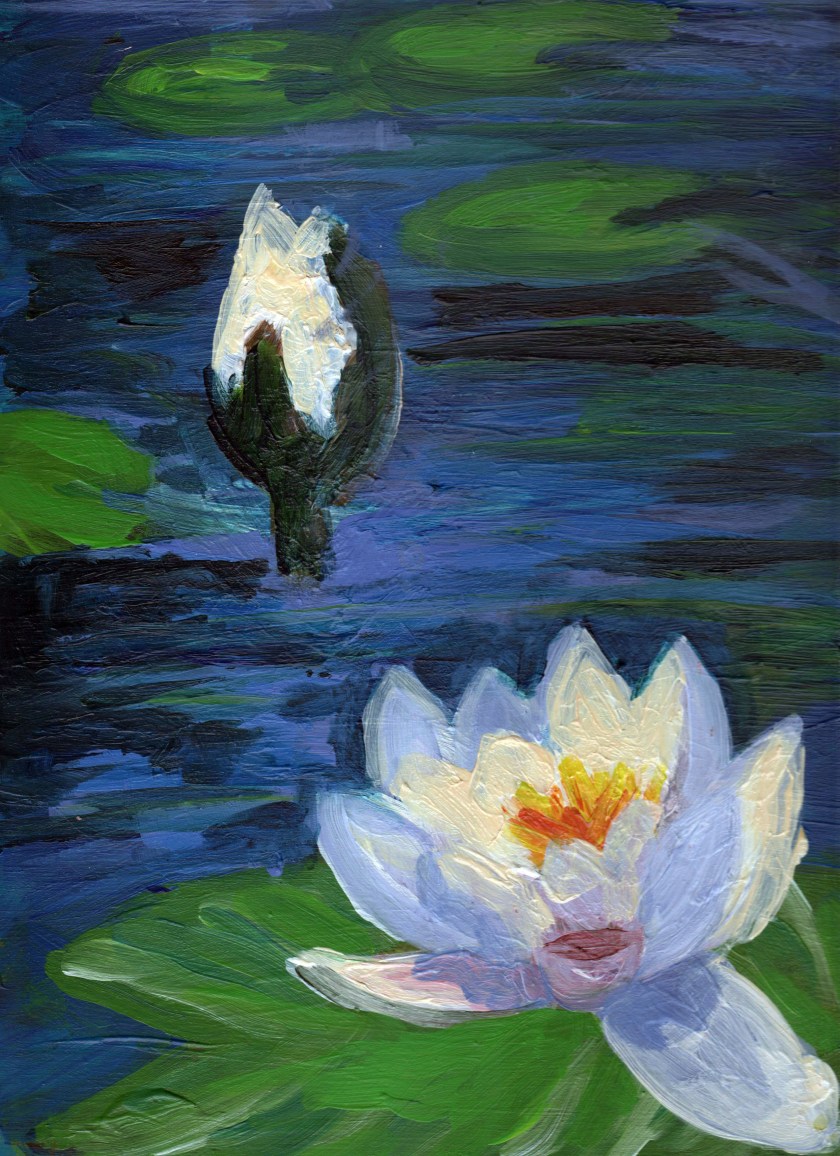
Hello, Friends, I will be updating my Art of Schmidt web site every week with new images of my art work which is available for sale on Etsy. I’ve been looking at my postings and realizing that many of the paintings I have posted on this site have already sold, and therefore do not represent the variety of items that I now have for sale on my commerce sites, Etsy, and Red Bubble. Here are some new acrylic paintings which are now available for sale on my Etsy web site. My art work is also available on my Red Bubble site as mugs, art prints, iPhone cases and more! Here is a link to the Red Bubble web site: https://www.redbubble.com/people/jsjschmidt2017?ref=account-nav-dropdown&asc=u.

Thanks for stopping by!


White Water Lilies

Acrylic on Masonite Board

9 x 12 inches

$150

Available for Sale on http://www.etsy.com/shop/artofschmidtWhite Waterlillies.jpeg


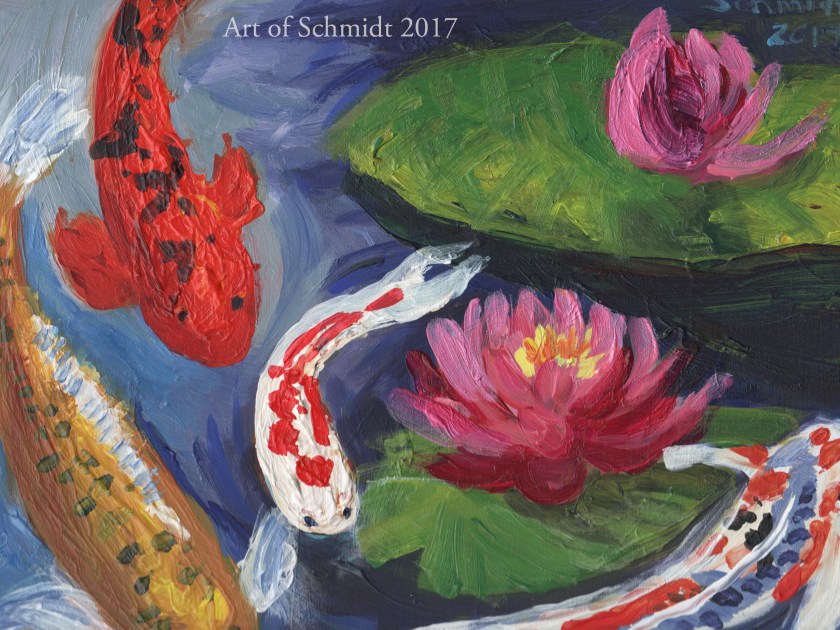
Waterlillies and Koi Fish

Splash!

Acrylic on Masonite Board

9x 12 inches

$150

Available for sale on http://www.etsy.com/shop/artofschmidt

What’s New?

Hello Friends,

Here is a new acrylic painting I just completed this week of a koi pond with water lilies. It is based on photos that I took of a nearby water lily pond center called Lilly Pons in Adamstown, MD which sells koi fish and water gardens. The center has an extensive water garden on site with various types of waterlilies and koi fish. Since I love the color, this subject seemed like the perfect choice! The painting is now for sale on my Etsy shop at https://www.etsy.com/your/shops/ArtofSchmidt.

Waterlillies and Koi Fish

Small Gems: Paintings in Progress

Hello Friends,

Here are some of my new acrylic paintings featuring my Autumn series which I plan to exhibit at the Frederick Coffee Company in Frederick, MD as Artist of the Month in October of  2017. I will be selling these miniature canvases for $35 each, and I will also have some larger paintings for sale. Pictured are some completed canvases and some three value sketches and color sketches to plan the other paintings which are

in progress. Here is a link to the Frederick Coffee Company website if you would like to find out more about the venue. The coffee house has a variety of coffees, teas, sandwiches, and salads and features live music on selected days of the week. http://fredcoffeeco.com/. If you would like to join my Mail Chimp email list to learn more about this event and more art shows like it, please email me at jsjschmidt2@gmail.com and I will gladly add your email address to my Mail Chimp account. Thanks for looking!