What to do when a painting goes wrong?

What to Do When a Painting Goes Wrong


Hello Friends, family, and fans,

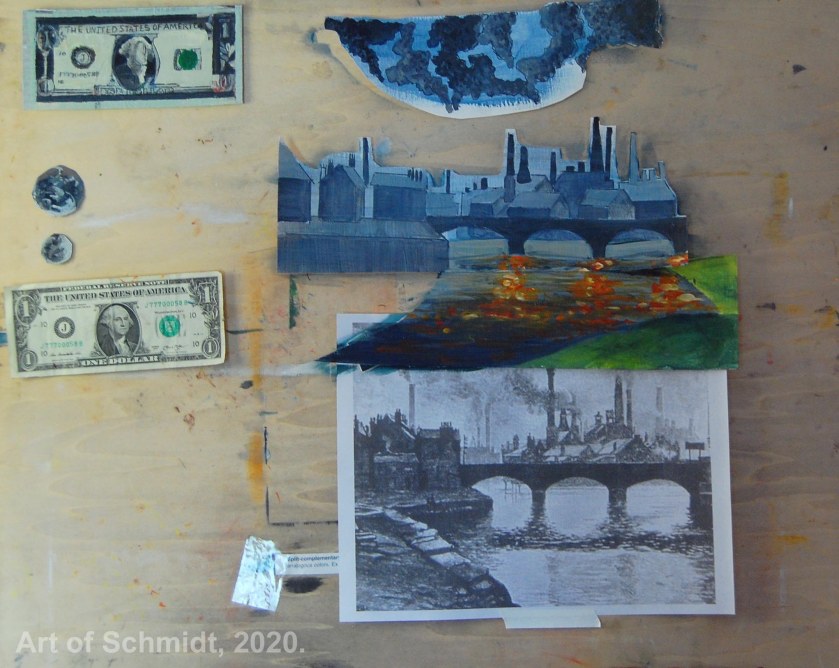
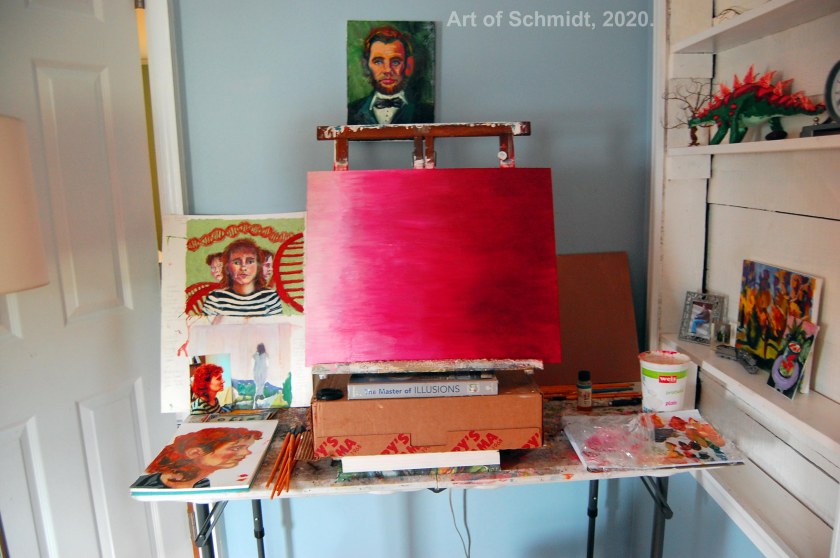
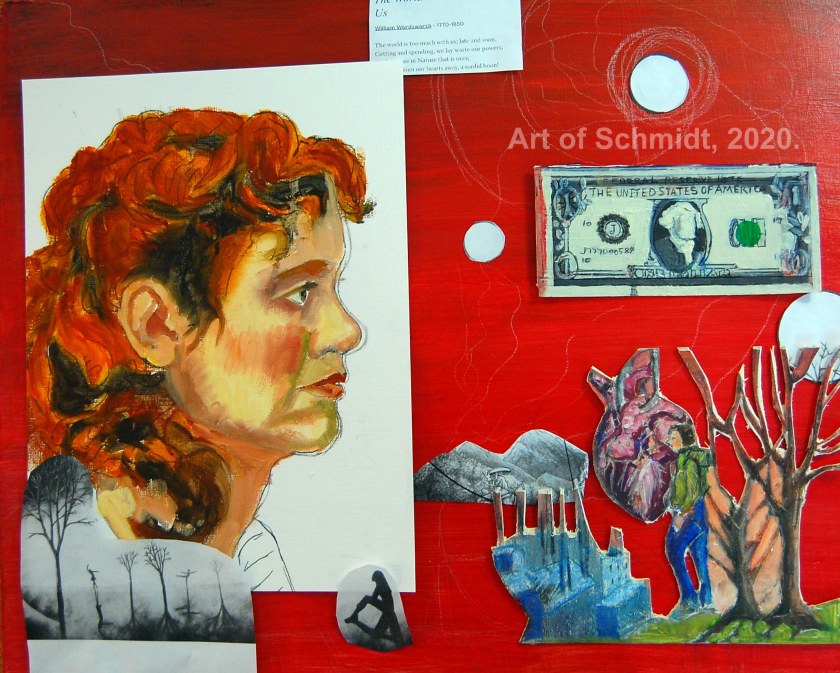
I am so glad you stopped by to read my post today!  While this blog post is a recycled one written several years ago, the artwork I am posting is completely new, and part of my new art portfolio. This week I am featuring the painting process of my latest work in progress, The Almighty Dollar. Its a mixed media collage which illustrates the poem, The World is Too Much with Us, written in 1807,The world is too much with us, flatStage 1, Almighty dollar, flatMasonite board. stage 2, flatcomposition stage 3, flat by William Wordsworth. Although this poem was written in the 19th century, the theme of capitalism and greed is still relevant today. I think that’s what makes great art and poetry, something is written or painted in the past, which still resonates today! If you are working on an artwork or other creative project and feel stuck, I hope this post will help give you encouragement to carry on, or just start over again.
If you are a creative type or if you like to make things, you have probably encountered the moment when the finished product you imagined, does not live up to your expectations. Creative types such as musicians, composers, producers, dancers, writers, artists, photographers, cooks, and makers of all types, can probably tell you what it feels like to hit a wall with a project, and how it felt, and what they did to navigate that feeling of utter frustration. As an artist, I have experienced this frustration more times than I can count. Some paintings and drawings are simply learning projects and are difficult to salvage, while others can be fixed. I know it’s been said that you learn more from your mistakes than your successes, but when I get to a point in a painting or drawing and I realize that the painting or drawing doesn’t look right, it can be really frustrating. I start doubting myself, feel like giving up, or doing something that I am not good at, like cooking or cleaning because I know that I am not good at these things, so my expectations of success in these domains are much lower than for painting or drawing since I have no training in cookery or housekeeping.  Since I know I am not a good cook, if it doesn’t turn out so well, it’s a waste of ingredients but I don’t feel as emotionally attached to the outcome as I would to a painting or drawing.

I recently read a forum question on the website, Wet Canvas.com, and the question of the day was,” When should I stop working on a painting? I was intrigued by the question, and wondered how other artists dealt with paintings that can “look like a dog’s breakfast.” I read about a variety of solutions suggested by artists who had hit the wall creatively. Some were familiar to me, like my tendency to put the painting away and stop looking at it for a few days, weeks, months, or even longer. Others were not as familiar such as putting the painting somewhere where you can see it, such as on an easel in a living room, and then taking time to look at it from time to time to diagnose the problem. Another favorite technique is to write a list of things I want to change in the painting, be it the drawing, colors, value, edges, etc.  In my case, some of the artwork I have abandoned was started about two years ago, and I am just now starting to look at the sketches and Photoshop files.

This week I took some time to work some more on my acrylic painting, Waiting: Creative Block. I realized that there were several things bothering me about it. The colors and values, and the composition were some of the biggest glaring errors.  I am realizing they there are many reasons why this painting series of poetry illustration works have been abandoned. One of which was being too busy with other things to give the series the proper amount of time it requires to get things right, such as the composition and the drawing. Since I dropped out of the Social Work program at Frederick Community College, I do have more time to work on paintings. And since I have deliberately looked at my schedule e and started marking studio days on the calendar, I have more “intentional “time.
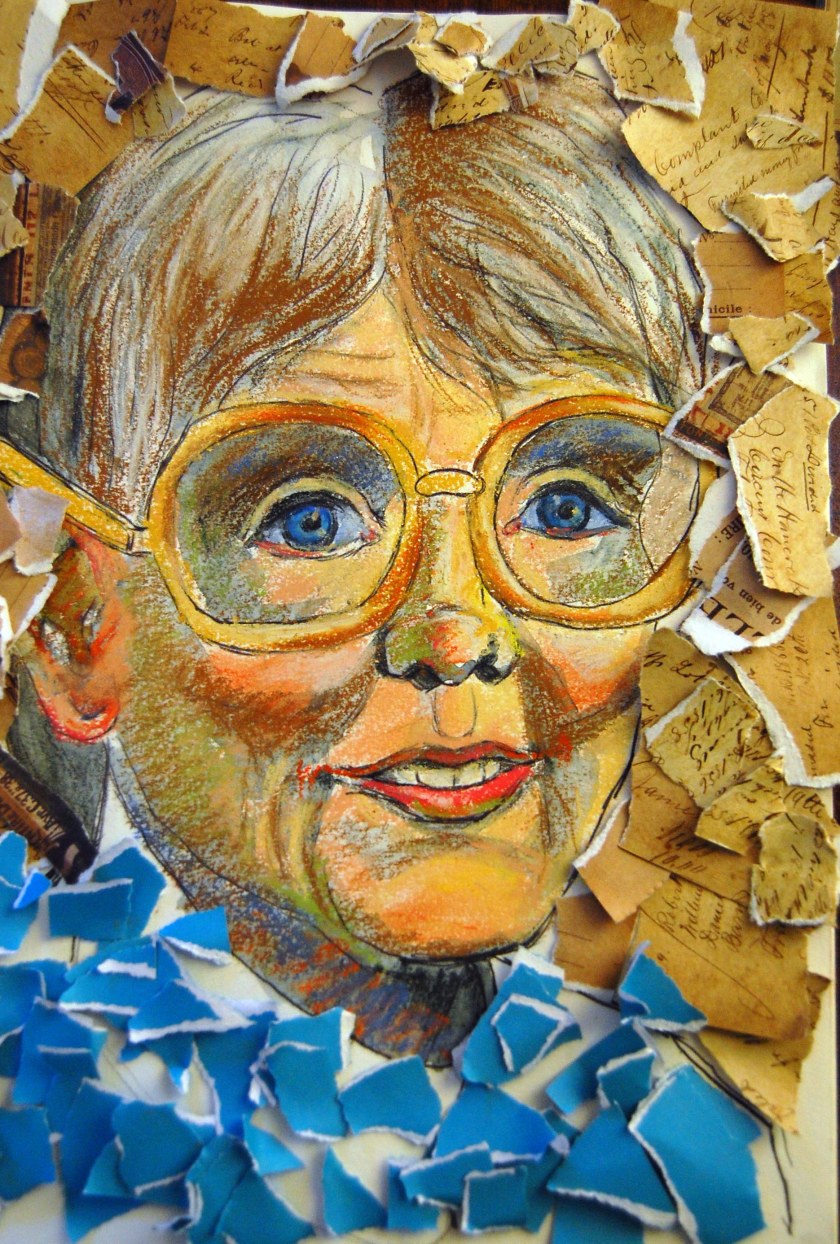
Mixed Media: A Portrait with collage and mixed media

mixed media collage
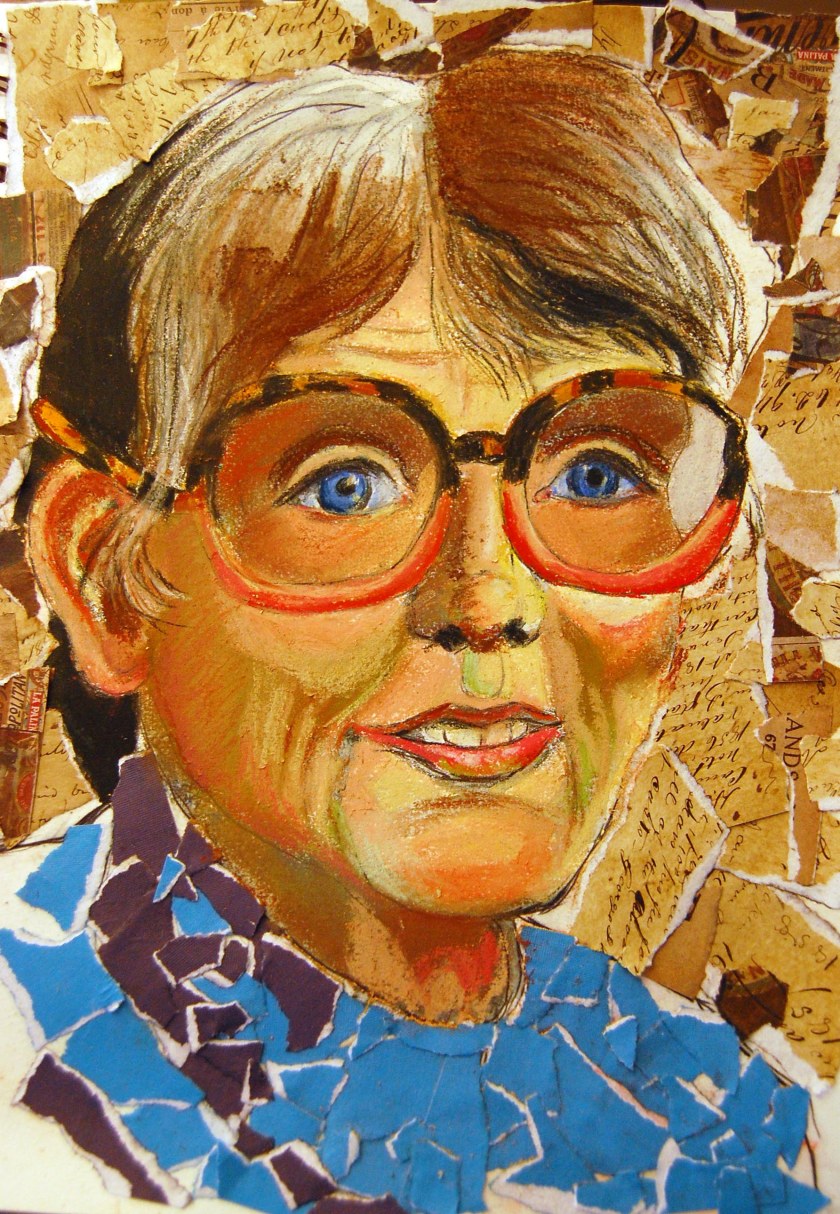
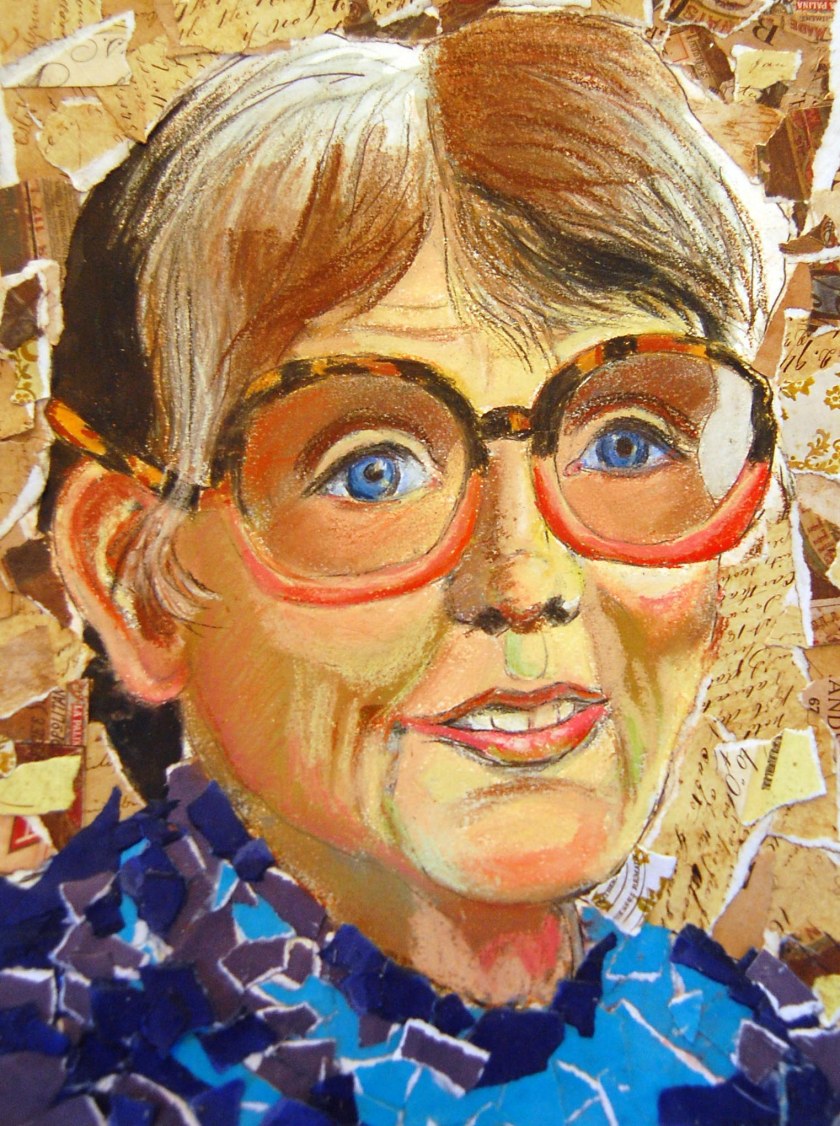
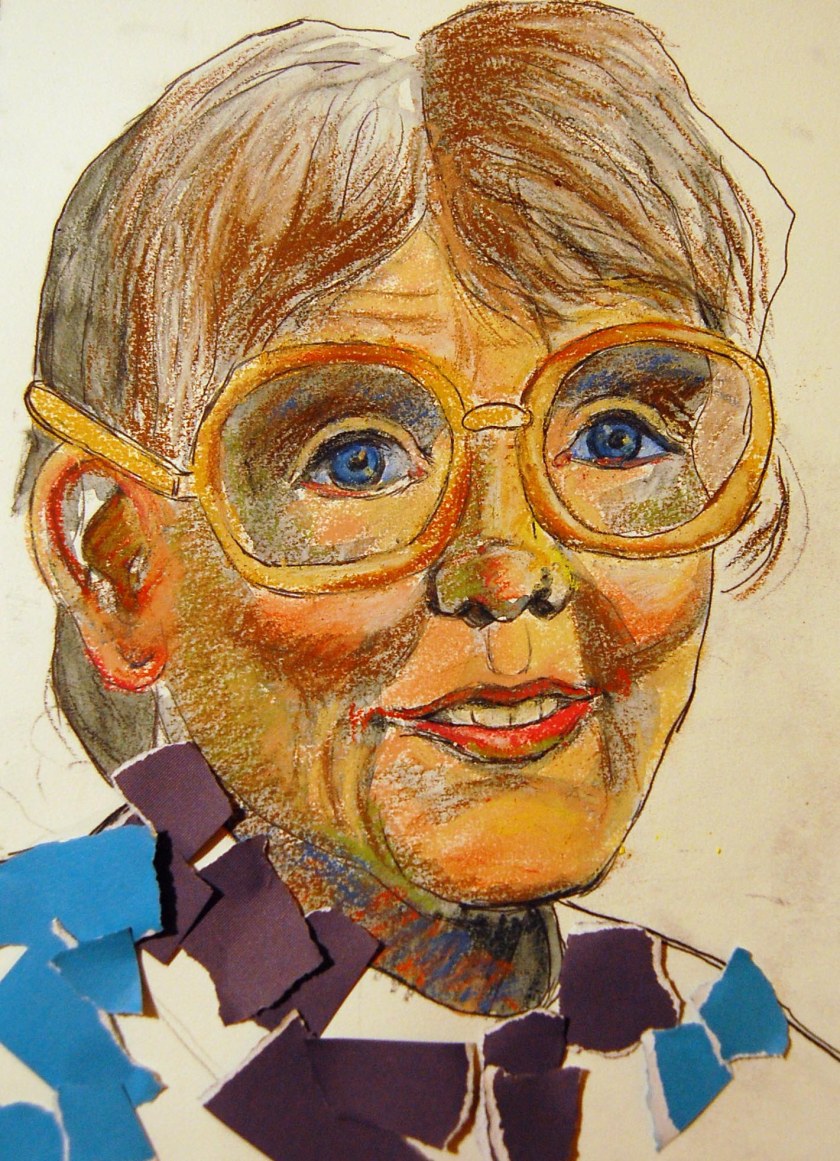
Portrait of my grandmother, Gladys, with soft pastels, watercolor pencil, and torn paper collage, stage 1.
mixed media portrait collage
Portrait of my grandmother, Gladys Carter, stage 2.
mixed media portrait collage
Portrait of my grandmother Gladys, stage 3.
Mixed media portrait collage
Portrait of my grandmother Gladys, stage 4.
book cover picture
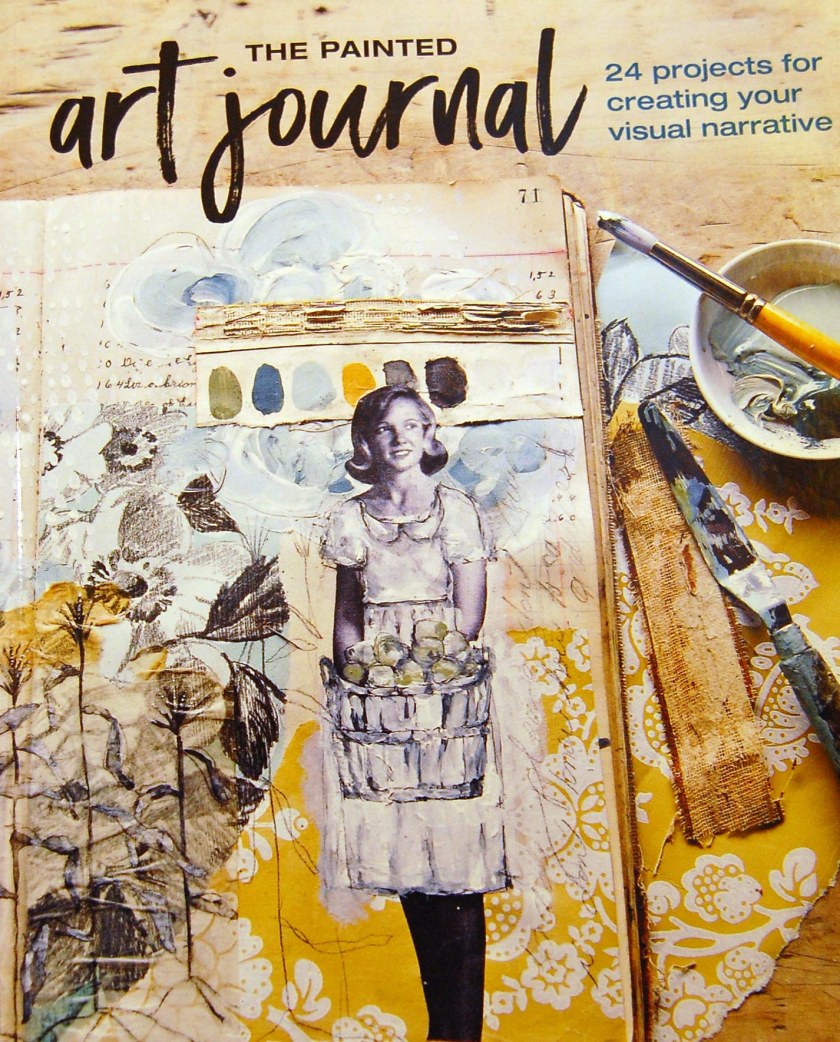
The Painted Art Journal, by Jeanne Oliver.
painted journal collage demonstration, flat
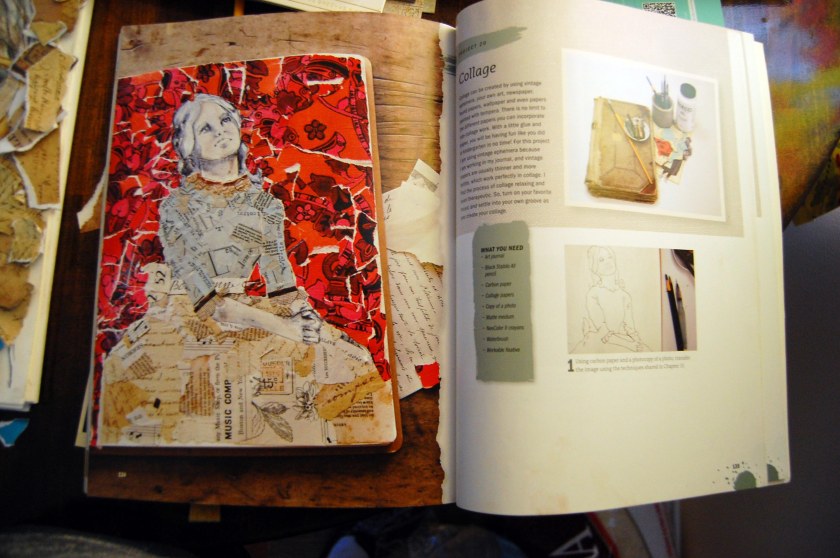
The Painted Art Journal, torn paper collage demonstration. 

Mixed media Explained: Part 2

Mixed media Explained: Part 2, Types of Mixed Media


Hello friends, family, and fans,

  • This week I am continuing to elaborate on the theme of mixed media art, and I will be highlighting specific types of mixed media art, such as sculpture, assemblage, and torn paper collage. Last week I covered a broad definition of mixed media art, and I also explored the historical roots of this art form, through the artwork of Pablo Picasso and Georges Braque. They began making cubist collage works in 1912, with a variety of materials including canvas and rope. (Source: Eapen, Boaz. 15 Inspiring Mixed Media Art Portfolios that You Must See, retrieved from November 12, 2019, pixpa.com.)


The following is a list of some frequently used types of mixed media art:

  • Sculpture: A sculpture can be made with a variety of materials; therefore, it can be classified as mixed media art. Some materials which can be used to create sculpture include wood, glass, wire, metal, or readymade objects, etc. To begin, you can start by making a base for your sculpture and then, incorporate other media to the piece such as paint. (Source: ibid.) While writing this blog post, I found a fascinating sculptor through an internet search, who specializes in fantastical animals with a surreal twist, named, Ellen Jewett. To see her work, go to my modern met website at https://mymodernmet.com/surreal-animal-sculptures-ellen-jewett/.
  • Collage: A collage can be defined as a base, or a surface such as wood, paper, stone, or anything which is adhered to another material such as paper or fabric. (Source: ibid.) You can use a variety of materials in a collage such as newspaper cuttings, photographs, ink, paint, magazine cuttings, fabric, etc. The artist, Romare Bearden (1911-1988), specialized in creating collages based on the African American narrative, using imagery from magazines, such as Look, Life, and Ebony. (Source: Romare Bearden Biography, (1911-1918), retrieved from,  https://www.biography.com/artist/romare-bearden
  • Assemblage: A close cousin to collage, assemblage has three-dimensional characteristics, which are composed in a new way to create a narrative. Readymade objects, such as children’s toys or items from the great outdoors, such as leaves or flowers can provide valuable fodder for this type of art. For instance, the artist, Joseph Cornell, (1903-1972) made assemblage boxes out of shadow boxes, photos, “Victorian bric-a-brac”, etc. He collected these items in junk shops throughout New York City and re-imagined these items to create artwork that expressed nostalgia. (Source: Wikipedia, Joseph Cornell, retrieved from https://en.wikipedia.org/wiki/Joseph_Cornell.)

With all of these options, it can be overwhelming to know where to begin your next project. As for myself, I like to look for supplies that are easy to find and relatively inexpensive. One good starting point for a mixed media project could be using paper as a surface or substrate. I have used Crescent cold press illustration board for my latest mixed media projects, which is a combination of cardboard and “100% cotton rag cold-press surface”. (Source: https://www.cheapjoes.com/crescent-no-310-illustration-boards.html#:)   My self-portrait pieces were made with a combination of wet and dry media such as acrylic paint, gouache, oil paint, and soft pastels to add texture and interest. There are many other ways to use paper as well in different types of mixed media projects such as torn paper collage, and printmaking, but this is just the tip of the iceberg. The possibilities are endless!

For example, below is a list of ways in which you can use paper in a mixed media project:

  • Printmaking: There are many types of printmaking such as linoleum block prints, silk-screen prints, and Gelli-plate printing. To make prints, you will need a surface on which you place or carve an image and then transfer it to your paper through various means. For instance, in linoleum block printing you can transfer your image on the block to the paper by applying ink to your design, and then pressing the block onto your paper to make a print. The supplies you will need may vary depending on what type of printmaking you choose to work with. To learn more, you can go to https://www.metmuseum.org/about-the-met/curatorial-departments/drawings-and-prints/materials-and-techniques/printmaking. (Source: The Beginner’s Guide to Making Mixed Media Art, 20 September 2018, retrieved from format.com).


The sky is the limit as far as what you can do here, although it’s a good idea to find out what the journal is made out of and what media it accepts, before attempting to paint in it. I recently obtained a Strathmore mixed media art journal from Amazon. It’s made of Bristol paper with a vellum finish. It’s designed to work well with dry media such as pencil, charcoal, and pastel. Or it can be used with pen and ink, marker, or college papers.

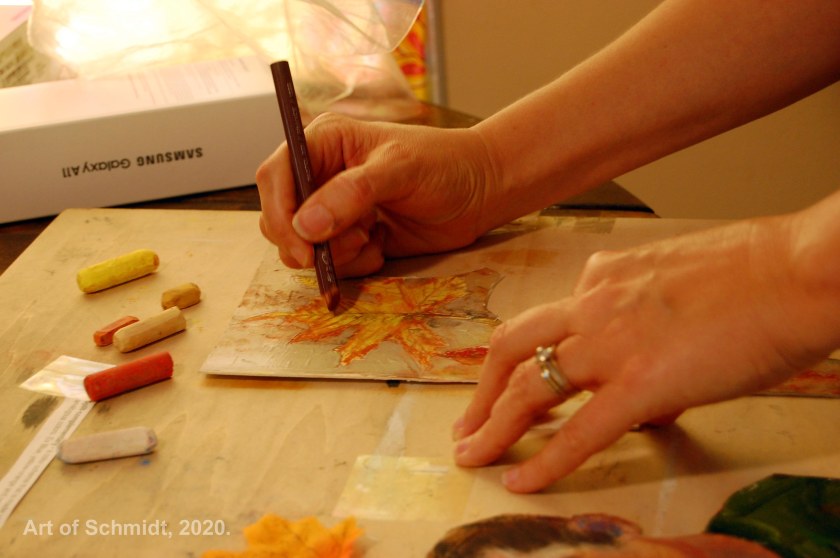
I’m hoping to use this journal to start some new projects from the Skillshare art classes I am taking online. Today, I tried my hand at the torn paper collage technique, and I used the tutorial by Jeanne Oliver provided in her book, The Painted Art Journal, which I highly recommend! My artwork was based on a family photo of my grandmother, Gladys Carter. Starting with a tracing of a sketch, I transferred the image to mixed media paper, using carbon paper and a pen. Then, I used a variety of different media here, with soft pastel, watercolor pencil, water, and torn papers affixed to the mixed media paper substrate. I’m hoping to post photos of this portrait project in next week’s blog post, I ran out of time today and had to go to work this afternoon. It’s a work in progress, and getting outside of my comfort zone to mix up all these different media types! That’s it for this week! Thanks for reading. Artist at work, with watermarkArtist at work, 2, with watermark, flatartist hands with watermark, flatThe World, composition, flatStudio space with watermark, flat

Mixed Media Art: Explained, Part 1

Mixed Media Art: Explained (A brief definition)


Hello friends, family, and fans,

Have you ever gone to an art gallery and observed a work of art that was labeled mixed media, and wondered what it meant? I know I have, and I have wondered, how might I incorporate these mediums in my artwork? This question was the catalyst for starting my new art series, Constructed Realities, which combines a variety of mediums including, gouache, soft pastel, acrylic, pencil, and oil paint with a cold press illustration board as a substrate. In some ways, my art is a mixture of mixed media and traditional techniques; because I use realism for the style, but I also combine it with a variety of media, rather than working on one media, such as in oil painting, as has been the traditional practice for painting.

Today, I am focusing on describing mixed media art, in terms of a broad definition, and more specifically to explain what I mean when I label my own art, mixed media. And now, I’d like to offer a brief definition of mixed media art. Mixed media is a type of art that doesn’t limit people who have limited experience with art skills such as drawing. (Source: Eapen, Boaz. 15 Inspiring Mixed Media Art Portfolios that You Must See, retrieved from November 12, 2019, www.pixpa.com.) Instead, it is an art form that is accessible to anyone, even beginners. (Source: ibid)  However, one caveat is that after you decide what type of mixed media art you want to focus on, you will need to develop some familiarity with specific processes and specific media, (Source: ibid), such as watercolor interact with other media.

Did you know that mixed media art has been around for about 100 years? I didn’t until I started researching this subject in more detail. Some historical examples of mixed media art include the artwork of the cubist artists, Pablo Picasso and Georges Braque, his cohort. About 1912, they began to incorporate collages into their artwork. (Source: ibid) In addition, “Surrealists, abstract expressionists, pop artists and brit artists” followed suit, and added mixed media to their repertoire of art-making. (Source: ibid)

In recent years, there has been an explosion of mixed media artwork on the internet on websites such as Youtube and Cloth Paper Scissors, (which also had a periodical format with artwork featuring a variety of artists), and in art technique books, by authors/artists such as, Pam Carriker, Mixed Media Portraits (2015) and Jean Oliver, The Painted Journal (2018). These artists have used a combination of wet and dry media, charcoal and paint, and or gesso, in their portraits. On youtube, you can find art journaling technique video demonstrations by artists such as Dina Wakely and one of my favorite artists and teachers, Julie Fan Fei Balzer.  It’s a fun and free way to learn new art techniques from the comfort of your own home, which is really important these days, since so many colleges and art centers are closed, due to the pandemic.

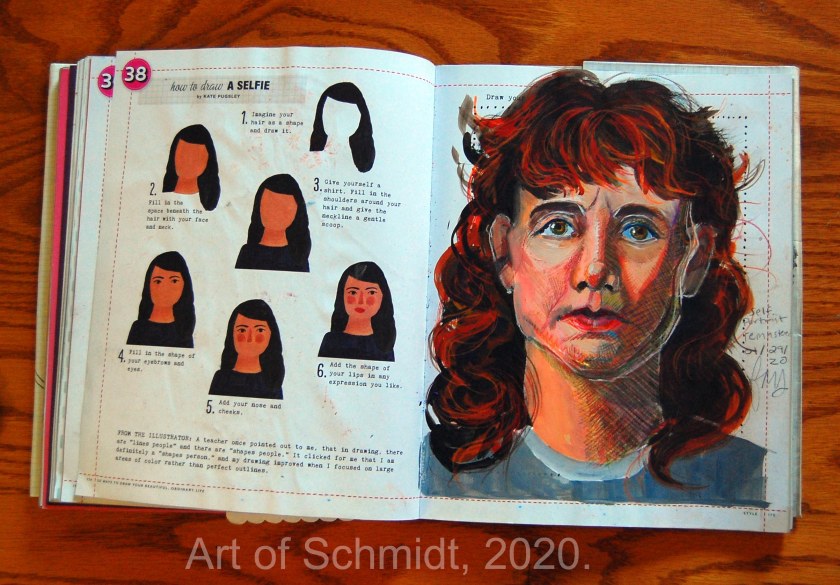
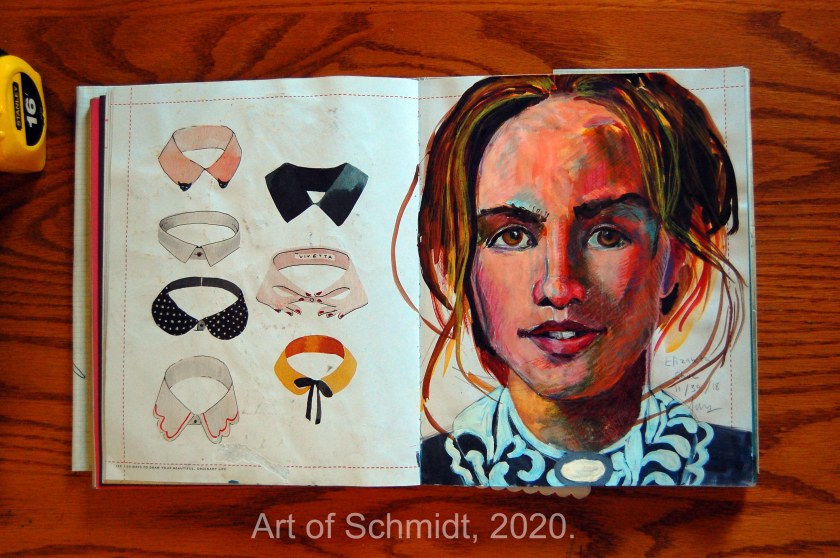
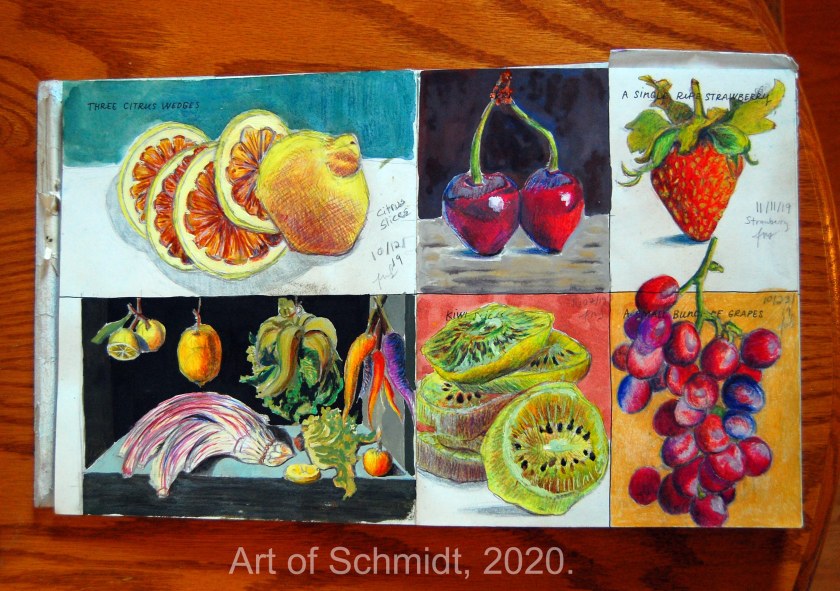
I started out my mixed media art journey by working in a sketchbook to conquer my fears about mixed media, and it gave me the courage to explore mixed media in this new series. There is little to lose if you don’t like the artwork, and you can simply turn the page, rather than worry about ruining an expensive art canvas. Creating artwork with mixed media techniques is also helpful if you find yourself caught in the dreaded state of mind called the artist’s block, where you know you want to create something but feel stale in your chosen medium and want to learn something new and feel excited about making art again. My favorite website for looking up art tutorials is youtube. If you have a specific artist you are looking for, you can search for them, such as Pam CarrikerCS Lewis with watermark, flatEmily Dickinson portrait, flatmixed media self-portrait sketch, flatElizabeth Shue sketch, flatstill life sketches, flatunfinished sketches, flat, who has many instructional videos. And to learn more about art journals, visit: https://mymodernmet.com/art-journal-ideas/, to read the article, “How to Combine Drawing and Writing into Deeply Personal Art Journals”, by Sarah Barnes, October 11, 2017. Thanks for stopping by!
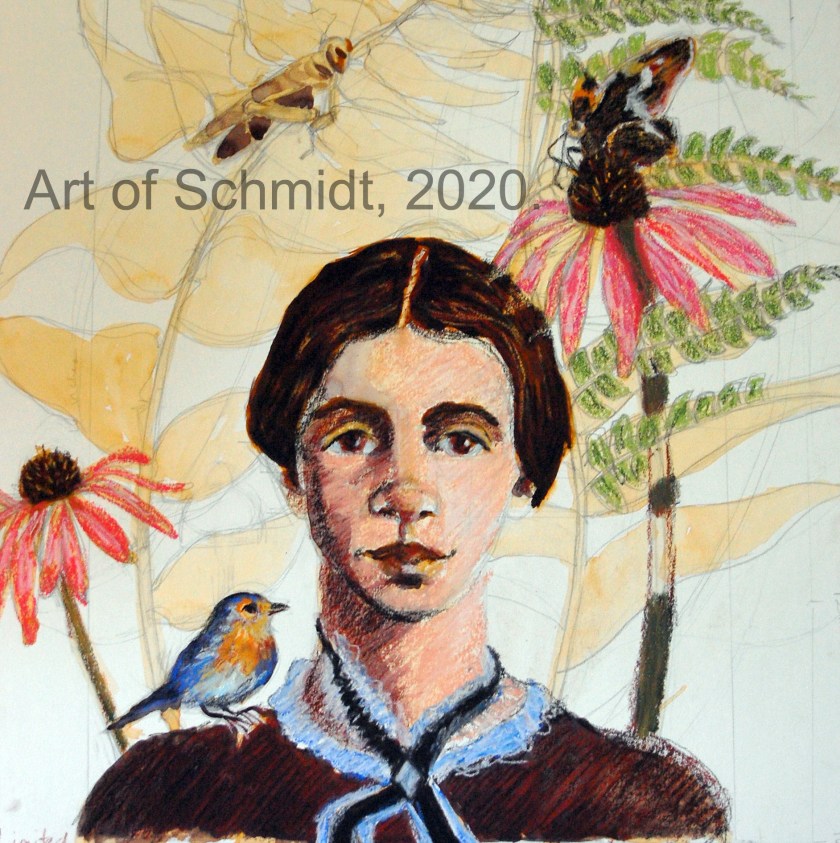
Biographical Portraits in a Mixed Media style

Hello Friends, family, and fans,

This week I am going in a slightly different direction than last week, but I haven’t given up on my poetry inspired work. I have started a new series of portraits based on the lives of writers, poets, and others to try something a little new but somewhat related to the poetry series.  Next to working on artwork, my other favorite hobby is to read biographies of people I admire, such as Emily Dickinson, Julia Child, and others. So I thought,

Emily Disckinson, flat, portrait, 1_edited-1
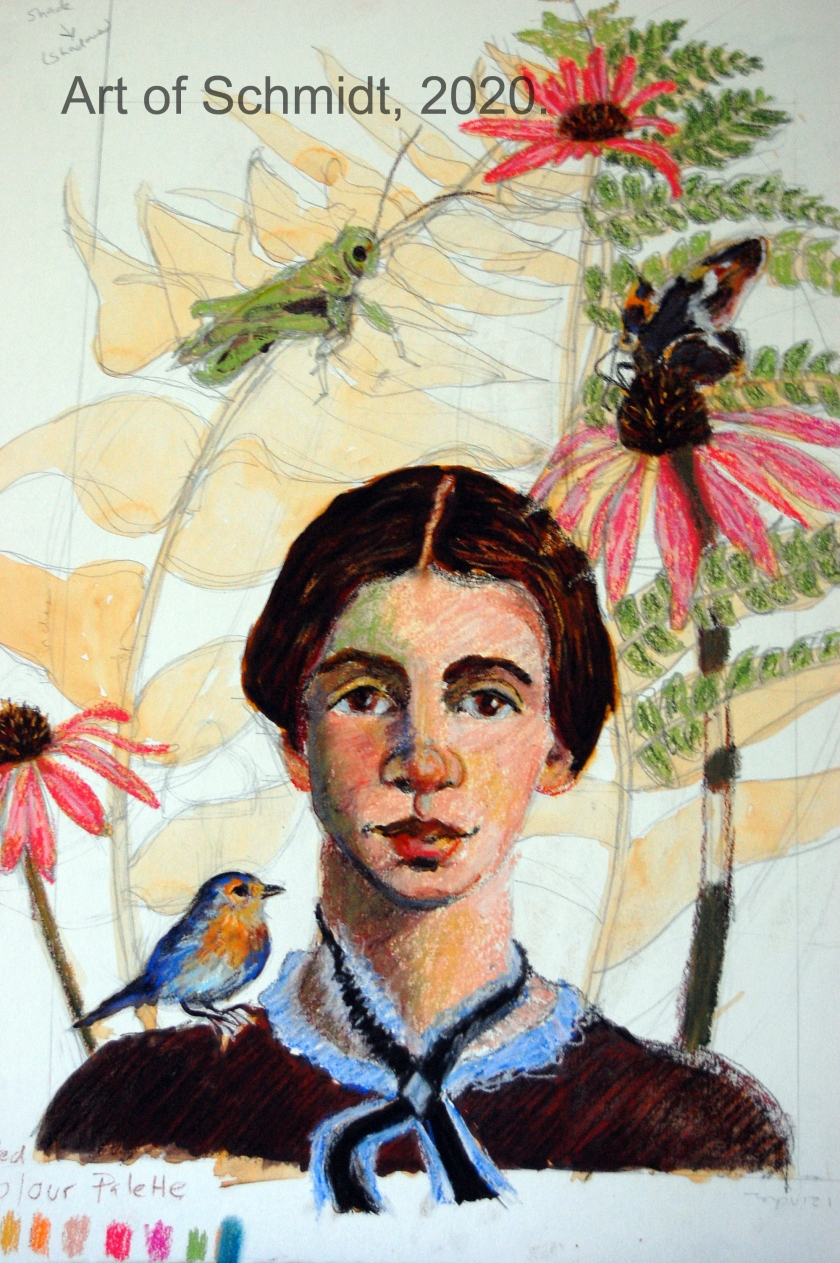
At home in Nature, Mixed Media, 2020, Jodie Schmidt. 
Emily Dickinson, portriait2, flat_edited-1
In this stage, I continued to add more details and some limited color to Emily Dickinson’s face, the songbird, and the echinacea flowers. 
CS Lewis portrait 1, flat
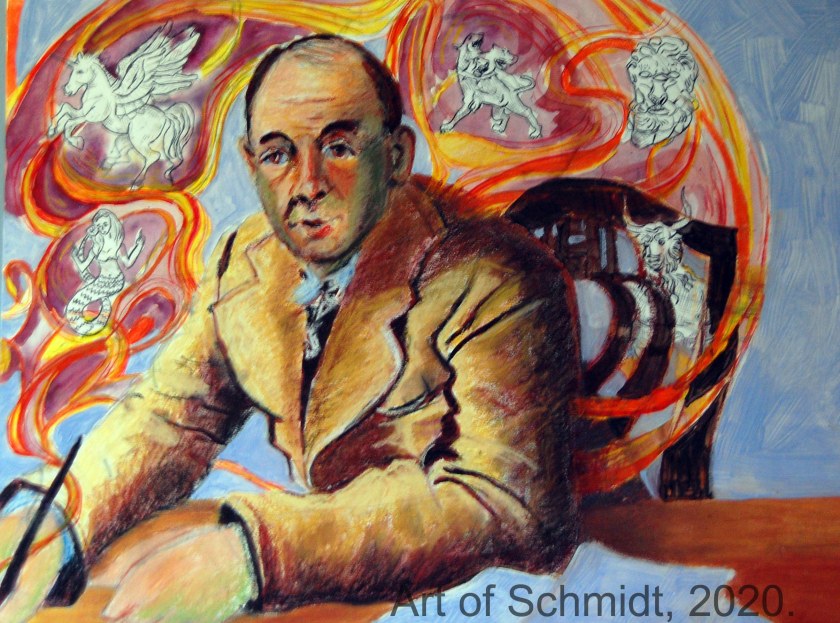
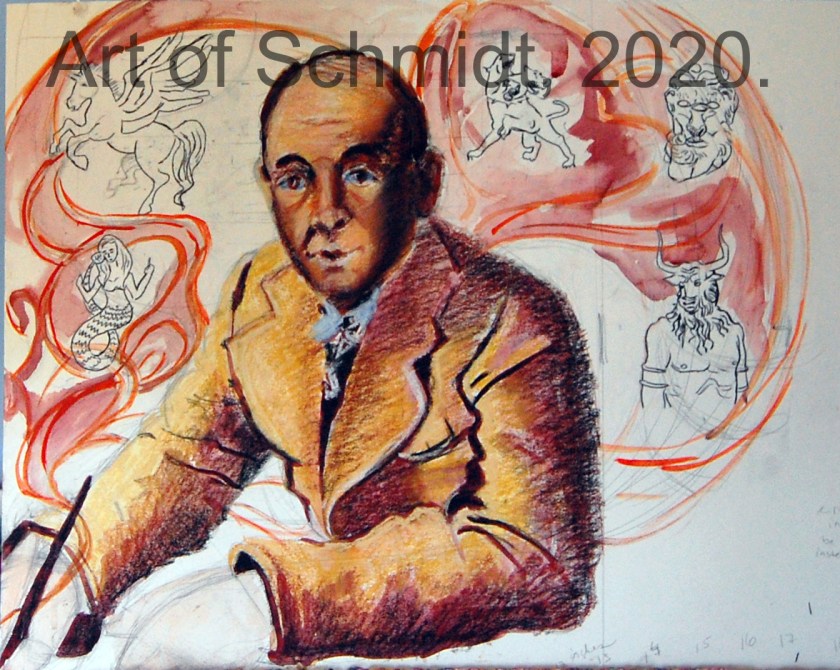
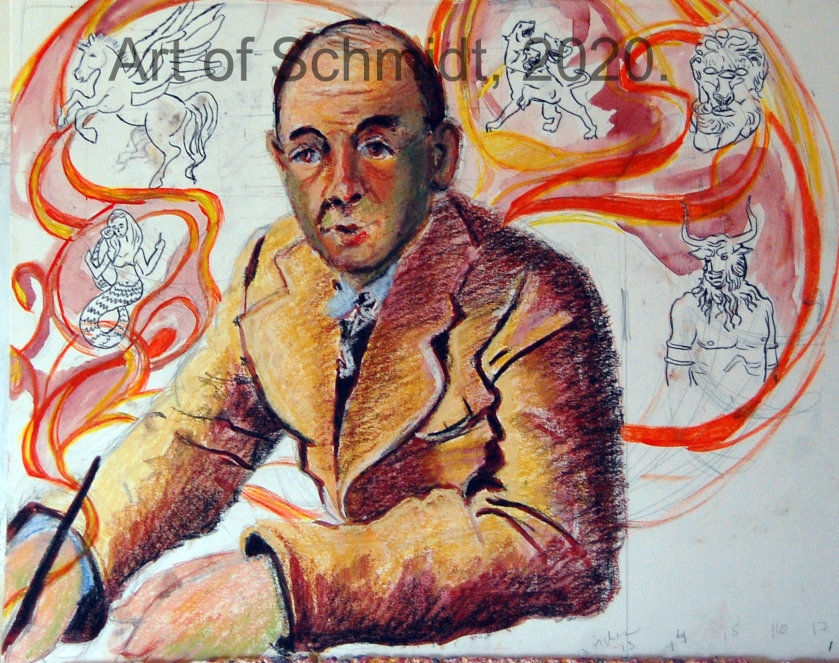
The fire of creativity,  Mixed media, 2020, Jodie Schmidt. 
CS Lewis 2 , flat, portrait_edited-1
On further review, I decided that the shadows had gotten too dark and overpowering. So I toned them down with some soft pastels to modify the tones. I struggled to figure out how best to represent this abstract concept of creativity and finally decided on using fire. I tried to combine a variety of sources, with some stock photos of greek mythology. This piece will be much larger when I am done since I plan to make it a triptych. 

what not combine my love of art and reading biographies?

Like the poetry series, the work focuses on the portrait and symbolic imagery to help describe the content of the piece. Similarly, I am working in a mixed media style with these portraits, beginning with a pencil sketch and then creating a tonal under painting in gouache. Finally, I finish it off with a more detailed limited palette with soft pastels on Illustration board. My goal is to make at least 10 poetry series portraits and 10 biographical portraits in preparation for applying to graduate school to get my master’s in fine art.

Today I wanted to show you my work process so far with these new portraits. The first one is a sketch of Emily Dickinson. Much has been illustrated regarding her and her poetry, but I wanted to show a different aspect of her personality and that was that she had a passion for plants and nature, even keeping a personal collection of plants in her home and a garden she tended frequently. It should also be noted that many of her poems are about nature, such as storms or sunrises, and so perhaps in some circuitous way, this painting is also about her poetry. To learn more about her passion for plants visit: https://www.emilydickinsonmuseum.org/emily-dickinson/biography/special-topics/emily-dickinson-and-gardening/.

My second portrait is about one of my favorite writers who wrote the beloved Chronicles of Narnia series, with hints of Greek mythology and even an allegory of the creation story in the book, The Magician’s Nephew. I wanted to make a portrait that showed the creative process of Lewis’s writing and the flow of new ideas. I likened creativity as fire and used that as a way to contain the various characters concerned in these chronicles of Narnia books.

This piece was closer to home for me because although I do love nature and being out in it, I feel that creativity is a large part of me, and I would feel empty without it, I think. It is good to remember that there are rewards to creativity and making things, especially when paintings don’t turn out so well, which I experienced yesterday when I was trying to complete a painting that has been languishing in my studio. Needless to say, it did not go well. And instead of calling it a loss and going to do something else, to give myself time to think about what I didn’t like about the painting, I just kept adding different mediums to the dried acrylic paint, to see what would happen. The lesson here was, paint mindfully, and not mindlessly. Thanks for stopping by!

Constructed Realities: Finishing unfinished work

When I started this new mixed-media series, which is based on poetry quotes, I was brimming with excitement and energy. I was on a roll, reading poems, writing notes, making sketches,  and photo collages in Photoshop.  Somehow though, about mid-way through the process, difficulties in composition and drawing issues in my sketches began to rear their ugly heads. In some instances, I got stuck and was unable to move forward. Some works were abandoned, while I took a break and started new works. Now, I have several unfinished pieces in progress, and I am trying to find motivation and energy to bring them to a conclusion. So, my new goal is to complete one painting a week to keep the momentum up, especially focusing on

The Dream of Time travel, with watermark
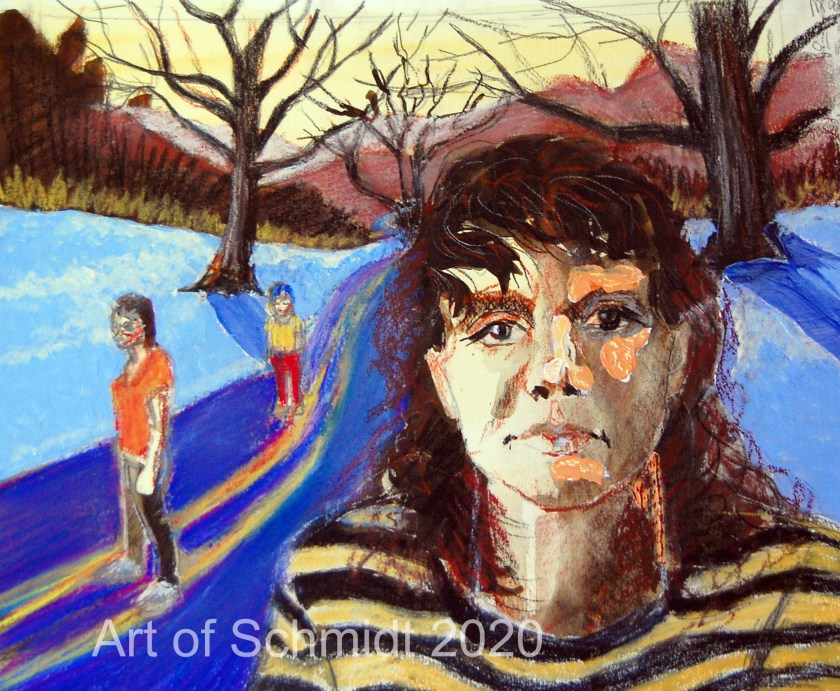
This artwork was inspired by a  quote from Mary Oliver, “Sometimes the desire to be lost again, as long ago, comes over me like a vapor.” 

those that have been languishing in my art studio. Why is it so easy to begin a new project, but difficult to finish it?


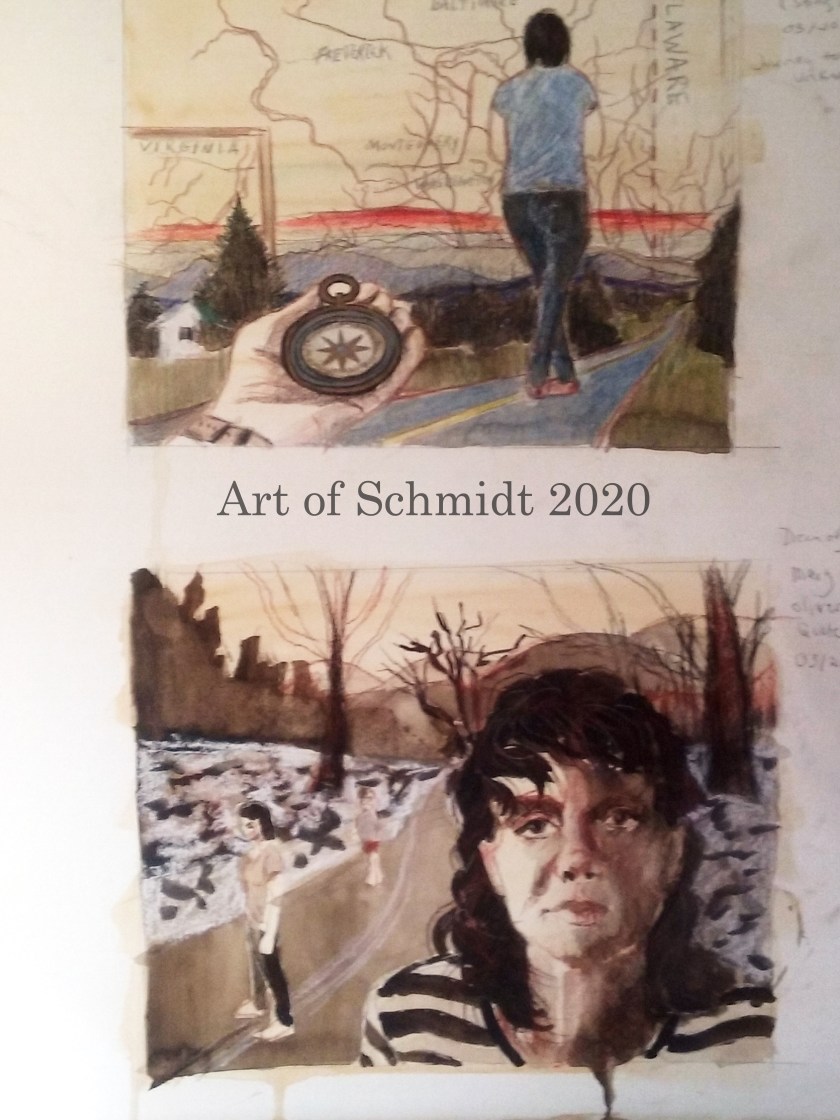
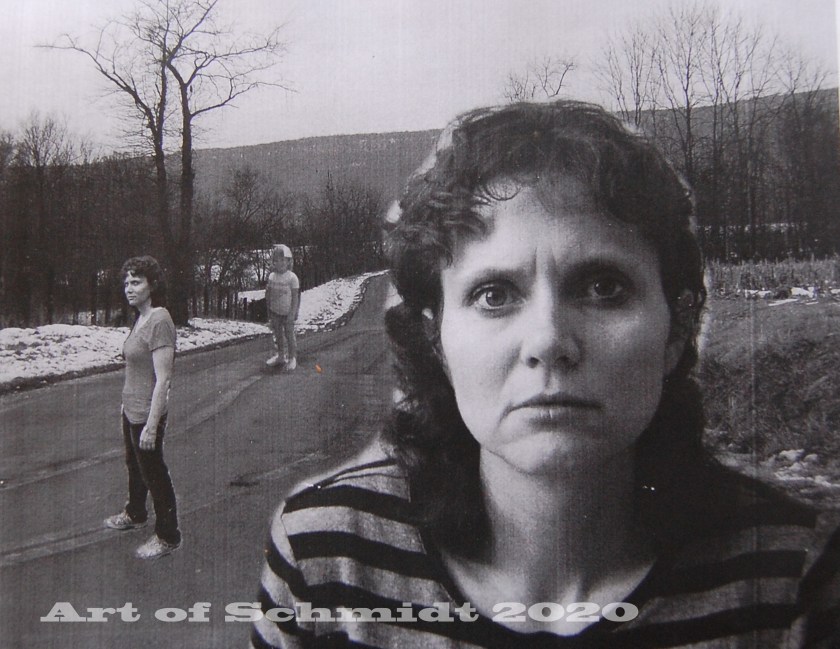
To that end, I am featuring a new work this week, focused on the theme of time travel. It has a bit of a surrealist tone to it with the theme of wishing I could go back in time to happier periods in my life, or at least, that is how I remember them. To represent this concept, I have included three self-portraits from different times in my life composed in a winter landscape. Time travel is something I used to be quite interested in as a child, during the 1980s. Popular books and films featured this concept such as Back to the Future, with Michael J. Fox,  Somewhere in Time, featuring Christopher Reeve. I also read books about this topic, such as the book, The Hunky Dory Dairy (1986), written by Anne Lindbergh, in which a young girl is transported from the 1980s to the nineteenth century one Saturday morning on an errand to fetch milk and a newspaper.

Constructed Realities: Part 3, A Focus on My Childhood

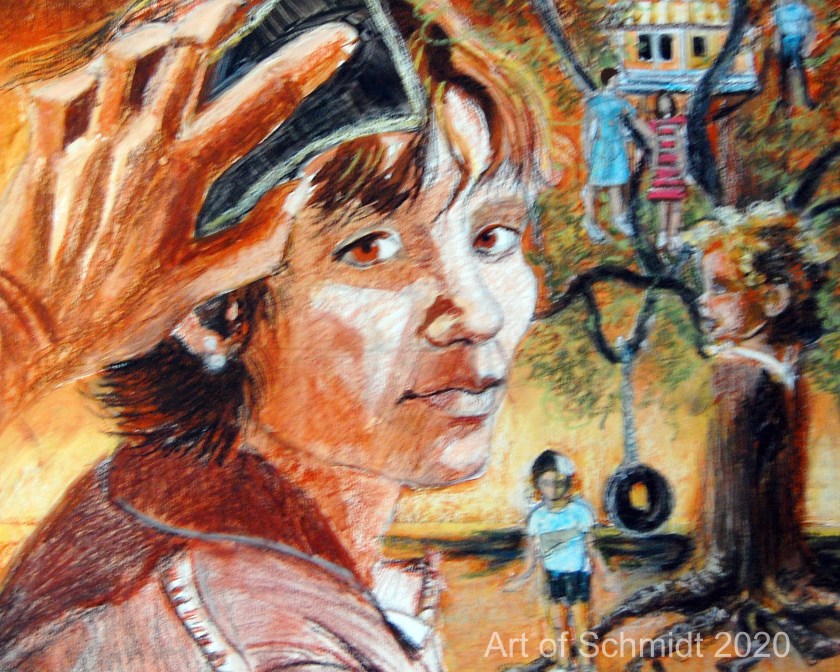
I am slowly making progress toward my goal of making 20 new artworks based on poetry quotes. When complete, I am hoping to submit them as a portfolio to apply to graduate school for a masters in fine art, so I can teach college-level art classes.  Over the past few weeks, I have been noticing a thread of common themes, one of which is my childhood. For some its a time of nostalgia, and for others, something to forget. For me, its a mixed bag, and the few memories I have from early childhood are fragmented, with few details. I took inspiration for this piece from many personal photos and from Billy Collin’s poem, Forgetfulness. The piece was created in stages with gouache sepia-toned paints, acrylic paints, gesso, and soft pastel with a limited color palette.

Childhood Collage memory loss, watermark
Childhood Memory Loss, Gouache and soft pastel, and acrylic paint, 16 x 13 inches, Jodie Schmidt, 2020. 

I took additional inspiration from this artwork by searching for poems written about the subject of forgetfulness. I found this gem of a quote from Billy Collin’s poem, “Forgetfulness,” “As if one by one, the memories you used to harbor decided to retire to the southern hemisphere of the brain, to a little fishing village with no phones.” Though the poem does not specifically address the issue of childhood amnesia, I felt it captured the feeling that memories are unstable and sometimes inaccessible.

I can remember small details, like elementary school book fairs, and my love of reading, library visits with my father, and being outdoors a lot on my favorite tire swing. However, more specific details have been more difficult to access, such as specific memories of how I got along with my sisters, who were many years older. It’s as if a giant hand has wiped out these memories, and without the aid of family photos and my mother’s memories, I would really be at a loss. All of this inspired me to make a pastel and gouache collage based on family photos of things I can no longer remember. This series has been a marathon, and a mirror, endless practice, mistakes, and setbacks. And all the while, it’s holding up a mirror to all of the weaknesses I have as an artist, especially in figure drawing and composition. How I wish I had paid more attention to figure drawing class as an art student! So, whatever the outcome of this series might be, getting into graduate school or not, it has been a journey chock full of lessons and opportunities to grow as an artist. Thanks for reading! 

Constructed realities: Part 2, Taking stock of my progress.

Hello Friends, family, and fans, At long last, I am posting some progress photos of my series, Constructed realities. They are still mostly in the phase 2 stage of color sketches, but they are coming along. So many things seem to get in the way of making time for art, I have got to start making this more of a priority. I often wonder how other creative types, such as Jane Austen, made time to write so prodigiously despite overwhelming household chores that were required during the 19th century in a family without servants or modern conveniences. Even when she was dying she managed to crank out a new book, Sanitation, which was left unfinished because of her death.

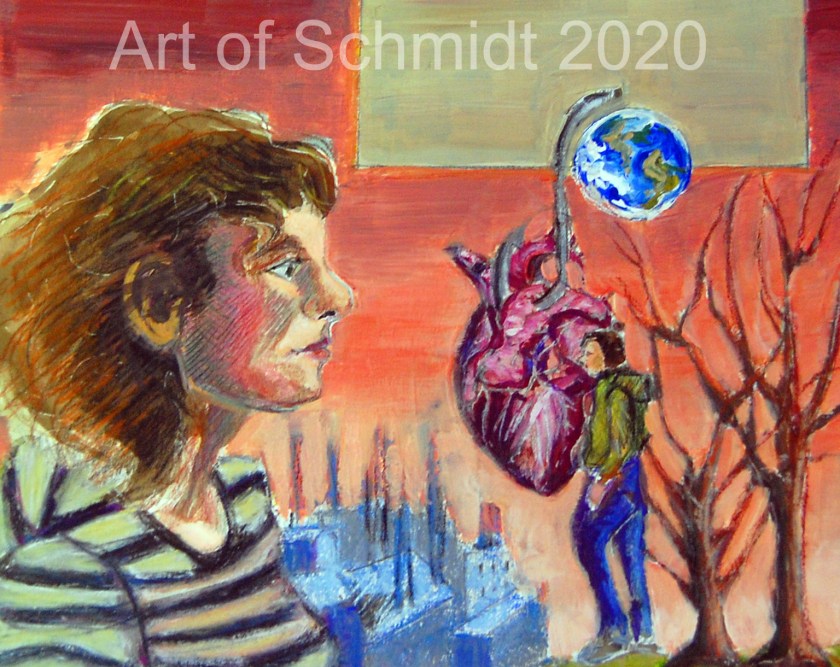
The world is too much with us, with watermark
This poem is inspired by a poem by William Wordsworth, entitled The World is too Much with us, about the dangers of industrialization and how we may lose our connection with nature, and eventually with ourselves, due to greed. “The world is too much with us; late and soon, Getting and spending, we lay waste our powers,;-Little we see in nature that is ours; We have given our souls away, a sordid boon! Wordsworth
The Dream of Time travel
Here is another mixed media piece in progress. It’s based on a fantasy I have about going back to being a child, as represented by the multiple figures that get smaller as you follow the path. Sometimes adulting is just too hard, and I long for carefree days full of energy, health, and creativity. Here is a quote from a writer Mary Oliver which nicely sums up this idea: “Sometimes the desire to be lost again, as long ago, comes over me like a vapor.” Mary Oliver
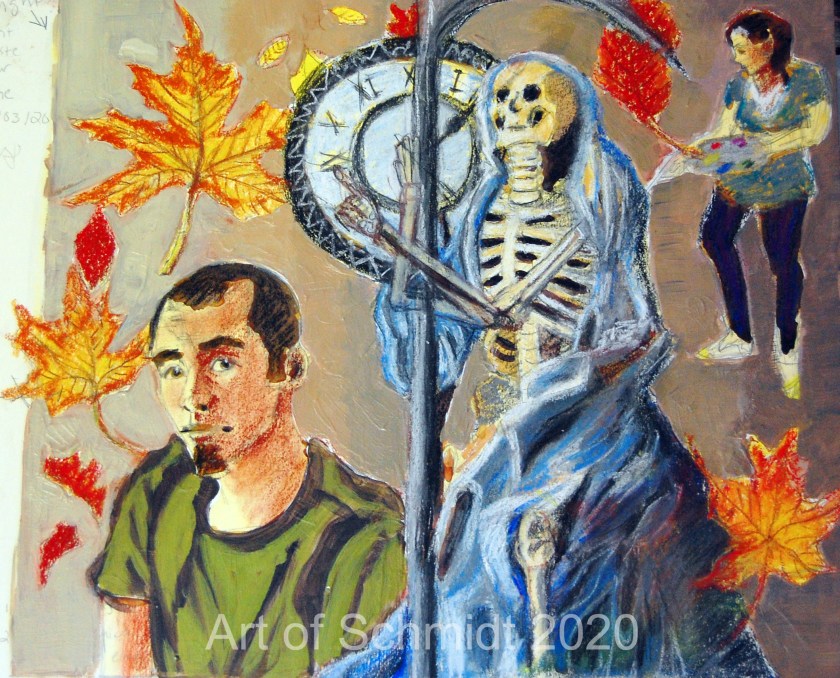
Gather Ye Rosebuds
This is an unfinished piece about the fleeting nature of time and youth. I have used several symbols to illustrate this, such as the clock and the grim reaper. The other supporting characters are myself and my husband, back when we were about 12 years younger. It’s about not letting too much time pass before you make important decisions. For us it was about getting married. The poem which inspired this piece states: “Gather ye rosebuds while ye may, Old time is still a-flying, And this same flower that smiles today Tomorrow will be dying.” Robert Herrick, To the Virgins, Make Much of Time.
Anxiety collage, with green paint
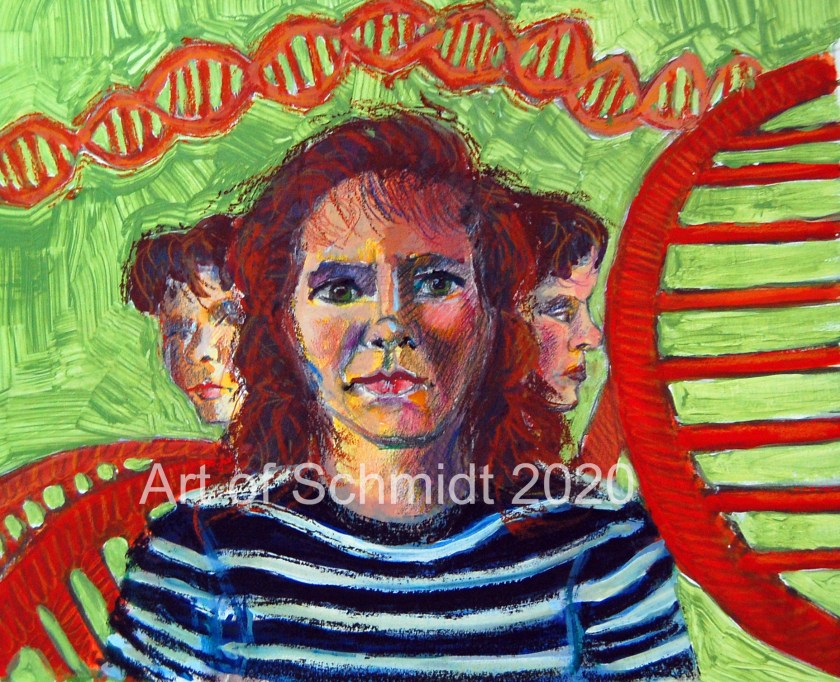
This piece is about emotionality, and especially about anxiety. I used bright contrasting colors here to try and emphasize the jarring and explosive nature of anxiety and symptoms associated with it, which can easily turn your world upside down, difficulty breathing, making decisions, sleeping, avoidance behaviors, etc. Its a subject close to my heart, because I suffer from generalized anxiety disorder and have had to work very hard to not let it take over my life. Several of my family members have it too, hence the DNA strands. Here is a quote from Emily Dickinson that inspired it: “In this short Life that only lasts an hour How much- how- little is within our power.

Despite the obstacles of daily life, she made time to write. I hope I can follow her example and bring my passion, time, and energy into making art, no matter what obstacles I face. I am taking stock of my progress so far to try and gain some more objectivity about the work still to be done, and to see the progress in hopes that it will motivate me to make more art! As mentioned in earlier blog posts this series is based on quotes from poetry, and a small portion of the quote will be added to the artwork so you can get the gist of what feelings and moods I hoped to convey in these pieces.

Drawing and Value Sketches, The Saga Continues

Hello Readers, Friends, and Family,

I am including my revised artist statement for this series, which I have called Voices and Visions, but I am now calling Constructed Realities. I am finally getting into he value sketches and drawings, and its starting to slowly come together. But I still have a long way to go toward the final product. I’m not sure if they will be traditional oil paintings or mixed media pieces. Right now, I am looking for readers to let me know how my artist statement sounds, and if the artwork I am posting here, “matches” with it. If you could, post a comment on my website,  http://www.artofschmidt.com or Art of Schmidt Facebook page and let me know how this statement and artwork make you feel. I want to be sure that I am not too esoteric, and that everyone who reads it can understand what I hope to express in my art. Anxiety with watermarkThe World, flat_edited-2Value Sketches_edited-1Thanks!

Artist Statement for Constructed Realities


How does an idea for a painting get born? For me, it’s sometimes a memory being replayed, hearing a song lyric that resonates with me, reading a poem that lends itself to telling a story or visiting an inspiring art exhibit. This series of paintings focuses on the connection between the human condition and stories described in the written word, through poetry and song lyrics. The works may describe a feeling, such as a search for love, broken relationships, and homes, uncertainty, nostalgia about one’s childhood, wishes and desires, journeys, the modern world and industrialization, overcoming adversity, artist’s block, etc. These themes are described using metaphors and symbols, such as maps, industrialization, etc. In addition, limited. The color palette in oil paint, to keep the focus on the content of the artwork and not the color.


Two things have sparked this re-current theme about visual storytelling, and they are: 1.) An art class that I took at Frederick Community College, and 2.) Learning about art journals and mixed media artwork. In January of 2015, I took a drawing course at Frederick Community College in Frederick, MD. One of the final assignments I tackled was to illustrate a poem of my choice using pastels. A major challenge in this assignment was to find a poem that had some concrete images to illustrate. I chose Robert Frost’s poem, Ghost House, which has an abundance of concrete imagery. The first lines, “I dwell in a lonely house I know, that vanished nearly a summer ago, and left no trace but the cellar walls …”

(Frost) griped me with a strong visual picture. I immediately thought of a derelict house and I tried to create a narrative about this haunted house. Slowly, different images popped into my head, a derelict house, a ghost bride, a tree, a path, and some crows. To facilitate this process, I collected artwork that inspired me on Google image searches and checked out art technique books on vampires and fantasy creatures from the public library. To create this current body of work, I collected a notebook of images that inspired me, from Google searches or Pinterest, and stitching them together in PhotoShop to create unique compositions. Next, I read books on poetry or did Google searches to look for poems that lent themselves to visual depiction. Brief lines from the poems or songs which inspired these works are embedded within the works so that the viewer can make the connection between the imagery and words which inspired each work.


I then collaged various photos of the house, ghost bride, path, crows, landscape, etc. in Adobe Photoshop and printed out the collage on copier paper in the size in which I intended to create the artwork. The final step was to trace the image with carbon paper and Pen and to begin filling in the pastel paper with tones and shades of blue and purple pastels. Some of the poetry that has inspired this new series, entitled, Voices and Visions, are verses written by Emily Dickinson, William Wordsworth, Robert Frost, and T.S. Elliot, among others.

And my second inspirational spark to create this series is the art journaling movement. A new trend in popular culture is the concept of the art journal, in which the artist writes and illustrates specific things, feelings, seasons, etc., often in mixed media materials. According to mixed media artist, Dina Wakely, art journaling is a way to express your emotions through imagery and text, and no specific rules need to apply to this process. She also shares that the idea of art journaling is not a new one, and well-known artists, such as Leonardo Da Vinci, kept a series of notebooks. Like Dina, I find that creating narrative art can be a meaningful process, either to express difficult emotions such as sharing universal truths with others in

Much the same way as song lyrics do. In a similar fashion to the poets, Dickinson and Frost, songwriters such as The Cranberries, Sting, Shawn Colvin, U2, Roseanne Cash, Johnny Cash, and Coldplay, and many others have masterfully shared universal truths about love, loss, uncertainty, identity, depression, and loneliness. A good case in point is Sting’s song, Let Your Soul Be Your Pilot, an ode about uncertainty and the process of finding answers in the midst of it.

The Dream of Time Travel: Extreme Makeover

Voices and Visions: Work in Progress: Extreme Makeover

Make Time for Art

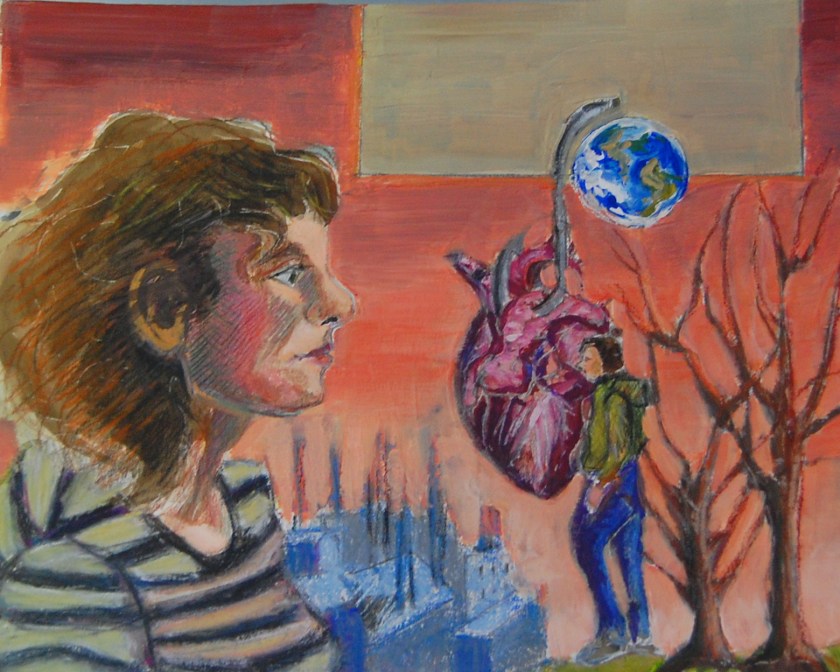
For the past two weeks, I have really been making an effort to make time to get into my art studio and work on my Voices and Visions series, every Thursday from 10 am-12 pm. It’s been challenging. I am focusing on finishing one piece of artwork that I started a few weeks ago, called, The Dream of Time Travel. This mixed media piece has gone through many changes and edits. I’ve subtracted some elements and added others trying to find the right composition and color scheme to express the emotions I want viewers to feel when looking at this artwork.

The Creative Process: Dream of Time Travel

And yet, I am still trying to figure out just what that feeling might be that I want the viewer to take away from my painting. Is it sadness, longing, discontent, or some other emotion? I feel that finding the answer to this question will be the key to solving the difficulties I have had with completing this piece in terms of composition, color choices and subject matter.

Extreme Makeover

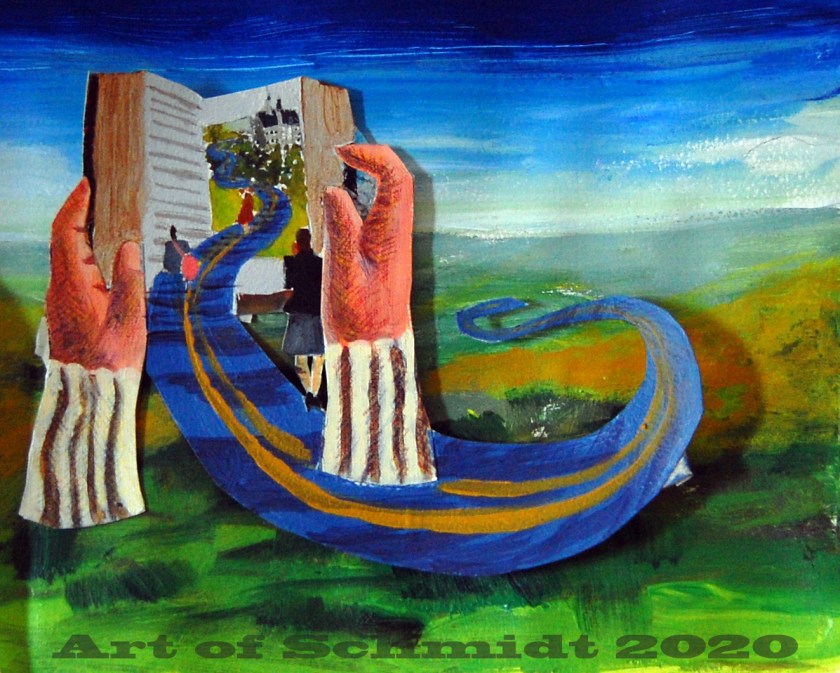
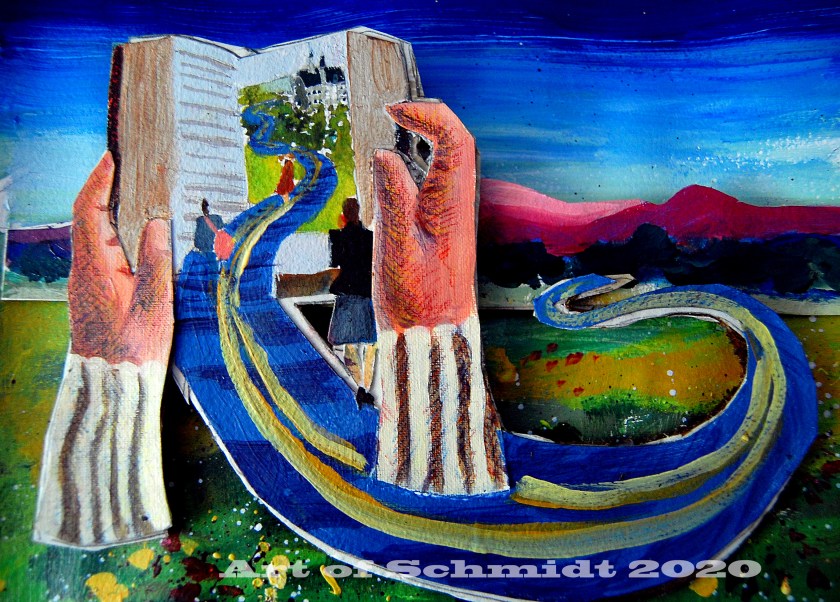
I began making my edits on this piece by cutting up my color sketches in watercolor and adding other elements such as paint chips for the clouds. After that, I took more drastic measures, cutting out anything from the painting that did not add to the composition, seeking simplicity. Even after hours of work, I could see that I needed to start the whole project over from scratch, because some elements of the piece just didn’t work, especially the imaginary ones, like the road leading to the fairy tale book. I realized that trying to do a surrealist style in this work, and it just wasn’t working.

Back to the Drawing Board

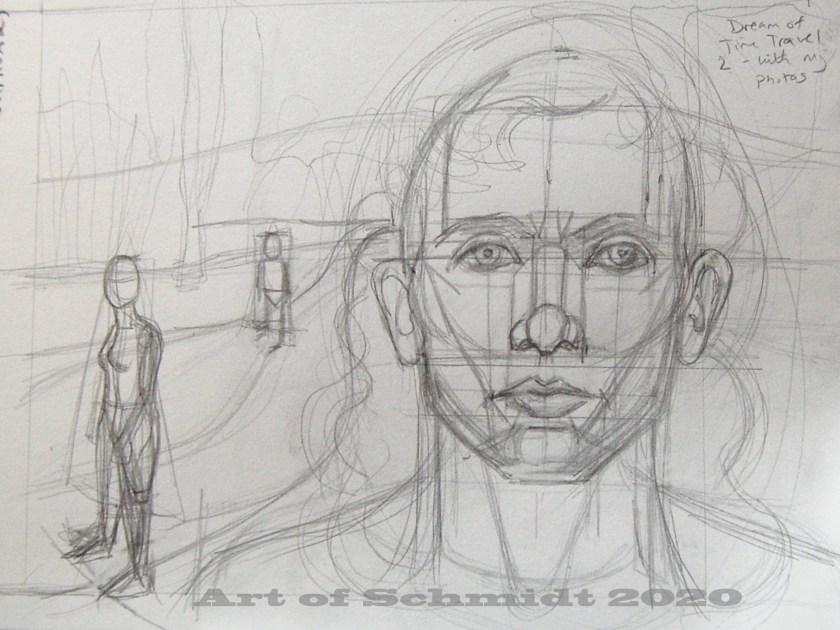
After I realized that the piece was not working, I decided to start over from scratch and gather my own photo references of self-portraits and a landscape to combine them into a Photoshop collage. Then, after I had placed all of my photos into the collage, I began drawing the composition free hand, trying to make it the same scale as the photo reference. While I was working on this piece, I realized I need to draw more often, and that I had become too reliant on tracing photos for my art, rather than drawing from life or photo references. So, my new piece is a sketch that I still need to finish, but one that I think will be easier to complete as a painting.


The Takeaways from the Creative Process

Otherdream of travel with hands, flatdream of travel with flowers_edited-1dream of travel, landscape_edited-1, flatPhoto College Dream_edited-1Dream of Travel Version 2, sketch_edited-1 takeaways from this project are: 1.) Sometimes you just need to get started on art to make progress, even if you’re out of practice, 2.) Failed art pieces can be the springboard for new art, 3.) Simple compositions work best for me, 4.) I need to draw more often, 5.) Drawing from one’s imagination is really difficult, and perhaps I need to stick to a more realistic style, and 6.) I need to think about what emotion I want my viewers to feel from my artwork, which will influence my color and compositional choices. Through it all, I am learning that everything on my journey of creativity is useful to me and that good art can’t be rushed, not for me anyway.