If you are a creative type or if you like to make things, you have probably encountered the moment when the finished product you imagined, does not live up to your expectations. Creative types such as musicians, composers, producers, dancers, writers, artists, photographers, cooks, and makers of all types, can probably tell you what it feels like to hit a wall with a project, how it felt, and what they did to navigate that feeling of utter frustration. As an artist, I have experienced this frustration more times than I can count. Some paintings and drawings are simply learning projects and are difficult to salvage, while others can be fixed.
I know it’s been said that you learn more from your mistakes than your successes, but when I get to a point in a painting or drawing and I realize that the painting or drawing doesn’t look right, it can be really frustrating. I start doubting myself, feel like giving up, or doing something that I am not good at, like cooking or cleaning because I know that I am not good at these things, so my expectations of success in these domains are much lower than for painting or drawing since I have no training in cookery or housekeeping. Since I know I am not a good cook, if it doesn’t turn out so well, it’s a waste of ingredients but I don’t feel as emotionally attached to the outcome as I would to a painting or drawing.
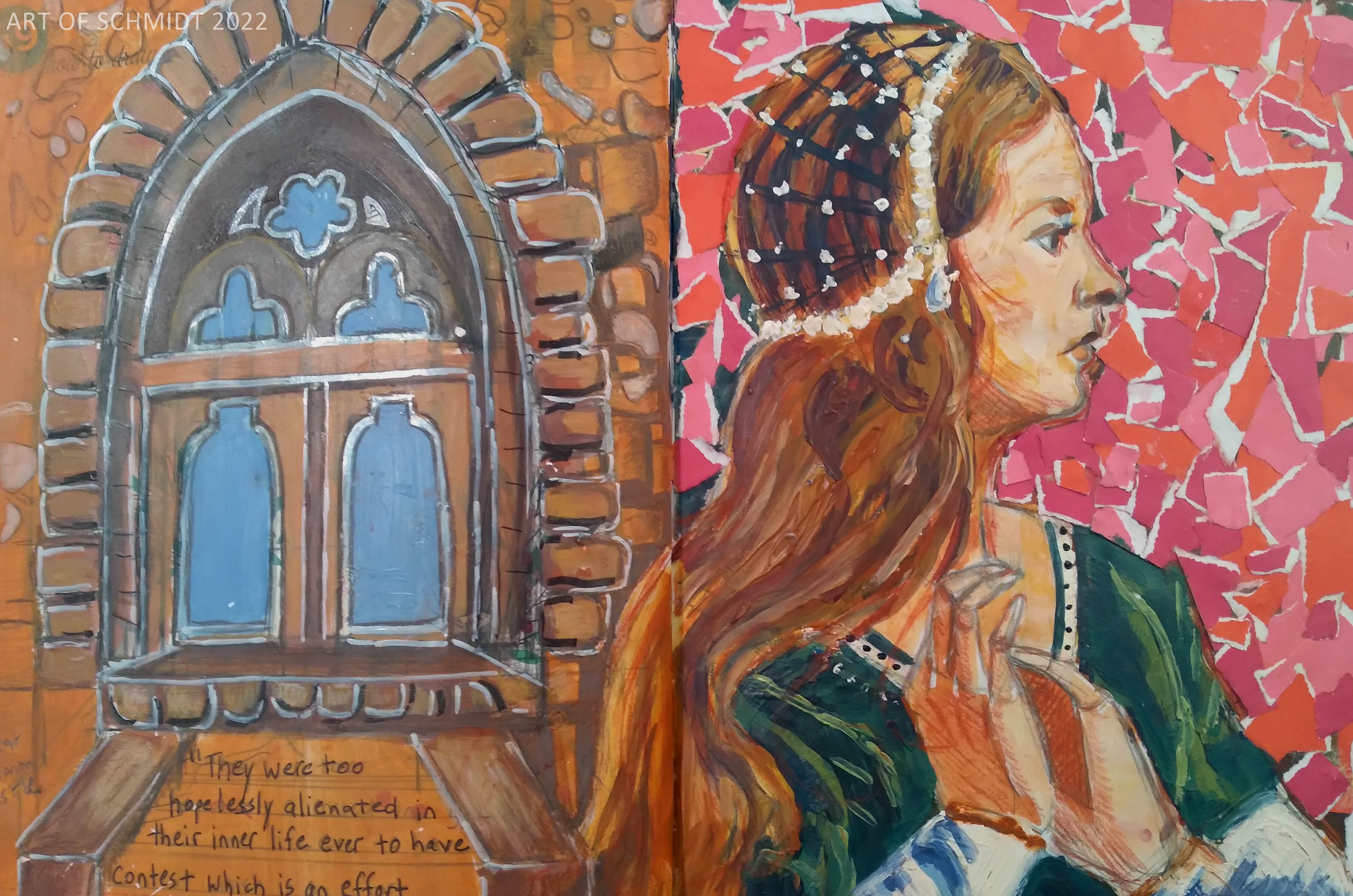
Romola Illustration with Lillian Gish, Mixed Media, Jodie Schmidt, 2022.
I recently read a forum question on the website, Wet Canvas.com, and the question of the day was,” When should I stop working on a painting? I was intrigued by the question, and wondered how other artists dealt with paintings that can “look like a dog’s breakfast.” I read about a variety of solutions suggested by artists who had hit the wall creatively. Some were familiar to me, like my tendency to put the painting away and stop looking at it for a few days, weeks, months, or even longer. Others were not as familiar such as putting the painting somewhere where you can see it, such as on an easel in a living room, and then taking time to look at it from time to time to diagnose the problem. Another favorite technique is to write a list of things I want to change in the painting, be it the drawing, colors, value, edges, etc. In my case, some of the artwork I have abandoned was started about two years ago, and I am just now starting to look at the sketches and Photoshop files.
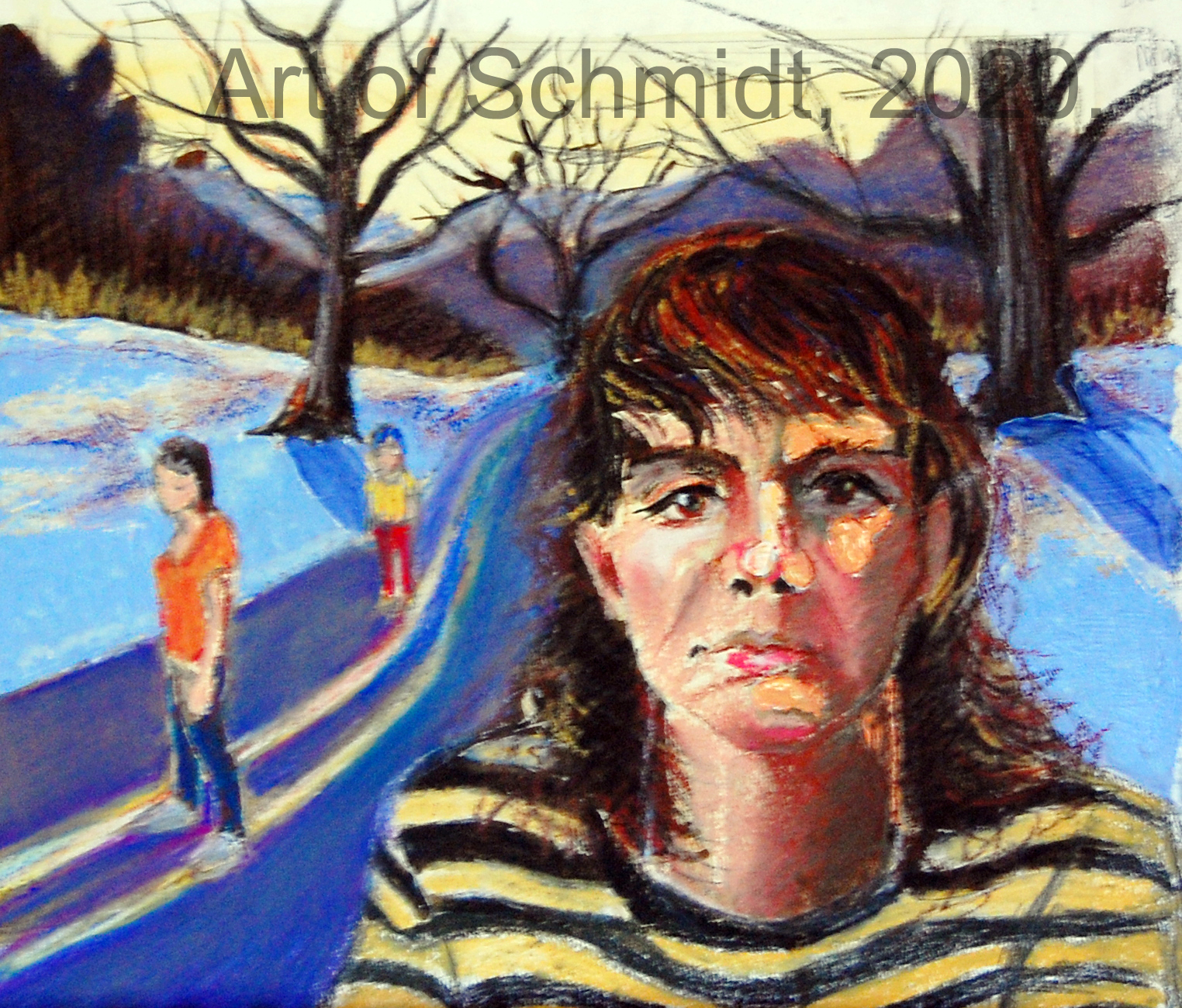
This week I took some time to work some more on my acrylic painting, Waiting: Creative Block. I realized that there were several things bothering me about it. The colors and values, and composition were some of the biggest glaring errors. I am realizing there are many reasons why this painting series of poetry illustration works have been abandoned. One of which was being too busy with other things to give the series the proper amount of time it requires to get things right, such as the composition and the drawing. Since I dropped out of the Social Work program at Frederick Community College, I do have more time to work on paintings.
And since I have deliberately looked at my schedule e and started marking studio days on the calendar, I have more “intentional “time. But I am also realizing just how hard this series is, as I am making some paintings almost entirely from scratch by combining different photo references in Photoshop and then drawing and painting them, with this technique, I do not have the luxury of working from reference photos already taken. I have to look for source material and then combine it to make it my own. This project is highlighting areas of weakness in me as an artist, and one of them is composition. I have a tendency to put everything in the middle and don’t often use more unconventional compositional styles. I want to change that and start looking to master artworks to try and broaden my skills in this area.
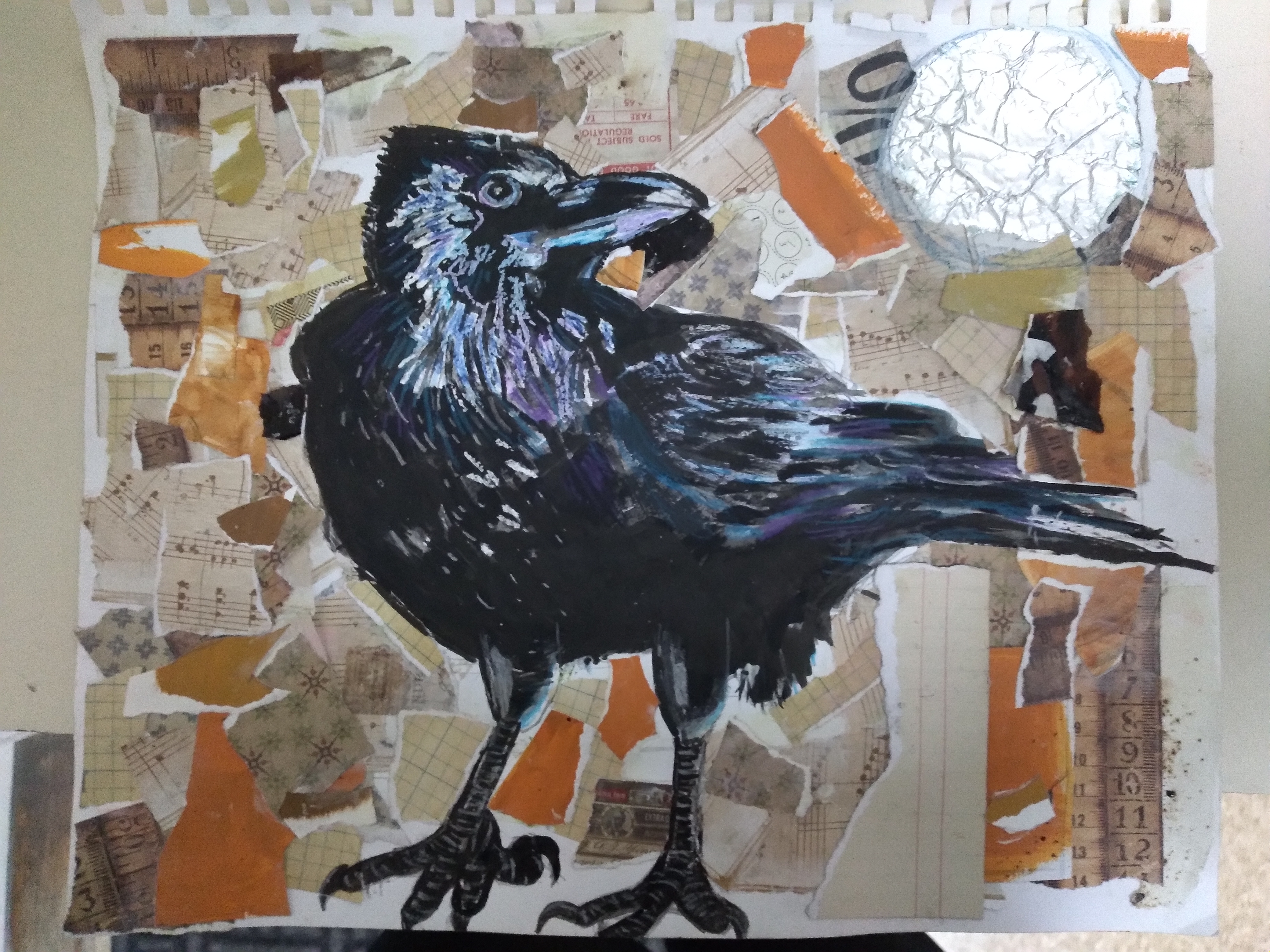
Another great way to improve your painting skills is to draw, yes draw. Regularly and in a sketchbook if you can, as much as you can so that you can practice things like composition, color, proportions, etc. It can also help you see patterns in your work, such as a favorite subject you return to, or a color palette. A sketchbook is also a great place to try out a variety of art media since it doesn’t feel as precious as a large painting can sometimes feel. This week I am featuring photos from my old sketchbook to show just how diverse you can be in art media. I include mixed-media collages and colored pencil drawings. The sky really is the limit with sketchbooks!
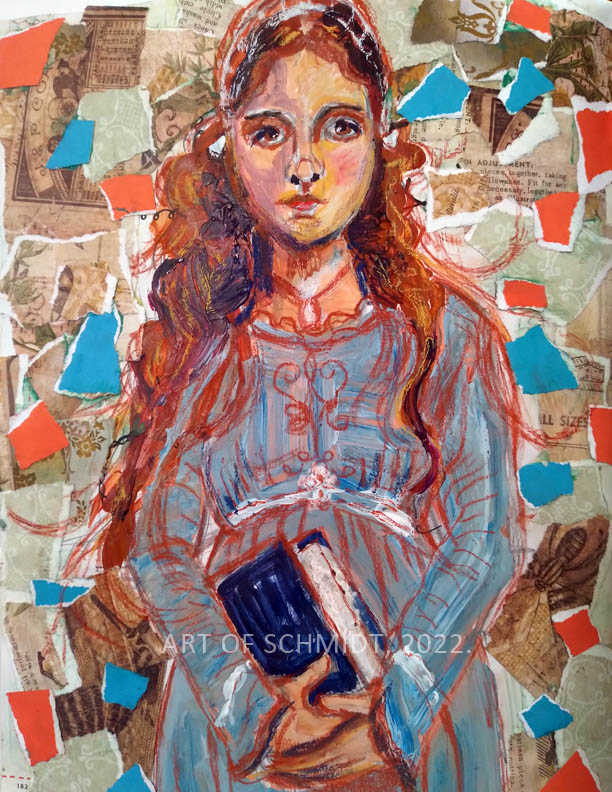
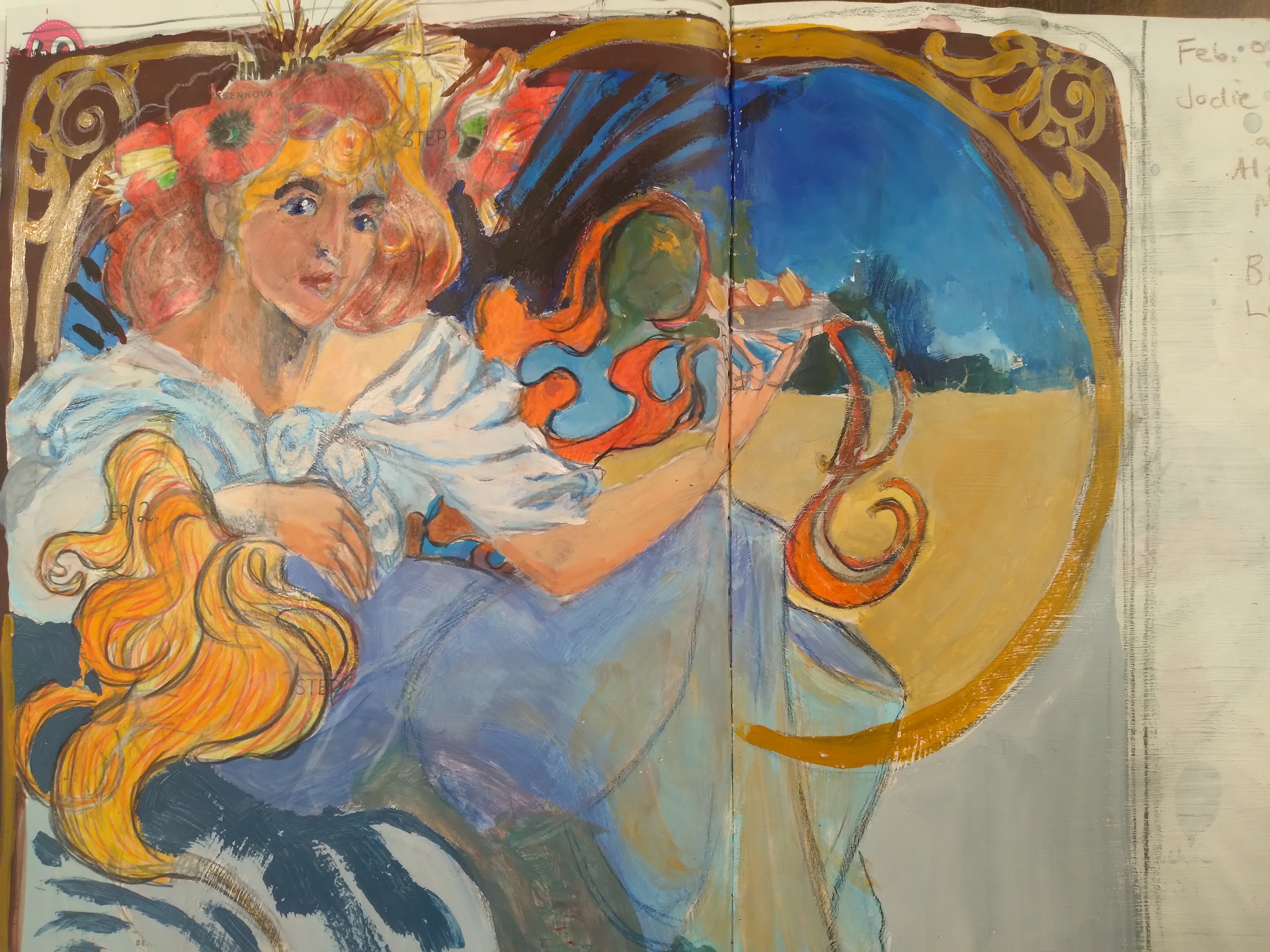
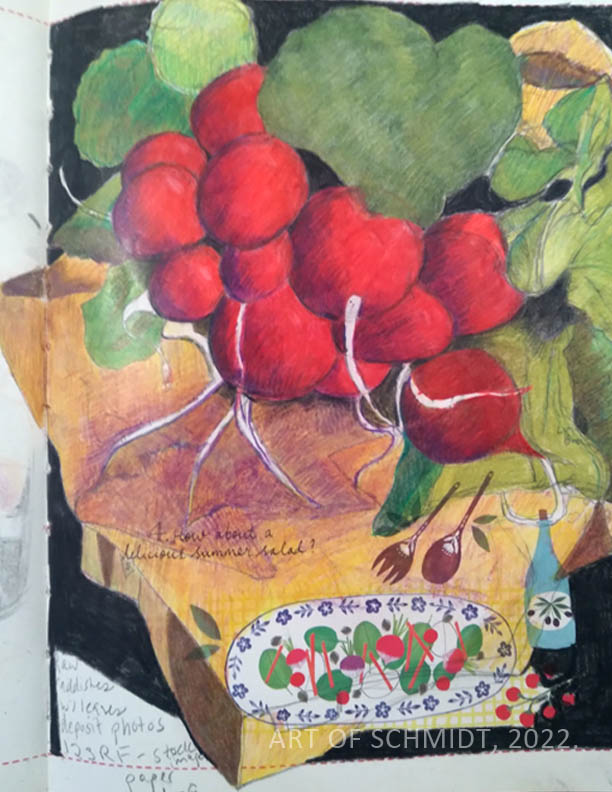
Lillian Gish as Romola, Mixed Media, Jodie Schmidt, 2022. Jodie Schmidt, After Alphonse Mucha, Mixed media, 2022.Fruit Bowl Drawing, Colored pencil, Jodie Schmidt, 2022. Radishes with paper bag, Colored Pencil, Jodie Schmidt, 2022.
This is an archived blog post that I edited today, but the artwork that accompanies it is fresh. It’s a mixed media art collage that tells a story about my family history, growing up in a rural area of Howard County, MD.
It all started with a bad day
It was a tough day in the art studio today. I woke up this morning with very little energy; however, I was determined to make time for art regardless of my lethargic state. After several cups of coffee and a long walk around my neighborhood, I set out to start a cat portrait I have wanted to work on for a while. I set my timer for 25 minutes and started drawing from an art demonstration book. Suffice it to say, the drawing did not go well, at all, despite several attempts to get the proportions of the cat’s body correct. Each attempt just brought on more feelings of frustration. After the third attempt, I finally gave up and put my supplies away, and went to do something else. After working on the cat portrait, I realized that I am really out of practice when it comes to doing animal portraits, as I have been focusing a lot more on floral subjects, which are made up of simpler shapes and less precise in their proportions than animals and people.
What I observed from the day
I tried not to beat myself up about it, or obsess about what my failure to meet my expectations might mean, but I think that this drawing might end up in the growing pile of unfinished artworks, which brings me to today’s topic, which is, what to do with your unfinished artwork. As I mentioned in a previous post, I have several unfinished or unsatisfactory art projects residing in my art studios, such as pastels, drawings, watercolors, and some oil paintings that did not turn out as I had envisioned. This makes me wonder, what should I do with this collection of art misfits? Earlier last week, I serendipitously found the article, “50 Ways to Use Your Unfinished Art,” by Carrie, on https://www.artiststrong.com/50-ways-to-use-your-unfinnished-art/.
What I have done in the past with unsatisfactory art
In the past, I have usually tried to resolve issues with unfinished artwork, sometimes starting over from scratch; i.e. Creating a brand new drawing on a new substrate and re-surfacing the canvas by sanding it with heavy grit sandpaper, so it can be re-gessoed. Other days, when I am more desperate or frustrated, I throw it in the trash, never to be seen again. Unless of course, my husband gets to it before I take out the trash. In which case, he fishes it out and says, ‘Why did you throw this away?” Or, some variation on that theme usually ensues when he finds my rejected art. At this point, the amount of unsatisfactory art and even uncompleted art is starting to grow and I am wondering what should I do with all of this stuff? Give it away to friends/family, donate it to Goodwill, toss or recycle it, or if I am liking this idea more, try to finish the unfinished art and post about it to keep myself accountable. And finally, what about those unsatisfactory pieces that I would otherwise throw away? Can they find a new life in my sketchbook, or in a mixed media piece? In one of my latest collages, I did just that, up-cycled old sketches into a totally new piece! It was so much fun and really got my creative juices flowing! This brings me to another point, I wanted to share that plans are in the works to teach a course that teaches you how to upcycle your old sketches and ephemera and tell your family story through narrative art. I will let you know when the details get finalized!
Artists: What kind of Artist Are You-Amateur, Hobbyist, or Professional?
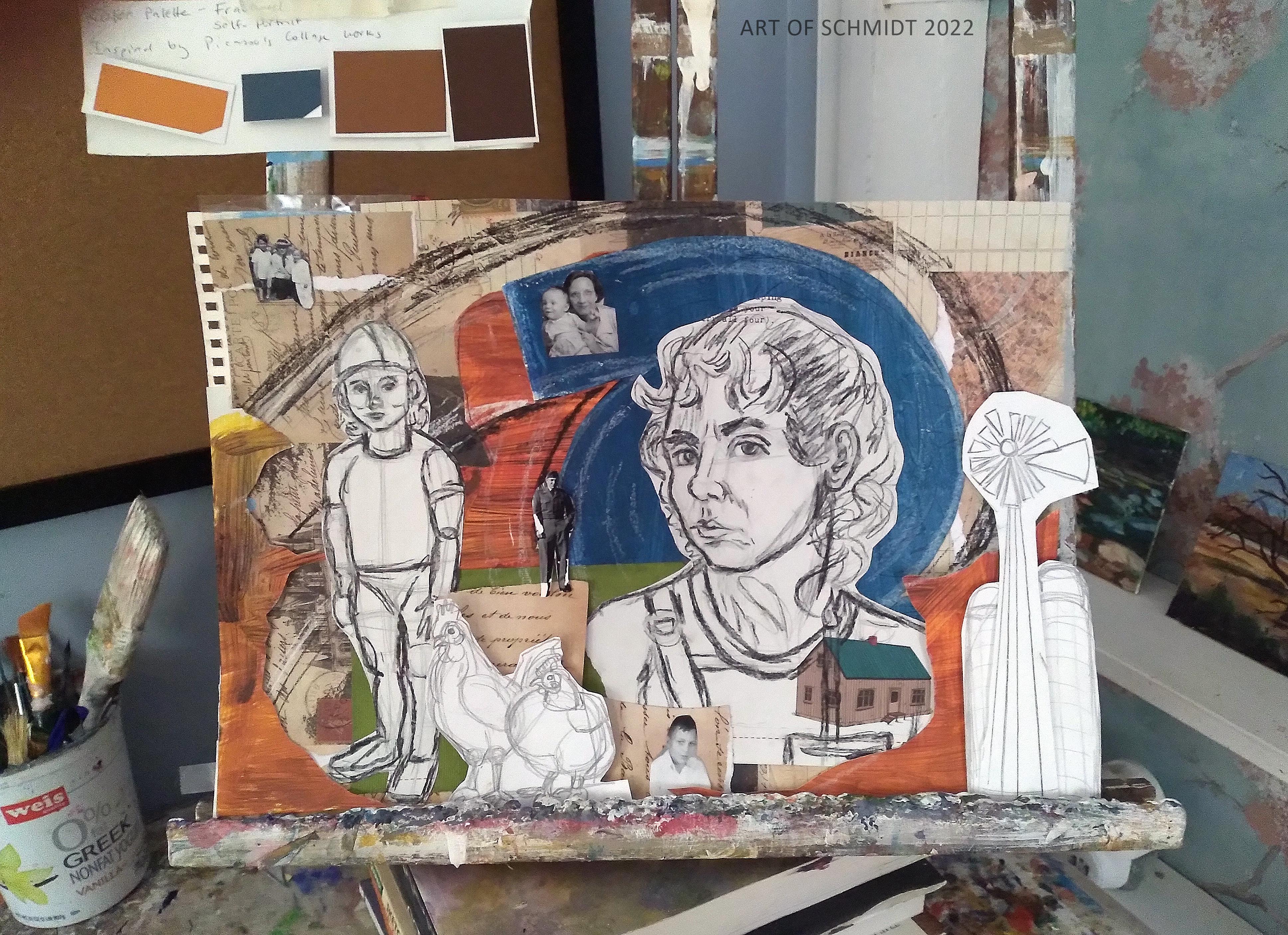
My Biography, Mixed Media, 2022, Jodie Schmidt.
Pictured is a work in progress, which I plan to use to advertise my upcoming mixed media narrative course at the Adams County Arts Council in Gettysburg, PA.
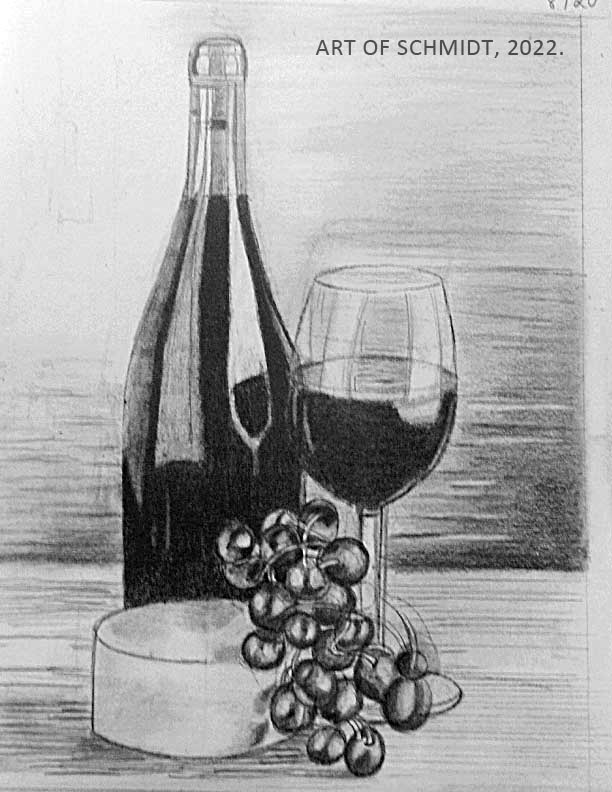
Wine and Cheese, After Steven Pearce, pencil on paper, 2022, Jodie Schmidt.
This is an example of a final project for my Classic Drawing course, which focuses on teaching beginners the fundamentals of drawing, such as line, shape, and form as well as shading techniques to simulate a variety of textures in still life. I will be offering this course in April at the Delaplaine Art Center April! Visit: https://delaplaine.org/class/?id=22-4-DR02 to learn more!
My Rendition of Monet’s Haystacks, Pastel and acrylic on paper, 2021, Jodie Schmidt.
Here is a photo of a mixed media piece from my course, Drawing Calm: A mixed Media survey, which will be offered again at the Delaplaine Art Center in April of this year. Click on the link to learn more: https://delaplaine.org/class/?id=22-4-DR03
Wooded Road, After Nathan Rohlander, soft pastel on paper, 2020, Jodie Schmidt.
This is a sample of the demonstrations which I plan to teach in my Continuing Landscapes course at the Delaplaine Art Center in Frederick, MD this April! Click here to learn more: https://delaplaine.org/class/?id=22-4-DR04.
Why I decided to Write about Artist Types
It’s been a while since I last posted on this blog, and I have debated off and on within myself, whether to continue blogging about the series I started in May called and famous failures. However, at the end of the day, I decided that I would switch gears and write about a more arts-based topic. Instead, I decided to examine the topic of different artist types and the pros and cons of each type. It’s my belief that there is no superior type of artist, and that it is all about what type works best for you. However, I do think that it takes a very unique person to be able to combine the roles of both artist and entrepreneur.
In my opinion, such individuals must be extremely dedicated to making art their life’s work, no matter what it takes, or how much time they have to invest in learning their craft and other business skills to make a profit. On the contrary, not every artist has that sort of drive or wants their art to be consumed by the public as a commodity. Perhaps for some, art is an outlet for their feelings and experiences and they would rather keep that private, which is perfectly fine. Meanwhile, there are other artists who find themselves somewhere in the middle between hobbyists and amateur artists. These artists, sometimes called, “double jobbers,” want to take their art to a more professional level, but also work a day job, such as the British artist described in the article, “The Double Jobbers, Making a Living into eh Arts, by Kathy B. Sweeney, posted on The Guardian, https://www.theguardian.com/culture/2012/jul/29/living-working-in-the-arts. Consequently, they are not pressured to make a living from their art.
On the other hand, there are artists who cannot imagine doing anything else with their lives and spend almost all of their time marketing and making their artwork, such as Elizabeth St. Hillaire, Kelly Wynne, and many others. The three types of artists which I will discuss in this blog post are hobbyist, amateur, and professional artists, along with the pros and cons of each type.
Why is it important to know what type of artist you are?
I picked this topic because I have been wrestling with the question about what category I fall into as an artist: Amateur, Hobbyist, or Professional? In my opinion, it’s important to know which category of artist you fall into because there are specific actions that you need to take if you want to go beyond making artwork for pleasure and start making it with a business mindset. According to the author, Alyson Stanfield, who wrote the art business book, I’d Rather Be in the Studio, it is not enough just to make art, you need to learn about how to market and sell your art, as well as to sharpen your artistic skills and creating a specific body of work that showcases your unique style as n artist. (Sources: Artwork Archive, “Alyson Stanfield Shares Her 10 Best Marketing Tips,” https://www.artworkarchive.com/blog/alyson-stanfield-shares-her-10-best-art-marketing-tips, accessed on 06/14/18, and Alyson Stanfield, I’d Rather Be in the Studio!, preface, pg. 1, 2008, Pentas Press, Golden. Colorado, and Aletta de Wal, “Hobbyist, Amateur or Profefessional Artist: Which Are You?” http://emptyeasel.com/2011/02/01/hobbyist-amateur-or-professional-artist-which-are-you, accessed on June 6, 2018. )
My Journey as an Emerging Artist
After my father died in 2011, I realized that I wanted to make the most of the time I had left. I wanted to live without regrets about pursuing art to the highest extent possible. For as long as I can remember, it has been my dream to be an artist. In fact, my grandmother reported in her scrapbook that I began drawing at the age of 3. When I first started making art with the intention of selling it, back in 2011, my catalyst for making art was that I needed an avenue to express my grief.
Deciding what level of involvement in art that I want to have in my life has modified my choices and informed my decisions about my career, how I spend my time, and how I spend my money. I’ve gone from being a wide-eyed dreamer of a someday art career, as an art student, who lived amongst the bubble of the art community, to living life after college with all its startling reality. This world I now live in includes: bills, student loan debt, working as much as I can on my art while balancing a night job, experiencing frequent rejections for art shows, and feeling unrelenting and crushing self-doubt about my abilities as an artist. I feel I have been drifting without many purposes in my quest to be a professional artist, and it’s making me wonder whether this is the life I really want.
Making the Jump from Hobbyist Artist to Amateur Artist
In more recent years, I have really stepped up my activity to bring my art to a more professional level, such as: creating profit and loss sheets in Excel, designing an art catalog of inventory, launching an artist website, blogging about art, participating in more frequent art shows, hosting studio sale events at my home, producing custom art, and starting commerce shops on Etsy and Red Bubble, etc. However, all of this activity has been challenging and sometimes disappointing. It seems to me that no matter how hard I try, I am still struggling to sell my art consistently. I have also made efforts to connect with people on a personal level through writing blog posts, and producing artist newsletters.
However, I am still not making a profit, and instead, I find myself falling into debt to pay for framing, art supplies, and marketing expenses. Even more importantly, I feel I have lost the joy of making art in the midst of all this business-related activity. Consequently, I’ve had severe doubts about whether I want to be a professional artist, because of the amount of work, time, emotion, skill, and unflagging confidence a professional artist must have to survive. I wonder, are any other artists are struggling with this situation? And I’m also asking myself, do I really want to be a professional artist, or not? If not, then what type of artist do I want to be?
Since writing this post, I am now adding a new dimension to my identity as an artist, as a teaching artist, and I now teach art classes at Delaplaine Art Center, Frederick Community College, and the Adams County Arts Council. This new role, which I began in 2019, has informed my studio practice in a way that challenges me to keep learning new skills, and techniques so that I have fresh new content to offer my students and to inspire my own personal work, which is becoming more and more content-based, i.e. art that is meant to be a personal expression of my thoughts, memories, poems that inspire, etc. My favorite new place to continue my education as an artist and teacher is youtube, which is chock full of free art tutorials, such as The Virtual Instructor, Rapid Fire Art, and my favorite pastel artist, Karen Margulis, to name a few! To learn more about my current class offerings in pastel, mixed media, and drawing, please visit www.delaplaine.org. I am also working on a new art course about mixed media narratives at the Adams County Arts Council. I will update that information as soon as it becomes available.
What are some Specific Types of Artists?
To investigate and to define the different types of artists that anyone can be, I read an article entitled, “Hobbyist, Amateur, or Professional Artist-Which are you?” written by Aletta de Wall on the website, Empty Easel, at http://emptyeasel.com/2011/02/01hobbyist-amateur-or-professional-artist-which-are-you. The author, De Wall, states that there are three categories of artists and they are: Hobbyist, Amateur, and Professional and that each type is distinctly different. (Source: ibid)
The Hobby Artist
For example, hobby artists are not trying to make a living from their art, and they may only make art when the creative bug bites. (Source: ibid) In addition, hobby artists may study for many years and hone their craft by taking classes and workshops, but they may not ever receive the recognition that their work deserves because they are not taking actions that would promote their art effectively, such as having a business or marketing plan. (Source: ibid) On the other hand, an advantage of being a hobby artist is that there is no pressure on them to cater to a specific audience or make a profit, so they are free to experiment with a variety of media and subject matter and styles and techniques. They may also have more time to make art because there is no imperative to make a profit and engage in business-related activities such as marketing, bookkeeping, or sales.
The Amateur Artist
Another category of artist types is an amateur artist. This type of artist has started to play with the idea of making their art into a profession. (Source: ibid) Perhaps they have started to think that they need to start selling their art to help foot the bill for their art supplies and to start being able to deduct their art expenses from taxes. (Source: ibid) An important distinction between hobby artists and amateurs is that amateurs are willing to give up their personal time in order to learn how to sell their art and create new works. (Source: ibid) However, they may be uncertain about how to turn their passion into a viable business. (Source: ibid)
The Professional Artist
Finally, the last category of artists that this article discussed is professional artists. This type of artist is distinguished from the other two types of hobby artists and amateur artists because they consider art to be their profession. (Source: ibid, and Drew Kimble, “9 Warning Signs of an Amateur Artist,” https://skinnyartist.com/9-warning-signs-of-an-amateur-artist, accessed on June 7, 2018. )
These types of artists want to make a profit from their art, build a following, and continue to build their business skills at the same time. They have an intense level of dedication for their art and are willing to sacrifice time, money, sleep, and do whatever it takes to make a profit. (Source: ibid, and Drew Kimble) They might work another day job to help support their business or eventually quit their day job when they are able so that they can devote more time to making art and learning how to sell it.
Other activities that they engage in are: making studio time a daily habit, applying for grants, writing artist newsletters, submitting their artwork for review at galleries and art fairs, writing business plans, extending their knowledge of effective business practices by attending art business workshops, etc. (Source: ibid, and Hayley Roberts, “Twelve Things No One Ever Tells You About Being An Artist,” The Huffington Post, https://www.huffingtonpost.com/hayleyroberst/twleve-things-no-one-tell.html. accessed on June 7, 2018.) They also promote their artwork online and offline through social media, their artist website, and in real-life artist events, such as art gallery openings, art festivals, etc. (Source: ibid)Some may also make a living by teaching their craft to others. (Source: Aletta De Wal, “Hobbyist, Amateur, or Professional Artist-Which are you?”, and Hayley Roberts, “Twelve Things No One Ever Tells You About Being An Artist,” ) .
These artists may receive more recognition for their artwork, but they may also experience more criticism and rejection than the two other types because they are more aggressively pursuing art gallery representation, etc. In addition, they may have less time for making artwork because they have to balance making art with business-related duties. Furthermore, they may struggle to sell their art or make consistent income and they may face stiff competition from other artists because it is such a saturated field. It is a long road for these artists towards building a following and making a success from their art, but they are dedicated for the long haul. (Source: Drew Kimble, “9 Warning Signs of an Amateur Artist,” https://skinnyartist.com/9-warning-signs-of-an-amateur-artist, accessed on June 7, 2018. )
What about You? What Type of Artist are you?
So what about you, reader? What type of artist are you? I would love to hear about your dreams and hopes with regard to making art. Thanks for taking the time to stop by and read this. Next week, I will be talking about this topic of artist types in more detail, with a slight twist. The twist will be a more in-depth look at what it really means to be a professional artist and why it has been traditionally so difficult to be successful in this field.
This spring I am teaching a new course called, Drawing Calm: A Survey of Mixed Media. Have you ever wondered if you can combine more than one art medium? You can, and this course might just be what you are looking for! Click here to learn more: https://delaplaine.org/class/?id=22-4-DR03.
This spring I will be teaching three courses at the Delaplaine Art Center, in Frederick, MD. Here are samplings from my Classic Drawing Course, Drawing Calm: A Mixed Media Survey, and Landscapes in Pastel. Click here to learn more: https://delaplaine.org/instruction/classes-workshops/drawing/.
Today I am blogging about an introduction to the color wheel and how artists can use it to choose an effective color combination. Since last week, I have been consulting a reference book entitled, Color is Everything, by Dan Bartges. I wanted to try out some various color schemes for my Biographical Portrait of Sting, which I posted about in last week’s Sketchbook blog post. After consulting the book about possible color schemes, I tried out two versions of a tetrad color scheme; one is described on pg. 35, and consists of oranges, reds, and greens, while the other color combination includes blue-greens, red-oranges, yellow-oranges, and blue-violets and is described on page 36. But before I get into the definition of tetrad color schemes, I would like to give a short overview of the color wheel and how it can improve an artist’s artwork.
According to the article, “Color Psychology: The Emotional Effects of Colors”, retrieved from www. art therapy blog.com, the color wheel displays the three primary colors and its secondaries, and the twelve colors which are included on the color wheel are yellow, yellow-orange, orange, red-orange, red, red-violet, violet, blue-violet, blue, blue-green, green, and yellow-green. The most important colors displayed on the color wheel are red, yellow, and blue, from which you can mix almost any color. (ibid) However, this concept should be considered in a theoretical context, because paints do not necessarily contain only one color. (ibid) In fact, paints often contain traces of other colors which can affect the final outcome of color mixtures, towards a warmer or color tone of a specific color. (ibid) Some colors that you can mix from the two primaries include: yellow + red= orange and red + blue= violet.
According to the author, Bartges, a triadic color scheme utilizes three colors which are equidistant from each other on the color wheel, and these colors create “a strong, triangular relationship.” For example, a commonly used triadic scheme for landscapes includes: green, orange and violet. And the “most visually powerful triad is red, yellow and blue, which are called the primary colors. In my upcoming courses, I will be instigating color in a variety of media such as pastel, collage, watercolor, etc. Starting in April, I will be teaching several art courses where I will be exploring the concept of color in a variety of courses, such as: Landscapes in Pastel, The Four Seasons, and Drawing into Calm: A Mixed Media Survey Course, at the Delaplaine Art Center. To learn more, visit: https://delaplaine.org/. You can register for the classes on their website by going to the instruction link, and then going to the classes and workshops link. Thanks for stopping by!
Would you like to learn a new skill to add to your drawing toolbox? Or, did you want to learn drawing , but felt intimidated by the prospect of drawing and the many approaches you can take to it, such as contour drawing? Enter thumbnail sketches. Source: Brummer, Carrie. “10 Creative Prompts for Thumbnail Sketching,” Artist Strong Blog, www.artiststrong.com. Accessed 09/11/2020.
A thumbnail sketch is a quickly drawn small sketch, hence the name, thumbnail sketch. It could be any subject you choose, such as animals, portraits, landscapes, city scenes, etc. the only guidelines are to make it small, about 2 inches by 2 inches for height and width. Your thumbnail sketches can be composed of boxes, rectangles or any shape you choose. And you can use pencils or pens. If you wish, you can add color to your sketches with colored pencils or watercolor paints. Think of your thumbnail sketches as gesture sketches, which can be done in seconds, and which can be used as a dress rehearsal for more complex art projects, such as paintings. Source: Brummer, Carrie. “10 Creative Prompts for Thumbnail Sketching,” Artist Strong Blog, www.artiststrong.com. Accessed 09/11/2020.
Want to know how to get started? To begin your thumbnail sketches, you can begin by gathering pencils, pens, rulers and watercolors or colored pencils, if you wish. Start by drawing a series of small squares, with pencils, papers and rulers. Then decide what you want to draw and gather your source materials, such s photos, a still life, or go out on location, such as to a park to draw people and landscapes from observation. Source: Brummer, Carrie. “10 Creative Prompts for Thumbnail Sketching,” Artist Strong Blog, www.artiststrong.com. Accessed 09/11/2020.
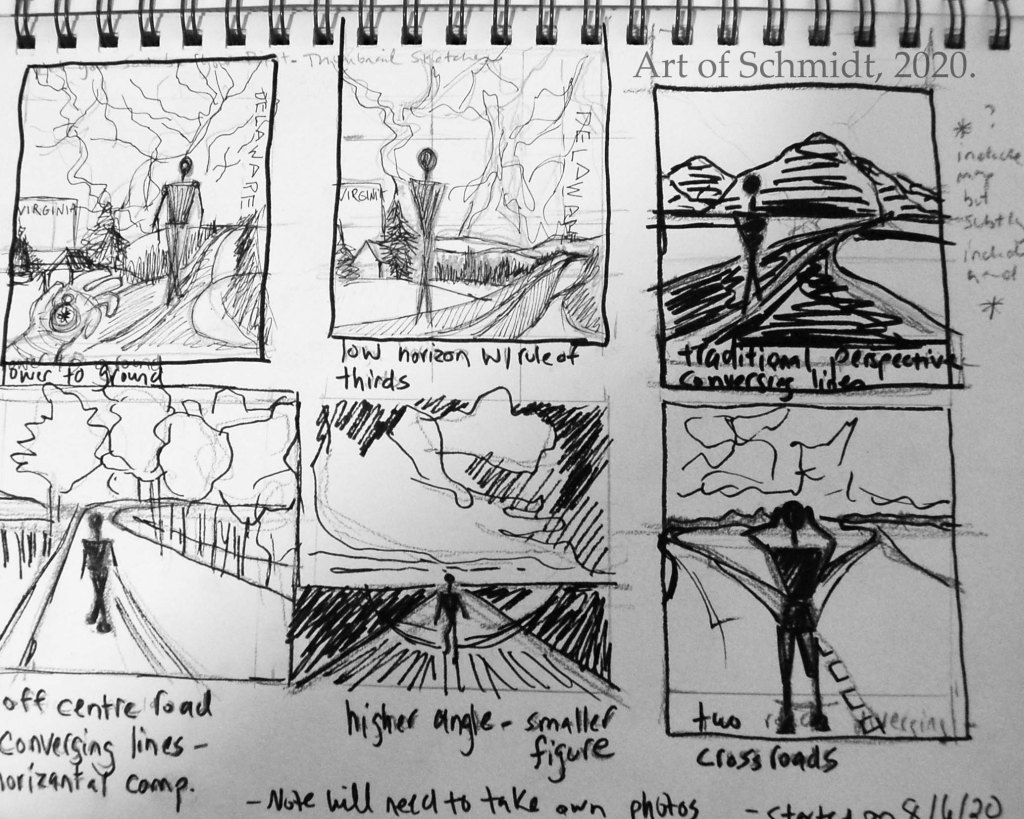
I began with six squares to test out different compositional concepts for my paintings, Let Your Soul be Your Pilot and Song of Service, using pencil, ruler, and pen to outline my drawings. If you can’t get outside, use your old vacation photos as a source, such as a beach vacation, etc. Be sure to try out different compositions for each box, such as: close ups, and eye level viewpoints, etc. Trying out the compositions now, will help you make the best choice for your projects and give you practice and confidence in your drawing skills. But don’t spend more than a few minutes on each sketch, keep it loose and free of detail. If you feel stuck, check out the list of prompts I am including below, from the blog post, 10 Creative Prompts for Thumbnail Sketching, by Carrie Brummer, posted on her website, www.artiststrong.com.
Draw a house plant, using close up views, details of leaves, etc.
Choose your favorite photo and abstract it, by simplifying it into smaller sections.
Compose a still life using objects from your home, such as plates, dishes, vases, or fruits and vegetables.
Draw the scenery at a park, while sitting on a park bench.
Drive to the beach, or look for old vacation photos if you can’t get outside this summer.
Look for patterns in your home, such as: fabric patterns in your curtains, throw pillows, or futon covers.
Get your family involved and participate in a scavenger hunt on a rainy day. Ask your family members to look for an element of art, such as: line, in your home and then share your sketches of these subjects as a group.
Bring your sketchbook to your appointments and draw the offices you are waiting in.
Design sketches that illustrate your favorite cookery recipe. 10.) Make a storyboard from your thumbnails to illustrate your favorite fairy tale.
I began with six squares to test out different compositional concepts for my paintings, Let Your Soul be Your Pilot and Song of Service, using pencil, ruler, and pen to outline my drawings. If you can’t get outside, use your old vacation photos as a source, such as a beach vacation, etc. Be sure to try out different compositions for each box, such as: close ups, and eye level viewpoints, etc. Trying out the compositions now, will help you make the best choice for your projects and give you practice and confidence in your drawing skills. But don’t spend more than a few minutes on each sketch, keep it loose and free of detail. If you feel stuck, check out the list of prompts I am including below, from the blog post, 10 Creative Prompts for Thumbnail Sketching, by Carrie Brummer, posted on her website, www.artiststrong.com.
Pictured in this week’s blog is my progress for the Let Your Soul be Your Pilot painting. I began with a somewhat busy composition and decided to simplify it, even though I liked all the symbolic imagery of map and compass. It felt like the figure, which was the main narrative was getting lost in all the detail, but I wasn’t sure how to proceed. Making thumbnail sketches helped me to see my options. The painting still isn’t finished, but I have a better idea of where I want to go next with the painting. I also began making some color sketches to try out color schemes for the finishing painting. I am hoping to have the final oil painting based on this new thumbnail posted to my blog or Instagram account by next week. Thanks for reading!
A variety of thumbnail sketches were explored here to try different viewpoints for my drawing, Let your Soul be Your Pilot. I used pencil, pen, and ruler to sketch on mixed media paper in my sketchbook.Basic sketch for the chosen thumbnail sketch. I used this sketch as a basis for my oil painting on masonite board. Photo collage I made in Adobe Photoshop of the revised composition from thumbnail sketches, reduced into a black and white image to focus on values, from darkest black to shades of grey and light gray. Doing this gave me more freedom to choose different color combinations, as I started to do below in watercolor paints on mixed media paper. Color Study one of the revised composition, with analogous colors of blue, blue-green and green as the main color scheme. This is the original sketch which I had started with before I made thumbnail sketches. I thought it was too busy and so I looked at different thumbnail compositions to try out, pictured at the top of the gallery.
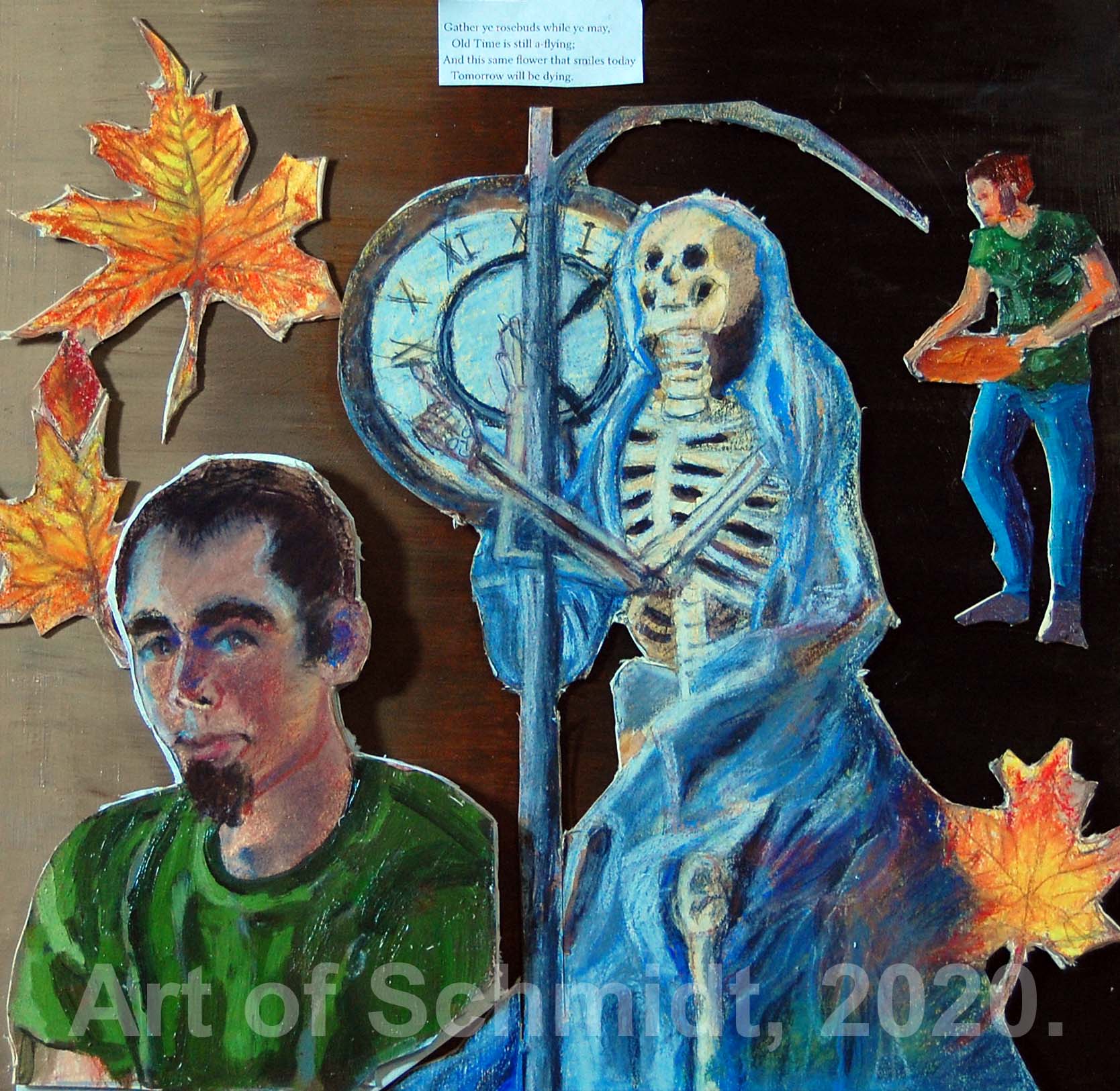
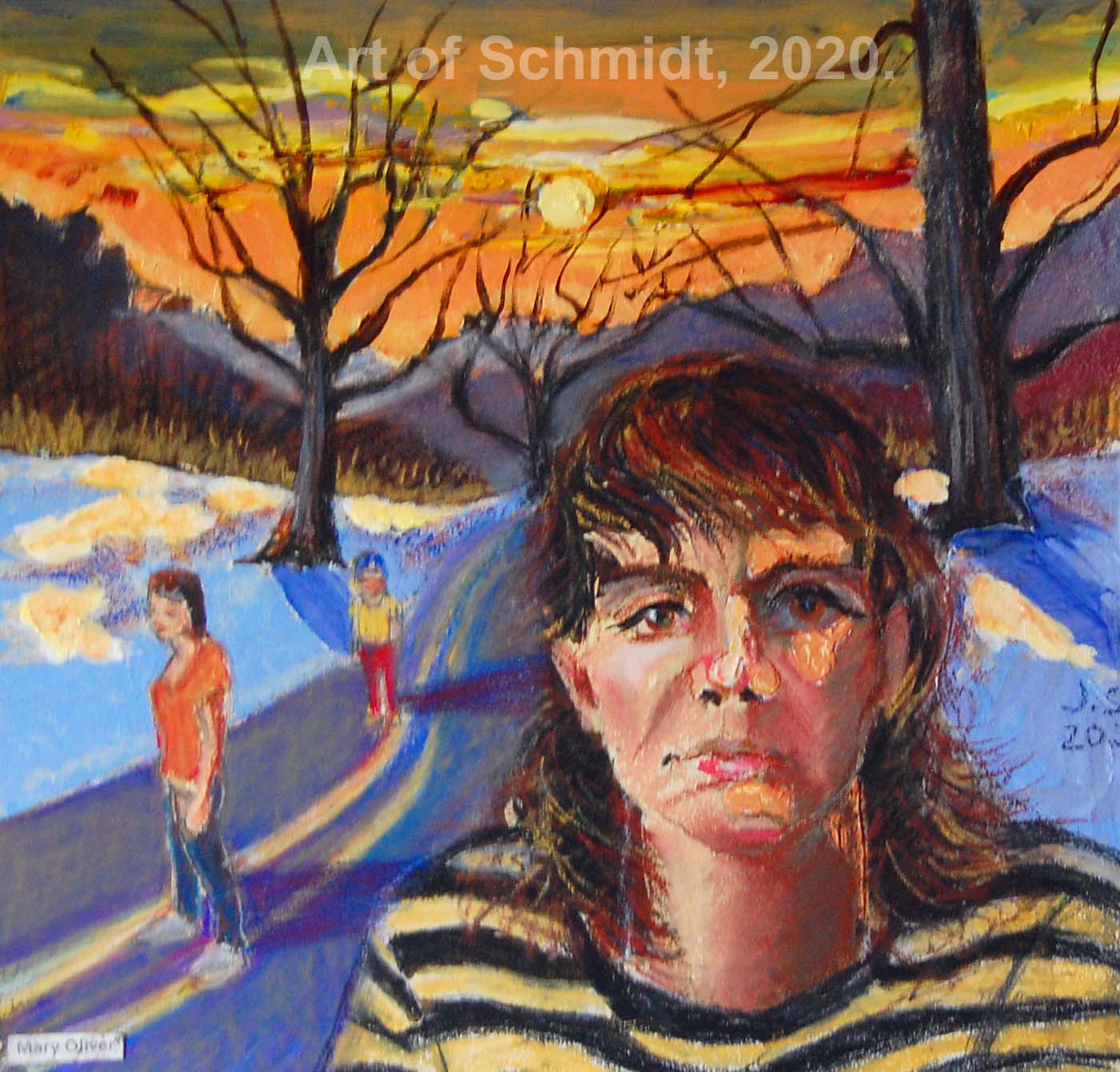
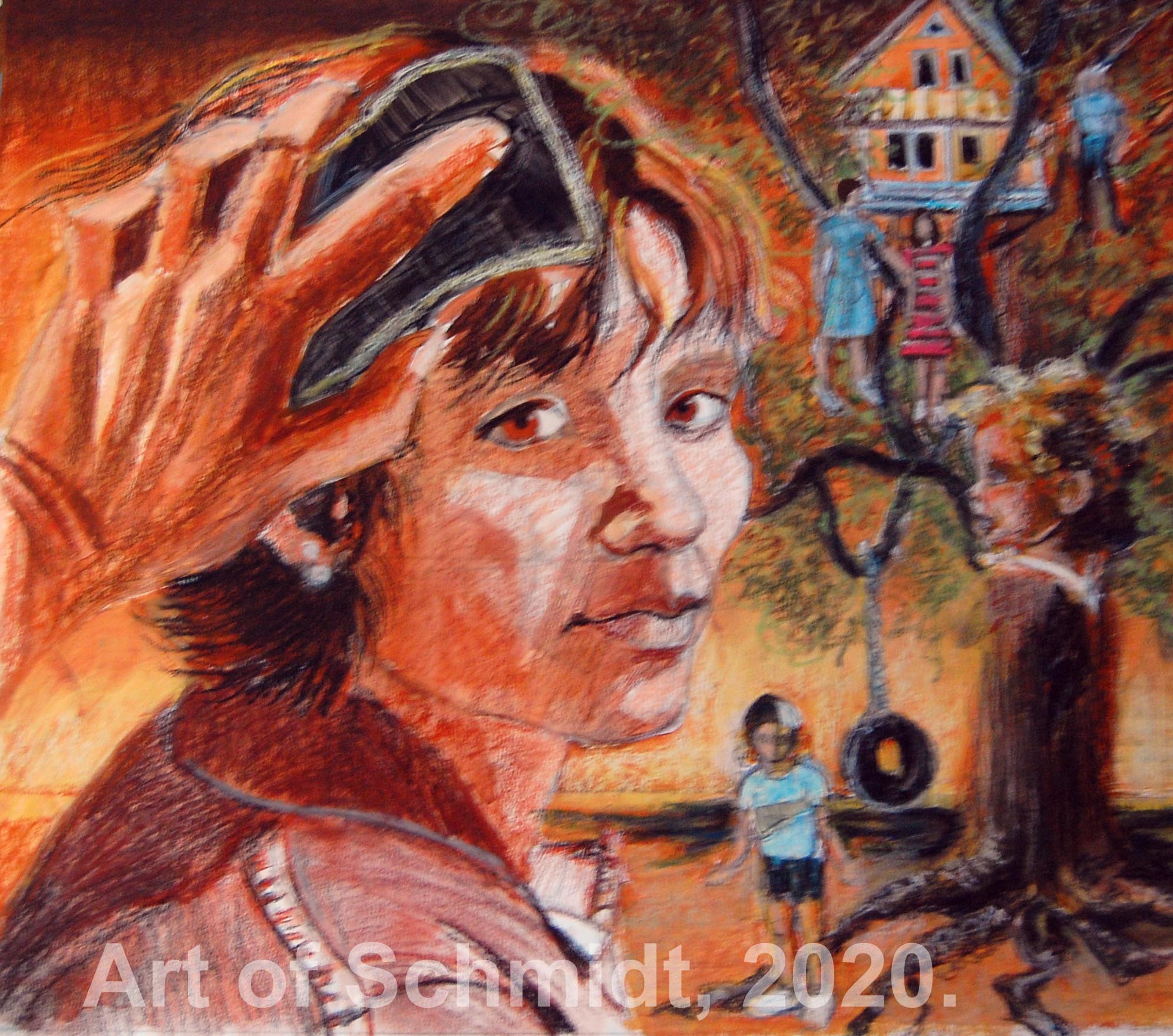
This week I am taking time to inventory my completed artworks for my series Constructed Realities. This mixed media series is a collection of poetry inspired works that incorporate both text and imagery with a variety of media such as soft pastel, oils, acrylics, and gouache. I am making these paintings as part of a portfolio in preparation for applying to graduate school in two years’ time. I’ve been stretched in ways I hadn’t thought possible working with a variety of media, and the challenge of translating abstract ideas into visual art. Here’s a snippet of my Statement of Purpose, which describes these works in more detail.
In my new works, I have incorporated mixed media and text, which is inspired by art journaling and mixed media art. For example, texts from selected poems or songs, such as the writings of Emily Dickinson, Maya Angelou, Robert Frost, and T.S. Elliot, Dylan Thomas, and Thomas Hardy are included in my paintings to give viewers clues about the content of my work. Other influences include the song lyrics of Sting, and other musicians, psychological theories of human development, and current events. These texts are incorporated into my paintings to help the view draw connections between the emotional content in my art and the written word.
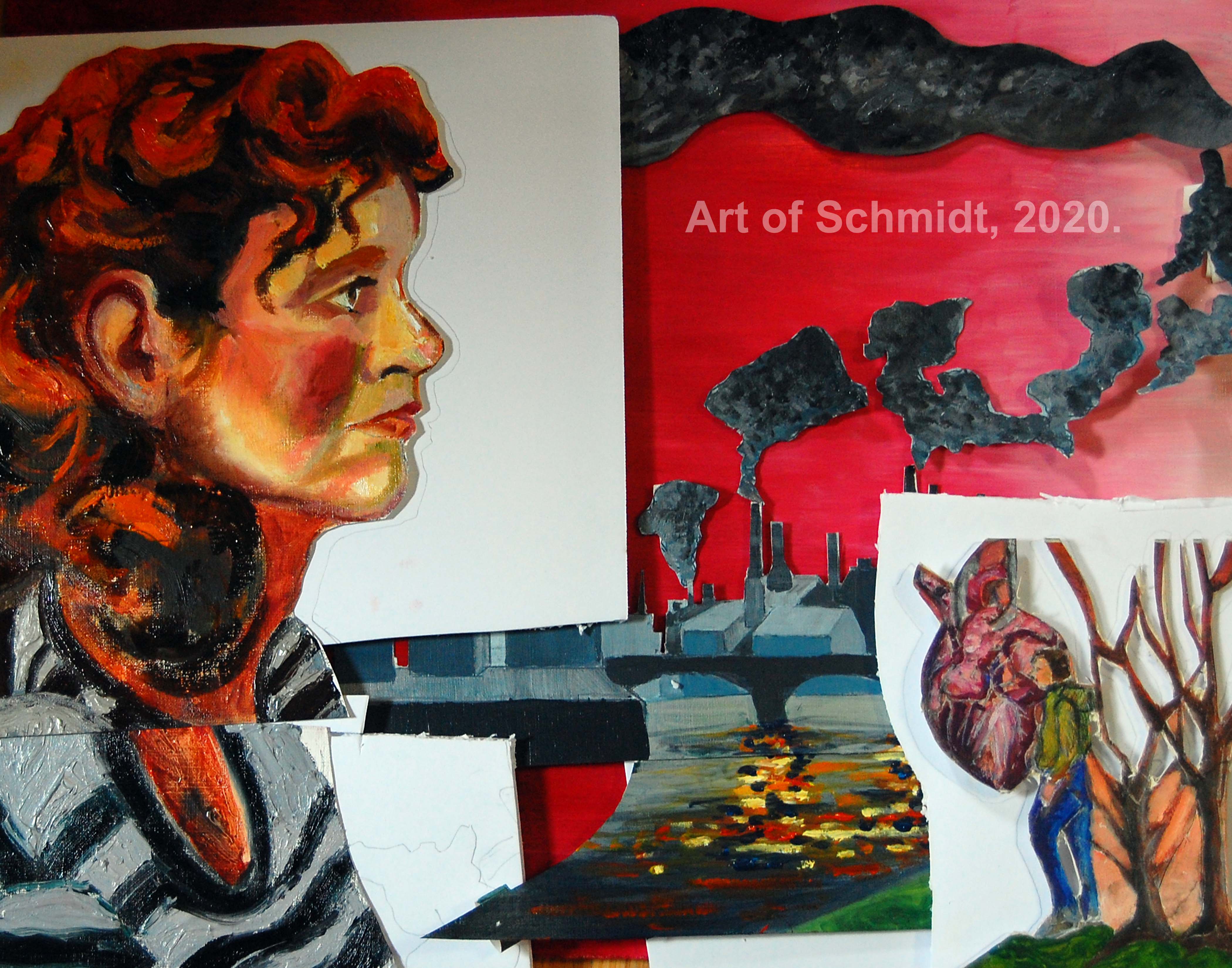
Jodie Schmidt, Time waits for no one, August 2020, mixed media: oil, acrylic, gouache, illustration board on masonite, 12 x 12 inches. Photo of Grim Reaper photo credit: Jbuzbee, 21 September 2008, Statue in the Cathedral of Trier, Germany, originally sourced on https://commons.wikimedia.org/wiki/File:CathedralOfTrier_Skeleton.JPG. The photo has been re-mixed into a fine art image with the addition of pastel, gouache and other pictorial elements have been added to the composition such as the clock and figures. The original photo source is liscensed under wikimedia commoms.
Jodie Schmidt, Dream of Time Travel, July 2020, mixed media: oil, soft pastel and gouache on illustration board, 12 x 12 inches.
Jodie Schmidt, Childhood Memory Loss, June 2020, mixed media: Soft pastel and gouache on illustration board, 16 x 20 inches.
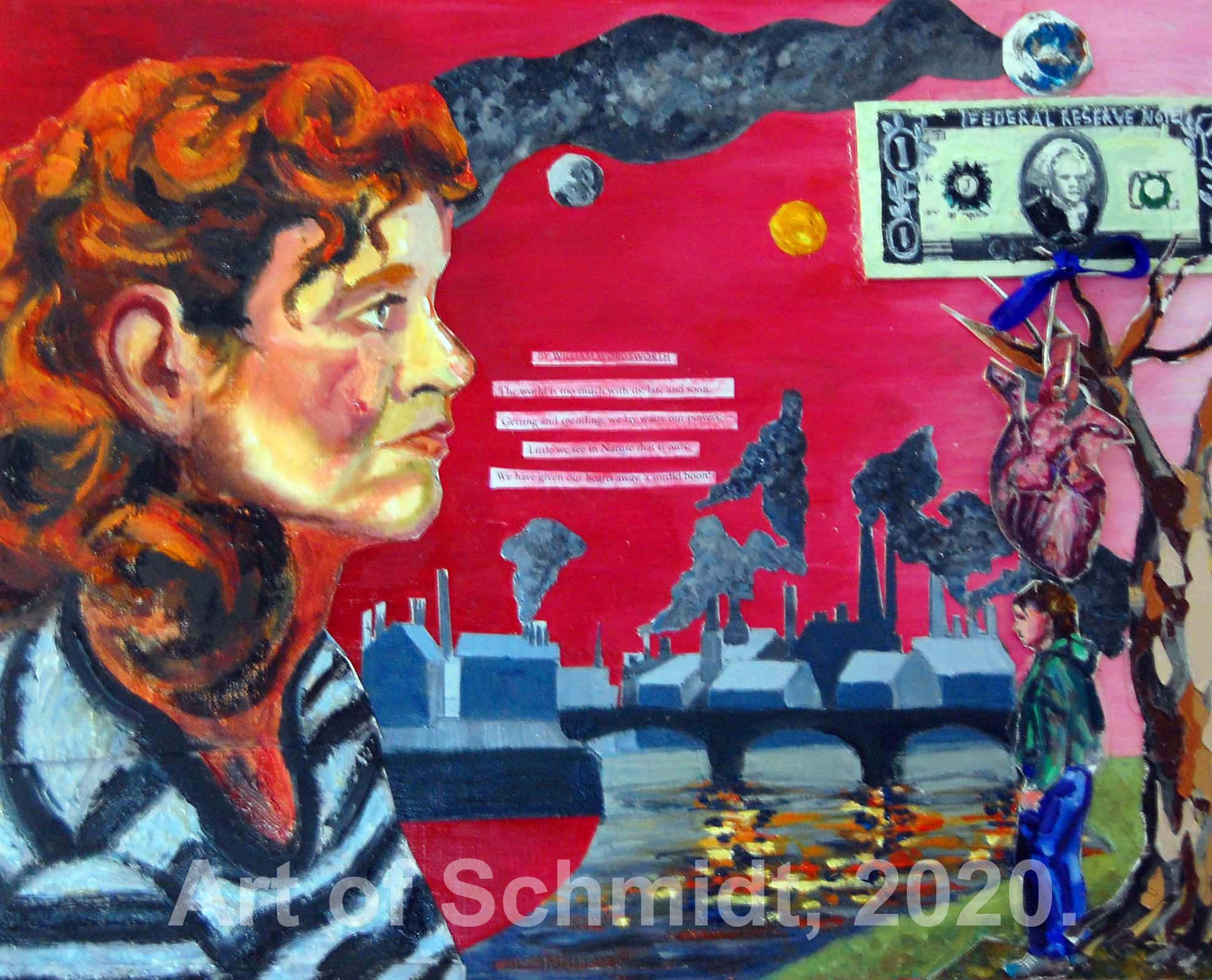
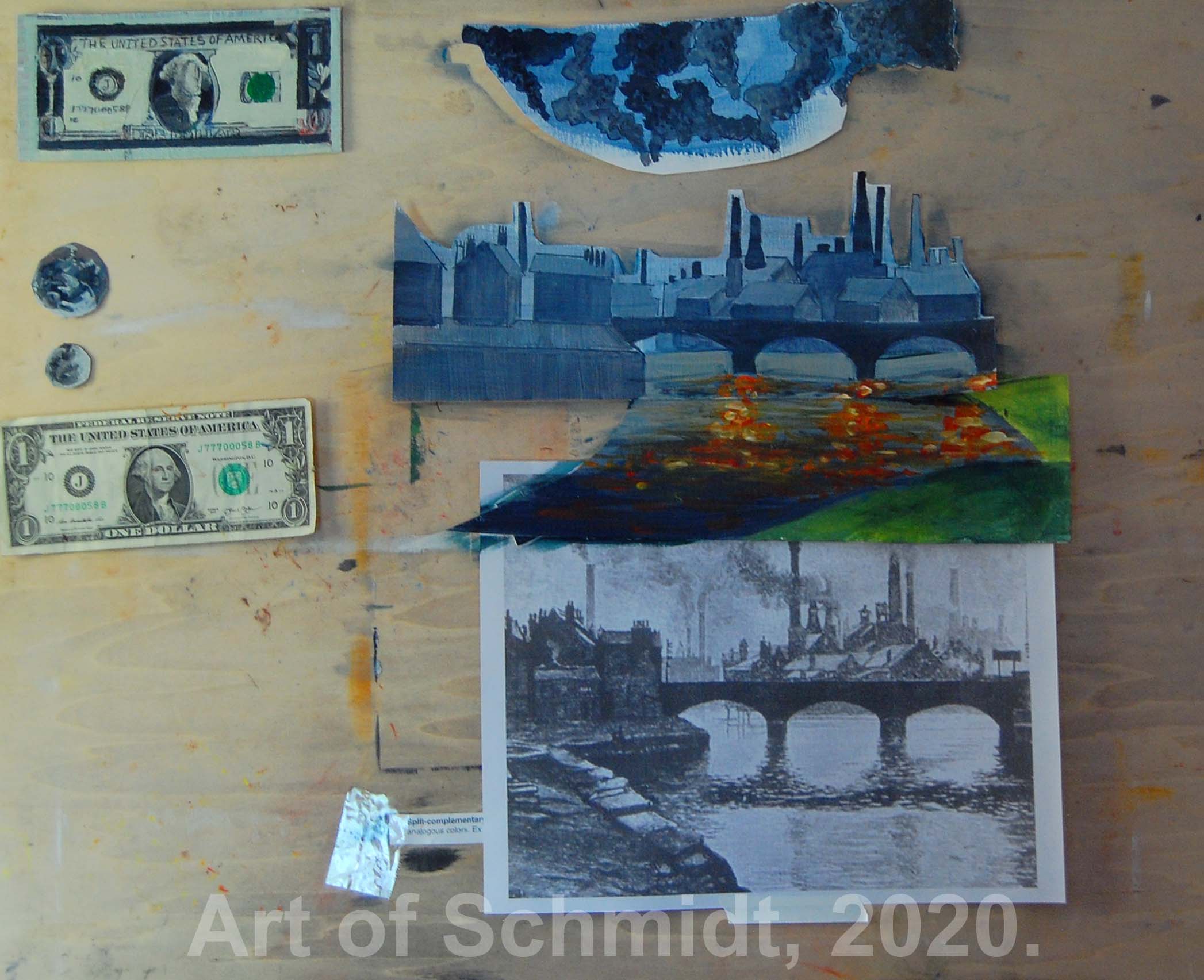
Jodie Schmidt, Money is the Bait, August 2020, Mixed media: oil, acrylic, paint chips, canvas paper, and illustration board on masonite, 16 x 20 inches.
About a century ago (well I exaggerate a little); I was a college student studying art at McDaniel College in Westminster, MD. I had a brilliant and successful art teacher named Steve, who demonstrated how the practice of art-making and the hatching of new ideas could be brought to life, using a sketchbook. He taught me many useful things, such as how to keep an art sketchbook pasted with photos of artwork by artists I admired, and how to write an artist statement that reflected my unique artistic voice. Above all, his most important advice was that I should draw every day. At the time, that task seemed quite difficult to stick with. I was always an impatient artist as a student and I often rushed through the drawing stage to hurry up and get to the painting. I learned later that that was a mistake. Now that many years have passed since my graduation from McDaniel, I can truly see the wisdom of his advice.
In hindsight, I realize that he was so right about drawing every day. Now, I no longer rush artwork and I have learned to love drawing, whether it becomes a painting or not. In fact, I have embraced his advice of a daily drawing habit at various times in my life, and I have worked on several art challenges for both human portraiture and pet portraits on my Instagram account. One of these challenges is called 100 faces in 100 days, in which I drew a pre-selected photo of a celebrity using only pencil and paper. I did not add in a lot of detail or shading and I limited myself to 45 minutes a day. The process of a drawing challenge gave me many opportunities for both successful drawing and ones that I didn’t like, but it helped me to see my progress, and that the practice bore much fruit in terms of learning to take the time to really observe my photo references and record my observations on paper. You could say drawing is akin to yoga or meditation because you need to be completely mindful in order to capture the nuances prevalent in realistic drawing.
At present, I am struggling to carve out time for drawing. Sandwiched in between working, and preparing an art portfolio for graduate school applications, and other responsibilities, I am striving to make time at least 1x a week to draw. This time, I am focusing on making mixed media pastel and torn paper collage drawings. These take several days to complete so I only post about 1x a week on my Instagram account. But this working process works well for me, as the breaks in the
Stage 4: I began composing this piece by moving elements of the collage back and forth until I was happy with them. Then I had to cut them all out and paste them to the masonite. I created an entirely new sketch for the self-portrait and painted it in oils instead of acrylic so I could get more working time to blend and smooth the edges.
Stage 3: Next, I decided to paint my individual details and then add them to the substrate as collage pieces. I had to try several different adhesives to make these collage pieces stick from crazy glue to heavy acrylic gel, with varying degrees of success. The collage pieces were constructed on the illustration board, and are remnants of my first attempt at this painting. I used canvas paper for the parts I completely re-painted, such as the self-portrait profile figure.
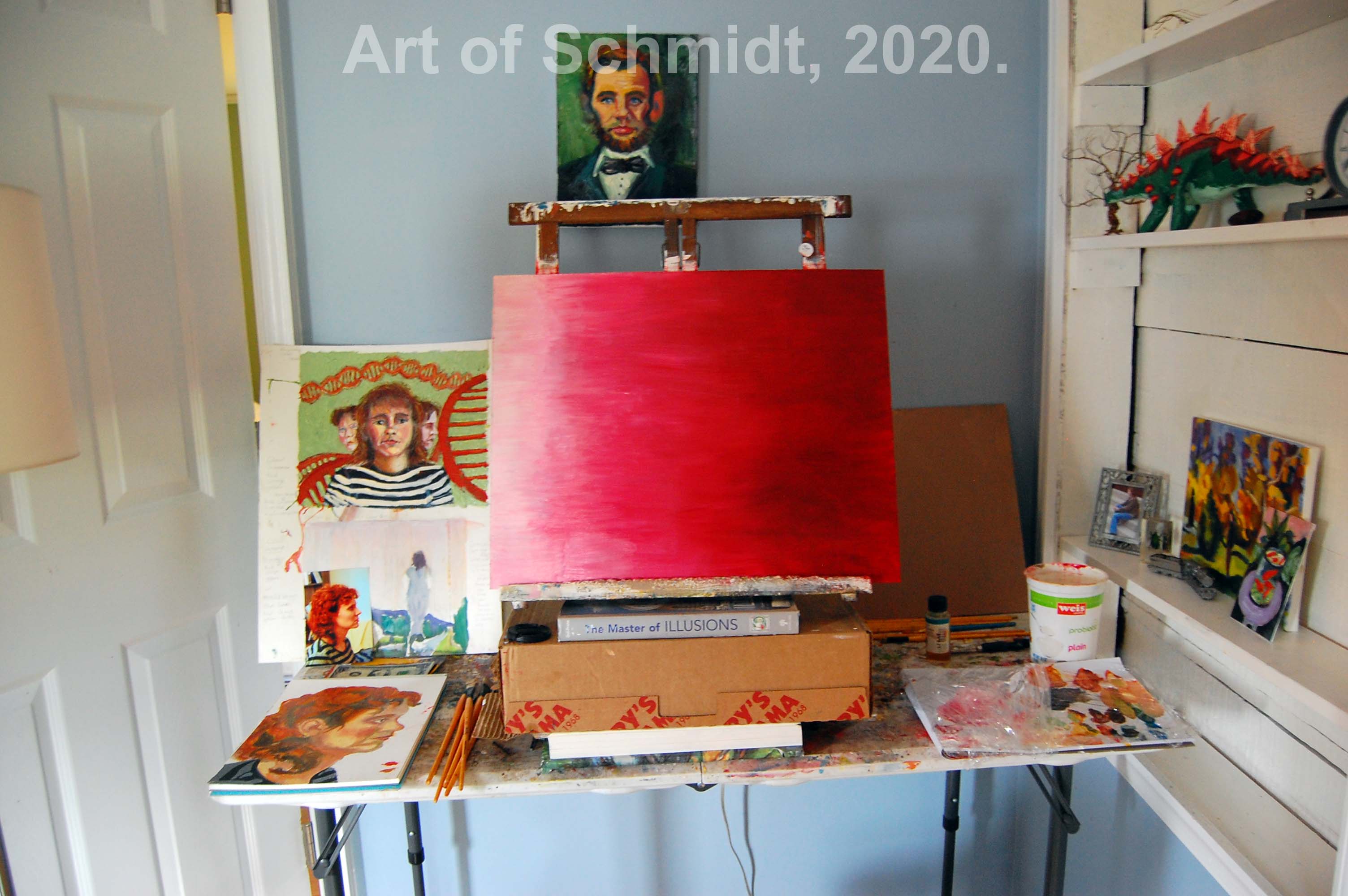
Stage 2: I started an entirely new painting on a new surface, using water-mixable oils on a masonite board as my support.
Stage 1: This was my initial sketch, created with acrylic, colored pencil, and pastel on illustration board. However, I wasn’t happy with it because of the colors, and some drawing errors in the self-portrait. I also decided to go with a more realistic style in the portraits and paint in tone rather than crosshatching in the final piece.
action, give me additional time to evaluate the accuracy of my drawing proportions and the values in my shading. The most important take away I can say about drawing and getting good at it, is that it really helps your art practice to flourish. For instance, once you have the drawing and composition mastered, you can enjoy the next step more fully, whether its collage, painting or some other art form such as graphic design or sculpture. With an accurate drawing, you won’t have to worry about continuing to fix it and can fully embrace your next steps, and I am learning that it’s so much better to take the time and lay a good drawing as your foundation for your art.
A good case in point was my latest painting in progress, Money is the Bait, which started out unsatisfactorily because of several drawing errors in the initial portrait. I ended up starting from scratch in oils on a totally new surface, and it still isn’t finished. I hope to finish it by next week. Thanks for stopping by! If you want to follow my progress with the mixed media portraits, you can follow me on Instagram under my profile name, jsjschmidt.
Have you ever wondered why some artists, such as Andrew Wyeth, and others create their artwork in a series format? My first experience with creating artwork as a series was as an undergraduate at McDaniel College, taking art classes at the senior level. In this Senior Studio Capstone class, my fellow students and I were given the assignment to create a series of artworks that expressed a theme of interest or importance to us and to write an artist’s statement that described our artwork’s theme. For example, according to the website The Abundant Artist, some themes that artists might explore in a series include, 1.) “color and texture,” 2.) politics (Kathe Kollwitz), 3.) death, (Hirst) or 4.) messages that uplift, like Kelley Rae Roberts, Source: https://theabundantartist.com.
Prior to that, my assignments in drawing and painting consisted of drawing or painting to try and copy the still life or model in front of me, to teach the skills of observation. At that time, I had no idea how to even get started and had artist’s block for two weeks while I searched for artworks that inspired, all in vain. My Teacher did give us some guidance to the process though. He suggested that we create sketchbooks in which we pasted artworks of inspiration, no matter the medium, and he suggested that we look up art magazines, such as Art in America. Pouring over art magazines and artist websites, such as Forum Gallery, I could think of nothing new to say with my artwork that hadn’t already been said. I felt I had a lot of competition since there have already been many artists who have gone before me, who have created several unforgettable artworks to boot, such as Vermeer’s, Girl with a Pearl Earring, painted in 1665.
After weeks of struggle and seeking out artwork that inspired me, I had a solution. My answer came from an unlikely source, music. I decided to illustrate some of the songs of my favorite musician, Sting, using my self-portrait as a muse, along with color, and composition to portray various feelings of uncertainty, sadness, etc. Some of the songs I illustrated in my self-portrait series were Lithium Sunset and Secret Journey. The first song talks about how medication can help bring a person out of depression and make them strong enough to get back up again. While the second song, Secret Journey, talks about a mystical journey of enlightenment. I printed out the songs from Sting’s website, www.sting.com, pasted them in my sketchbooks, and underlined words and phrases that I thought were good candidates for illustration. And I referenced these songs and artworks of inspiration as I crafted my Artist’s Statement. As I searched through artwork that inspired, it became evident that I was drawn to the subject of the portrait, but I didn’t know how to make my work unique, because the portrait has been done numerous times before.
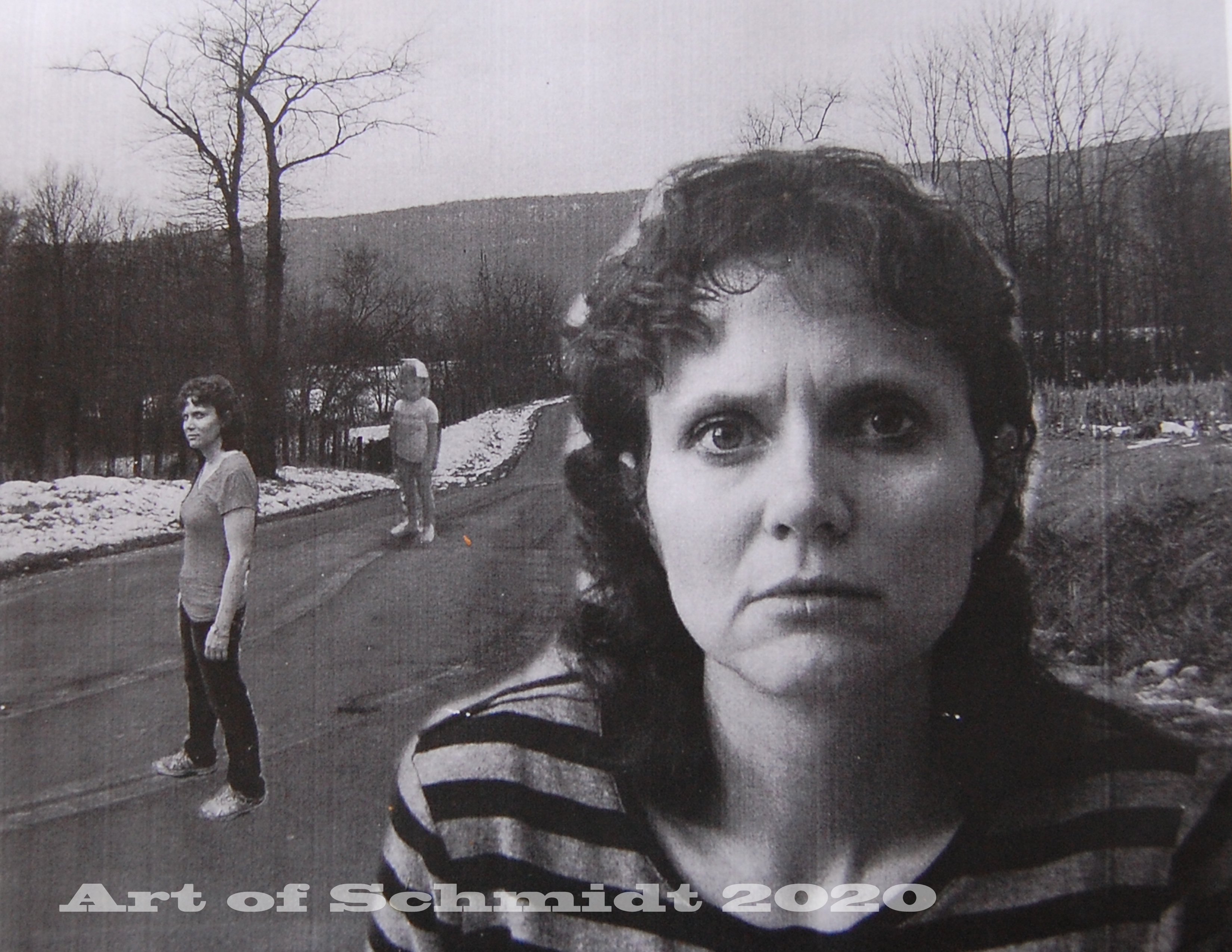
The imagery of Sting’s songs provided the perfect solution to my dilemma and I was off and running. My then-boyfriend, Dan, took photos of me to provide the source photos for my oil paintings. To make a long story short, I finished the series in time and even made a PowerPoint presentation as part of the project requirements of my finished works. In addition, I crafted an artist’s statement, which helped me to define the artwork by describing what the artwork would be about and what influences had to lead me to the finished work. I learned a lot about myself as an artist, such as how to distill ideas through writing artist statements and creating sketchbooks to illustrate my ideas by pasting artwork that inspired onto its pages. In particular, I discovered that I liked to make artworks that had a message, even if the search for the solution was far from easy. But back to my main question, “Why should artists work in a series?”
To investigate that question more fully, I did what many people would do, I googled it. The websites, Abundant Artist and Art Business.com, shed some light on the subject of content-based art. According to the authors, some of these benefits include: 1.) Making artwork in a series gives the artist a platform to connect with their audience on an emotional level because the artwork is focused and personal, 2.) Creating artwork in a series format helps others to understand what an artist’s work is about and who they are as a person, 3.) Artists who make artwork in a series are more likely to find art galleries to exhibit their work because they know how to market the artist and this format follow their business model, and 4.) Working in a series format helps artists to understand what topics/subjects are important to them, and which they like to draw or paint.
This week I am posting some photos of my latest painting, The Dream of Time Travel, which I started many months ago, and I am happy to say is finally complete! It is part of a series of paintings about the human condition, which is part of my portfolio for graduate school. These new works are a continuum of the series of paintings I completed as an undergraduate at McDaniel College, using the theme of the self-portrait, but expanding its representation to other themes such as poetry illustration. Thanks for stopping by!











 Art of Schmidt
